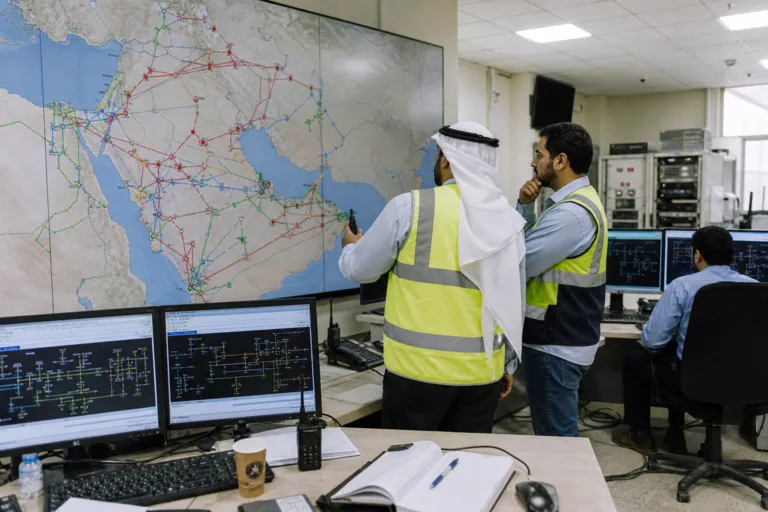
Energy security in the Gulf is no longer only about pipelines and ports. It is also about electricity moving across borders when shocks hit. The Strait of Hormuz remains central, with official energy data cited in regional reporting saying it handles roughly one-fifth of global oil trade. The IEA also warns that disruption to flows through the Strait has major implications for affordability and the world economy, noting that about 20% of the world’s LNG supply moved through the Strait in 2025. As tensions and attacks raise the cost of volatility, Gulf states are building redundancy. That context is pushing power-sharing and cross-border infrastructure higher on the agenda, including the GCC power grid interconnection as a platform for resilience.
The recent shock has been severe. The IEA describes the conflict that began on 28 February as impeding energy trade flows through the Strait and driving significant market volatility. It reports Brent futures peaked at more than 60% above pre-conflict levels in late April, before easing in late May and early June as strategic stock releases and demand weakness helped. It also reports global observed oil stocks have declined by 3.8 million barrels per day on average since the start of the war, including a draw of 143 million barrels in May alone. Columbia’s Center on Global Energy Policy adds that about 12 million barrels per day of “missing” crude exports and refined fuels from the Gulf are currently unable to reach the market, with roughly 1,500 vessels described as trapped in the Persian Gulf. In this environment, having multiple ways to keep economies running matters, and power links complement oil-route diversification.
Why Oman and Iraq Links Matter for Grid-Level Security
Oman’s internal power build-out is accelerating, which changes what regional interconnection can do. A market analysis from Mordor Intelligence expects Oman’s installed base to rise from 12.87 GW in 2025 to 14.33 GW in 2026, and to reach 21.61 GW by 2031, with a CAGR of 8.57% over 2026-2031. The same source says thermal generation led with 87.55% share in 2025, while renewables are expected to advance at a 24.69% CAGR through 2031. It also notes OPWP has 1.6 GW of solar and wind capacity under active tender in 2026, and highlights a 500 MW Ibri III solar-plus-100 MWh battery project awarded in September 2025 as Oman’s first utility-scale energy-storage system, with an LCOE below 2.5 US cents per kWh. As supply becomes more diverse and flexible, cross-border connections become more valuable as a balancing tool—especially during regional stress events.
Iraq sits at the center of the electricity-trade opportunity and the political imperative. An AGSI analysis argues that the current outlook for electricity trade within the GCC Interconnection Authority and with Iraq, Egypt, and Jordan falls far short of potential, even as renewables plus batteries rise and domestic demand surges across the Gulf. A Columbia Global Energy Policy tracker says a similar interconnector to the Saudi-Egypt project will begin supplying Iraq with GCC states’ electricity next year. The same tracker notes Saudi Arabia is building a high-voltage direct current interconnector that will eventually send 3,000 MW of electricity to Egypt, at a cost of $1.8 billion. These projects underscore a shift: Gulf states are not only exporting hydrocarbons, but also building the ability to export reliability—using interconnectors to share capacity and reduce the consequences of localized shortfalls.
This wiring push also sits beside a broader, coordinated strategy to bypass chokepoints. Travel and Tour World reports that Oman, Saudi Arabia, the UAE, Iraq, and other Gulf countries are expanding alternative pipelines, ports, and export corridors to reduce dependence on the Strait of Hormuz amid rising US–Iran tensions, framing it as a long-term resilience effort. The IEA notes Saudi Arabia and the UAE have successfully redirected some exports to terminals loading outside of the Strait. Columbia’s Gulf disruption analysis adds that approximately nine million barrels per day of crude is being diverted through the Saudi East–West pipeline and the Emirati Fujairah pipeline, alongside continued exports from Iran and Omani exports that avoid the Strait. Electricity interconnection does not replace these logistics. But by strengthening the region’s ability to keep grids stable and economies operating during disruption, it reinforces the security case for deeper regional coordination.
How is the GCC power grid interconnection changing regional energy security?
What scale of Oman power growth is forecast in the sources?
What do the sources say about the Strait of Hormuz share of global energy trade?
What are the key figures on the Saudi-to-Egypt electricity link mentioned in the sources?
What do the sources report about the current disruption to Gulf energy flows?