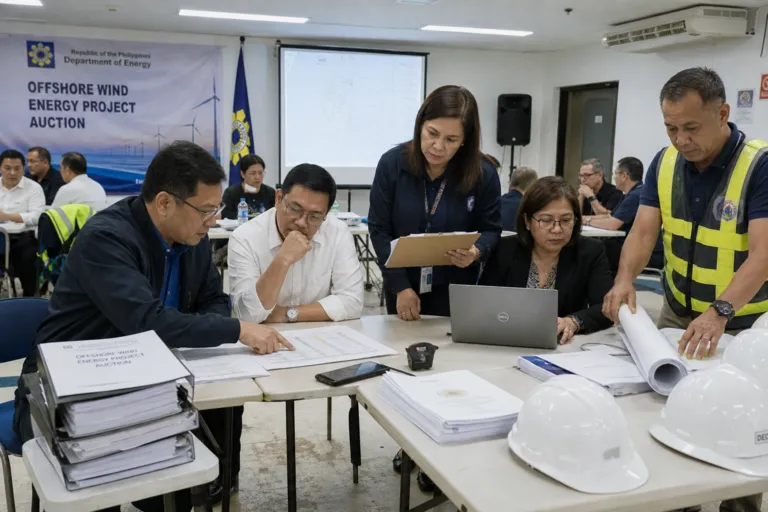
The Philippines’ offshore wind market has shifted from years of analysis into a commercial procurement phase. Before 2025, work focused on foundational studies, including the World Bank’s identification of 178 GW of technical potential and the development of policy roadmaps. A major constraint was the restriction on foreign ownership, which limited the participation of experienced international developers and capital. From 2025 onward, the direction changed. The Department of Energy (DOE) launched Green Energy Auction 5 (GEA-5) on November 25, 2025, positioning offshore wind as a bankable procurement opportunity rather than a long-range concept.
GEA-5 targets 3,300 MW (3.3 GW) of fixed-bottom offshore wind capacity for delivery between 2028 and 2030. Sources describe it as the country’s inaugural competitive auction for fixed-bottom offshore wind projects, and it sits inside the DOE’s broader 10-year Green Energy Auction Program (GEAP) designed to procure at least 25 GW of additional renewable energy capacity in the Philippines, with deliveries scheduled from 2027 to 2035. In parallel to the auction route, market access has widened. After foreign ownership caps were removed, nine fully foreign-owned offshore wind service contracts totaling 5,510 MW were reportedly attracted before the auction even began.
How the Rules and Price Cap Aim to De-Risk the First Round
The auction’s mechanics and pricing framework show how government is trying to reduce early-stage risk. GEA-5 is described as a price-based auction, with bids evaluated from lowest to highest until the 3.3 GW cap is reached; if there is a tie, bids are ranked by Delivery Commencement Dates, with earlier dates prioritized. The Energy Regulatory Commission (ERC) revised the Green Energy Auction Reserve (GEAR) price upward, moving from a proposed ₱10.3859 per kWh to a finalized cap of ₱11 per kWh in February 2026. One source notes this cap was roughly double the average wholesale power prices of the previous year, framing the decision as a way to reflect high upfront capital requirements.
Developer qualification requirements are designed to filter for readiness, not just low pricing. Within 30 calendar days of award, successful bidders must submit a System Impact Study (SIS) from the National Grid Corporation confirming nameplate capacity, a Wind Resource Assessment with at least 12 months of site-specific data, and a Port Infrastructure Plan detailing local port use and potential partnerships. Separately, sources describe the DOE’s inclusion of non-price criteria such as technical readiness and grid connection status as a signal of maturity, prioritizing project viability and execution certainty. The Terms of Reference also introduce a more explicit offshore wind infrastructure plan covering grid connection, port usage, logistics, and milestones.
What comes next is the hard work of delivery across grid, ports, permitting, and finance. GEA-5 winners are set to receive 20-year contracts, supporting long-term revenue certainty for financing and aligning with projects scheduled to begin commercial operation between 2028 and 2030. Infrastructure remains a constraint. The DOE has identified at least ten ports for potential redevelopment, with public-private partnerships discussed as a likely route for financing upgrades. Two ports have been designated as installation ports: Pambujan Port in Camarines Norte and Sta. Clara Port in Batangas. On transmission planning, the Transmission Development Plan (TDP) 2024–2050 outlines regional upgrade pathways, and sources warn that misalignment between SIS submissions and TDP timelines could delay projects and erode confidence.
What capacity is the Philippines targeting in its first offshore wind auction round?
What is the GEAR price cap set for GEA-5?
How does the Philippines offshore wind auction 2026 rank bids and handle ties?
What documents must winning bidders submit after award?
Which ports are designated as installation ports for offshore wind projects?