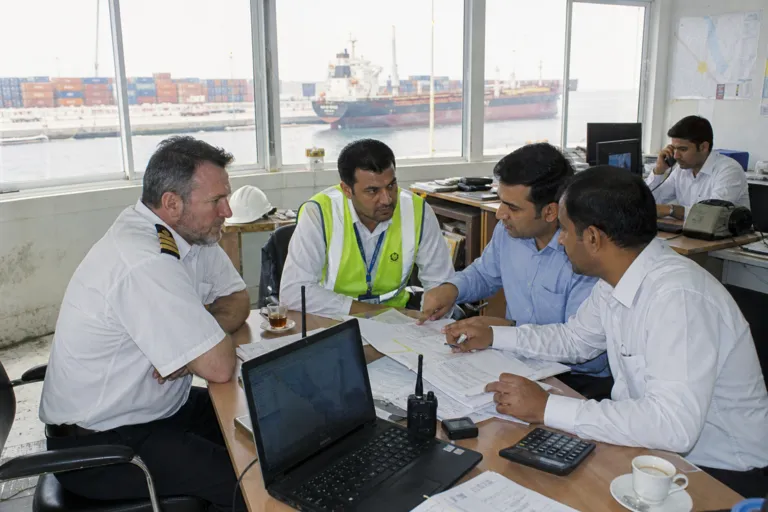
The Gulf’s shipping calculus changed when military escalation beginning February 28, 2026 triggered the closure of the Strait of Hormuz and the suspension of Suez Canal transits. SeaVantage estimates the disruption directly impacts 10.7% of the global container fleet by TEU capacity, with up to 470,000 TEUs initially trapped in the Persian Gulf. The same source describes the strait as a 21-mile-wide passage that, in normal times, carries about 20% of global petroleum liquids daily, or approximately 20 million barrels per day, plus around 80 million tonnes of LNG annually pre-crisis. Those baseline flows help explain why today’s extra insurance and routing costs are reshaping trade decisions far beyond the immediate war zone.
Insurance moved from “manageable surcharge” to “gating factor” in a matter of days. SeaVantage reports that, ahead of February 28, war-risk premiums climbed from 0.125% to between 0.2% and 0.4% of ship insurance value per transit. As the crisis deepened, Reuters reported war coverage premiums surging in some cases by more than 1000%, while at least 200 ships remained at anchor off major Gulf producers and at least nine vessels suffered damage in the area since the conflict began. On the underwriting side, S&P Global said additional war-risk premium (AWRP) reached around 2.5% of hull and machinery value per seven-day period earlier in March, before easing to close to 1%.
Surcharges, Delays, and a New Cost Curve for Gulf-Linked Freight
With transit risk repriced, carriers and cargo owners face a new cost curve that blends insurance, delay, and rerouting. SeaVantage notes that Cape of Good Hope diversions add 10–14 days per voyage on Asia–Europe and Asia–U.S. East Coast lanes. It also reports transpacific container rates to the U.S. West Coast up about 40% since pre-war and Asia–North Europe rates up about 20%, alongside emergency surcharges of up to $3,000 per FEU across Gulf-linked corridors. These freight impacts sit on top of war-risk charges that can be quoted per seven-day period in the Persian Gulf, turning time spent near the region into a direct cost driver.
Different vessel classes feel the spike in different ways, but the trend is consistent: exposure time now has a price tag. S&P Global said that for Medium Range tankers, the current AWRP is around $40,000 per seven days in the Persian Gulf, four times the pre-war level, with some owners paying about $80,000 to $120,000 for the same period depending on age and value. Another chartering source pegged it at around $250,000 for Long Range tankers. S&P Global also reported that close to 40 Long Range tankers were stuck in the Persian Gulf, pushing importers to look for alternative sources such as the US Gulf and West Coast India, and noted that ships with American or Israeli flags, or links to those countries, have to pay a higher AWRP.
As private pricing rises and coverage tightens, the market is revealing its limits. The World Economic Forum wrote that JPMorgan energy analysts estimate roughly 329 vessels are operating in the Persian Gulf, each requiring hull, liability, and pollution coverage, implying about $352 billion in insurance coverage that private markets are no longer providing. The same article says the Joint War Committee expanded its “high-risk” designation to cover the entire Persian Gulf, and that traffic has reportedly reduced by about 95% since the onset of the war, versus an average of 178 ships transiting the Strait of Hormuz each day in the weeks prior. The National reported war-risk premiums at about 4% of a ship’s value for seven days, versus around 0.001% pre-crisis, underscoring why Hormuz war risk shipping insurance has become a defining input into Gulf shipping economics in 2026.
How high did war-risk premiums climb in the Persian Gulf during the 2026 crisis?
What did the Strait of Hormuz disruption do to container capacity and freight pricing?
How much extra time can rerouting around the Cape of Good Hope add?
Why is Hormuz war risk shipping insurance now a strategic issue, not just a cost line?