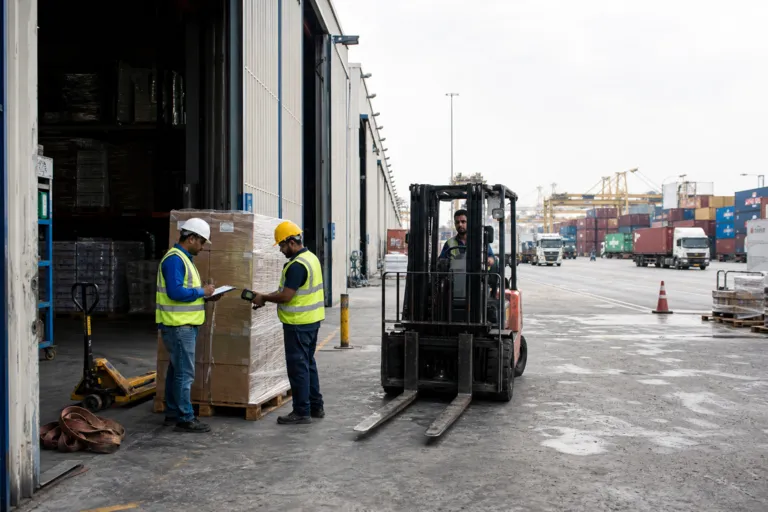
Jebel Ali Free Zone (Jafza) has long been framed as a trade enabler built around proximity and integration. It is DP World’s flagship free zone and sits near Jebel Ali Port, Al Maktoum International Airport, and the Expo 2020 Dubai site, a combination that supports global trade operations. The zone’s growth arc is clear in the numbers Jafza publishes. From 19 companies when it commenced operations in 1985, it expanded to 500+ businesses by 1995 and now hosts over 11,000 businesses. These companies come from 150+ countries, and the base includes 100+ Fortune Global 500 companies.
That density matters because the zone’s influence is not only measured by tenant count. Jafza states it provides 130,000+ jobs and attracts 23.9% of Dubai’s foreign direct investments. In market commentary about the commercial district, Jafza is also tied to large trade flows. Chestertons MENA says the district’s Jafza companies contributed more than USD 169 billion in trade value last year, and repeats the same 23.9% figure for Dubai’s foreign direct investment. These headline metrics are often used to explain why Dubai’s western corridor remains central to trade and industrial planning.
What Expansion Signals in an Ecosystem Built for Speed
When decision-makers discuss a Jebel Ali logistics park expansion, the operational logic is usually about speed, adjacency, and the ability to scale without leaving the corridor. One industry comparison article emphasizes how Jafza’s port integration reduces friction versus zones that require transfers across Dubai. It also claims that, during optimal conditions, Jafza companies can move containers from warehouse to vessel in under 2 hours. The same source frames Jafza as handling roughly USD 108 billion in annual trade value, and links that activity to about 23% of Dubai’s total GDP, underscoring how logistics capability is presented as a macro driver, not just a tenant benefit.
Scale and clustering also show up in specific community facts. Wikipedia states that, as of 2025, Jafza hosts over 11,000 businesses from more than 150 countries, including over 100 Fortune Global 500 companies. It also notes that, in 2023, 1,500 Indian companies established a presence in Jafza. The same entry references Bharat Mart as a development spread over 2.7 million square feet distribution hub, described as being set to become the market reach for Indian products. These details illustrate how the zone’s growth story is paired with targeted trade corridors and sector communities.
Jafza’s next chapter also lands in a wider Dubai commercial backdrop where industrial and logistics performance is highlighted. A Dubai market analysis notes that industrial and logistics is the strongest performing commercial class, with yields often in the high-7% range and high tenant demand in areas including Jafza. For operators, this context helps explain why capacity additions and new logistics facilities are treated as strategic infrastructure. Jafza’s stated mission is to establish a trade corridor by attracting, retaining, and developing trade customers through high-quality logistics and industrial solutions enhanced by innovative and differentiated services.
How does a Jebel Ali logistics park expansion fit Jafza’s broader growth story?
How many businesses operate in Jafza today?
What share of Dubai’s foreign direct investment is linked to Jafza?
What trade value is associated with companies in Jafza, according to the sources?
What does the industrial and logistics market context say about demand around Jafza?