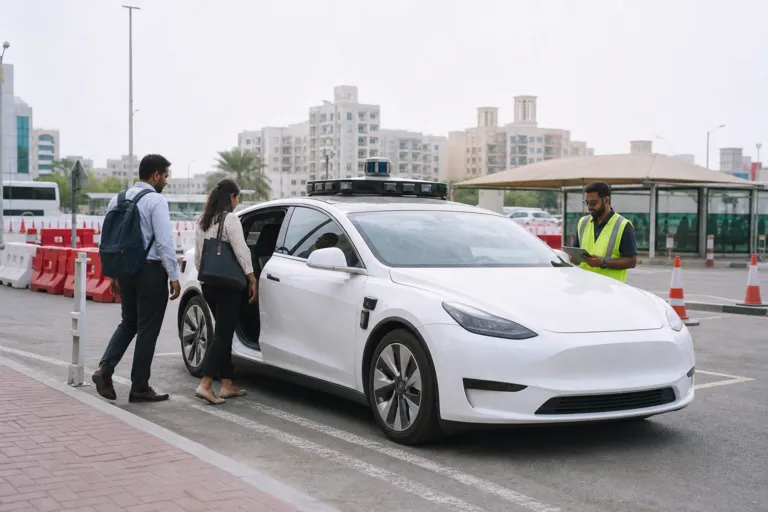
Robotaxis are no longer just a concept. They are becoming a test of operations, safety, and trust. In the Gulf, Dubai is pushing the idea into real streets through a structured rollout that blends pilots and defined service areas. This matters for the wider conversation about autonomous vehicles Middle East, because the region is not only watching global leaders. It is also building its own pathways for everyday use, starting with controlled environments and partnerships that can support fleet control, maintenance, and expansion.
Dubai’s Roads and Transport Authority has already issued permits to Baidu’s Apollo Go, WeRide, and Pony.ai to test self-driving cars. Trials have taken place in Jumeirah, Umm Suqeim, and Dubai Silicon Oasis, with Baidu’s Apollo RT6 vehicles running pilot routes in Jumeirah. Dubai’s first autonomous zone is planned to cover 12 square kilometres. Inside it, robotaxi trials are set to begin at the end of 2025, with a public roll-out in early 2026. The zone is designed to make autonomy visible and measurable before wider expansion.
From Pilot Routes to Scalable City Systems
The self-driving zone is not only about cars. Plans include robobuses and roboshuttles across 20 km of dedicated roads. They also include autonomous abras and roboboats across 10 km of waterways, plus delivery robots serving a 3.8 km last-mile area. Dubai has also set a target for one in four journeys to be driverless by 2030. This multi-mode design is part of how the city aims to reduce risk while proving the systems can operate safely and reliably in a defined setting.
Operational readiness is becoming as important as the driving software. Dubai inaugurated a dedicated autonomous vehicle operations centre, described as Apollo Go’s first outside China, to support testing, maintenance, safety systems, and fleet control. The same plan includes aspirations to expand the autonomous fleet to more than 1,000 vehicles in the coming years. This focus aligns with a broader industry shift toward the “unsexy” work of deploying services, such as business operations and infrastructure, rather than only talking about the technology.
Globally, scaling is hard, and progress can be uneven. Waymo operates in more than 10 cities across the US and has about 3,000 vehicles on the road, and it has only started to significantly scale services in the past year. Other efforts have faced setbacks, including GM’s Cruise closing its project after a mishandled pedestrian dragging incident in 2023. Research coverage also notes that as of early 2025, robotaxis were available in more than ten cities worldwide, primarily in China and the US, but most services operated on a relatively small scale and covered a limited area.
Against that backdrop, the Gulf’s bet is that tightly designed zones, permits for multiple developers, and dedicated operations centers can shorten the path from pilot to public use. The promise of new approaches is also expanding. For example, Wayve describes its system as a “general purpose foundational model for driving,” aiming to generalise and scale beyond geofenced limits, although it has not yet been tested at scale with the general public. For autonomous vehicles Middle East, Dubai’s structured rollout is a live case study in how to move from trials to daily rides while keeping control, oversight, and scaling plans at the center.
What is Dubai’s timeline for robotaxis in its self-driving zone?
Which companies have permits to test self-driving cars in Dubai?
How does Dubai support operations beyond the vehicles themselves?
What does Dubai say about scaling its autonomous fleet?
Why do autonomous vehicles Middle East efforts focus on controlled zones?