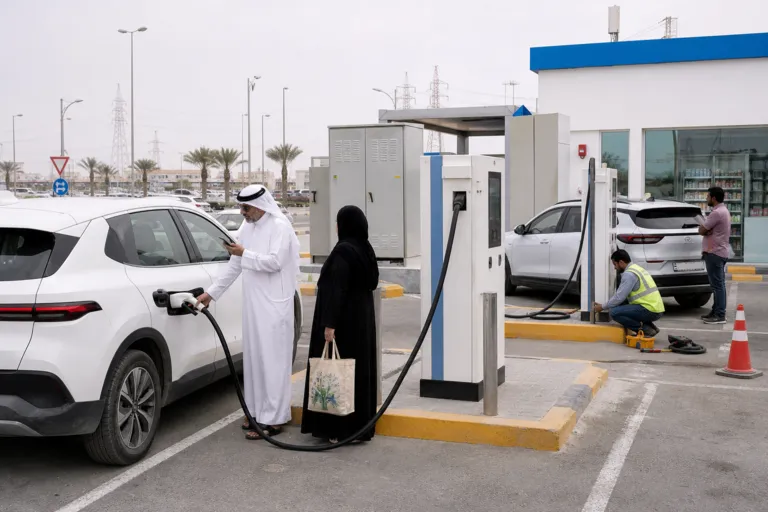
EV adoption GCC is moving from curiosity to strategy. Sources describe electrification in the region as a “rising wave,” but also stress that mass adoption is not only about more models on the road. It is about charging networks that work, power systems that can carry new loads, and incentives that make ownership feel low-risk. A PwC-cited view is blunt about the next step: leaders must align policy, infrastructure, and consumer behaviour toward a future where electric cars can be powered by the sun. That framing matters in the GCC, where solar potential is repeatedly highlighted as a core advantage.
The global signal is already strong. A PwC-sourced figure says global electric car sales surpassed seventeen million units in 2024 and are projected to exceed twenty million in 2025. For GCC decision-makers, this matters because scale changes everything. More sales can bring more competition, more supplier focus, and faster learning curves for fleets and operators. At the same time, the same source warns that if the power used to charge EVs still comes from fossil fuels, the environmental benefit is “drastically diminished.” That pushes the conversation beyond cars and into generation, grids, and planning.
Infrastructure and Incentives: What the Acceleration Phase Looks Like
CleanTechnica’s adoption framing helps explain why infrastructure and incentives become decisive. It describes an early window around 5% to 15% adoption where investments and incentives quietly set up later change, and a critical mass phase from 15% to 40% where infrastructure expands rapidly and policy shifts become more decisive. It then calls 40% a tipping point, arguing that once EVs cross it, the convenience and economics that support gasoline and diesel can “unravel” quickly. The article also cautions the S-curve is “lumpy,” and that regulatory pressures, economic incentives, infrastructure readiness, and consumer perceptions of risk shape how fast markets move.
Even outside the GCC, infrastructure examples show the pattern. CleanTechnica notes that between 2023 and 2025, Germany saw the growth rate of public charging points rise by approximately 35% each year. It also reports that the Netherlands exceeded 100,000 public charging stations by early 2024. These are not GCC numbers, but they illustrate what acceleration looks like when incentives and demand reinforce each other. In Singapore reporting, analysts also underline that “infrastructure planning is critical to adoption,” and that clear policies help operators and consumers plan around stable incentives and infrastructure.
For the GCC, the constraint is not only charging posts; it is systems integration. A PwC-cited view says the power grid and existing charging solutions were not designed for the dynamic needs of combined solar-EV systems, and that high initial costs for hybrid systems remain an obstacle for many. Yet, other regional context shows the scale of what can be built. Strategy& authors cited by Consultancy-me describe a GCC pipeline of $2 trillion in infrastructure and industrial expansion, including an estimate of about $1.5 trillion in mega projects in the planning phase over the next decade. That pipeline can be a platform for coordinated charging rollout, grid upgrades, and procurement approaches that build local supplier capability.
Finance and regulation are the other half of the inflection point. A Strategy& perspective notes that climate concerns and government incentives have created an investment surge reshaping the global economy, citing the US Inflation Reduction Act boosting climate-aligned investments across batteries and electric vehicles, and EU Green Deal changes increasing emissions reporting and product standards. CleanTechnica also points to the EU mandate to cut average emissions of new vehicles by approximately 55% by 2030 compared to 2021 levels, a policy signal that forces automakers to shift toward EVs. For EV adoption GCC, the lesson is practical: incentives, standards, and clear rules can reduce perceived risk and accelerate infrastructure-backed demand.
What does “EV adoption GCC” depend on most at the inflection point?
What global EV sales momentum is shaping planning discussions?
Why is 40% EV adoption described as a tipping point?
What infrastructure buildout examples show how fast charging can expand?
What barriers exist to coupling solar power with EV charging in the GCC?