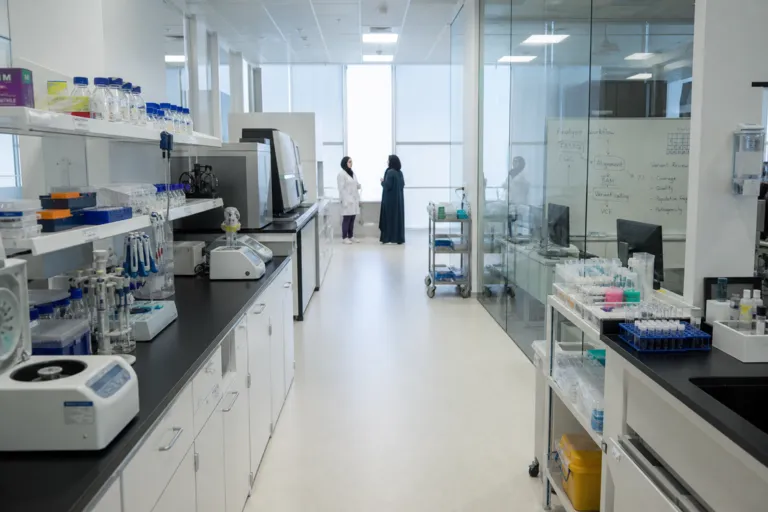
Turning large-scale sequencing into better care depends on what happens after a genome is read. In the UAE, the shift toward clinical use is supported by expanding capabilities across sequencing, analytics, and multiomics. MarketsandMarkets estimates the UAE next-generation sequencing (NGS) market at USD 27.4 million in 2026, with projections to USD 42.5 million by 2031, a 9.2% CAGR. The same source describes growth drivers tied to strategic investments in precision medicine, genomic research infrastructure, and healthcare digitalization, alongside rising demand for applications such as oncology, rare disease diagnosis, and preventive genomics.
Sequencing alone does not deliver clinical action without interpretation, workflows, and scalable computing. That is where bioinformatics becomes central to the delivery model. MarketsandMarkets values the UAE bioinformatics market at USD 95.2 million in 2026 and projects it to reach USD 157.9 million by 2031, implying a 10.7% CAGR. The report links this growth to the country’s focus on healthcare modernization and precision medicine initiatives, and it also highlights integration with broader digital health, including AI and cloud computing. In practice, these capabilities support the clinical pathway from data processing through interpretation and reporting.
Building a Precision Medicine Stack: Sequencing, Multiomics, and Policy
Clinical precision medicine increasingly relies on more than DNA sequence. Multiomics approaches add proteomics and metabolomics signals that can strengthen diagnostic and treatment decisions in specific use cases. MarketsandMarkets estimates the UAE multiomics market at USD 11.9 million in 2026 and forecasts USD 18.3 million by 2031, a 9.0% CAGR. The same source notes steady expansion as providers integrate genomics, proteomics, and metabolomics into clinical practice, with clinical diagnostics, oncology research, and personalized medicine among prominent use cases. Together with NGS growth, this points to an ecosystem that is broadening from sequencing into more clinically oriented, multi-layered insights.
Policy and standardization can determine how fast genomics moves into routine care, especially when multiple institutions need to share and interpret health data. A Towards Healthcare report states that the UAE government’s Precision Medicine Policy aims to establish a roadmap for standardizing health data, develop a robust regulatory framework, and emphasize the implementation of precision medicine. In the same report’s global market breakdown, genomics held the largest share of the precision medicine market by 45% in 2025, and hospitals and clinics accounted for 55% by end user. These global shares do not describe the UAE specifically, but they provide context for why clinical integration and governance matter as adoption expands.
Looking beyond the UAE, regional and global benchmarks show where investment and demand are concentrating. Straits Research estimates the Middle East & Africa represented 3.4% of the global genomics market, totaling USD 1.59 billion in 2025, and identifies the UAE as a key market in the Middle East driven by investments in precision healthcare and national genomic initiatives. In parallel, Towards Healthcare estimates the global genomics data analysis market at USD 7.95 billion in 2025 and USD 9.18 billion in 2026, projecting USD 33.51 billion by 2035 with a 15.45% CAGR from 2026 to 2035. Against that backdrop, the story of UAE genomic medicine is increasingly about building end-to-end clinical readiness: sequencing capacity, scalable analytics, multiomics signals, and the rules that make data usable in everyday care.
What market signals show genomics moving closer to clinical care in the UAE?
Why is bioinformatics essential for translating sequencing into treatment decisions?
How does multiomics support precision medicine in the UAE?
What does the UAE Precision Medicine Policy emphasize?
What does “UAE genomic medicine” require beyond sequencing?