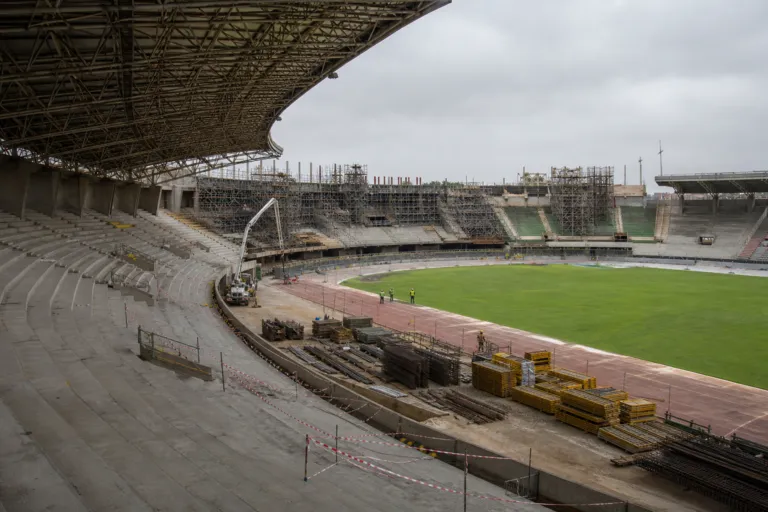
Morocco’s co-hosting role for the 2030 FIFA World Cup, alongside Spain and Portugal, is driving a broad construction agenda that stretches well beyond matchday venues. With just over 1,400 days to go at the time of reporting, Morocco’s planning bodies are framing the tournament as an infrastructure catalyst with long-term utility. The Guardian reports 50-60 billion Moroccan dirhams are budgeted for direct football investments, with further infrastructure upgrades totalling a reported £17bn. An International Monetary Fund assessment cited in the same report says accelerated expenditure between 2024 and 2030 would be equivalent to 11.9% of Morocco’s 2024 GDP.
For delivery teams, the program’s scale and timelines matter as much as its optics. Morocco’s tournament preparation organisation, the Morocco 2030 Foundation, started work in 2024 and has spent time in the United States to learn from its World Cup organisation, according to The Guardian. Coordination is also structured: meetings with Spain and Portugal happen monthly “to align cooperation,” and FIFA is expected to designate host cities at the end of the year referenced in the report. A Moroccan official told The Guardian that the stadiums in Rabat and Tangier are “100% ready,” a signal that some assets are already in an operational state while other packages move through procurement and delivery.
Where the Work Concentrates: Cities, Mobility, and Tourism Capacity
Several sources converge on a six-city footprint, which helps contractors map opportunity by location and asset type. A September 2026 market guide lists six host cities—Casablanca, Rabat, Tangier, Marrakech, Agadir, and Fez—and says Morocco has approved roughly USD 41 billion of infrastructure spending running to 2030, covering rail, airports, urban transport, hotels, and stadiums. A separate property impact analysis also refers to six Moroccan host cities and describes “70+ billion MAD” of Morocco-side 2030 investment across stadiums, transport, public hotels, and urban redevelopment. Taken together, the pipeline suggests multi-discipline coordination: civil works and systems for urban transport, building programs tied to hotels and public assets, and stadium-related packages where readiness varies by city.
Transport and gateway infrastructure appear repeatedly as legacy priorities. A 2025 report on accelerated investment lists a USD 2.8 B airport investment plan aiming to nearly double capacity from 38 million to 80 million passengers annually by 2030. It also cites USD 9.6 B for extending high-speed rail to connect urban centres, and USD 7.5 B for upgrading and expanding 27 ports. Separately, the 2026 market guide argues the entry window that matters is 2026 to 2029, before FIFA controls access and pricing in 2030. For contractors, that implies near-term packages in enabling works, intercity connectivity, and upgrades that must be commissioned and stress-tested ahead of the tournament year.
Demand-side indicators help explain why Morocco is linking football delivery to tourism throughput. Iqal Analysis reports that in 2025 Morocco welcomed nearly 20 million visitors and generated around $15 billion in revenue, roughly 9% of GDP. The September 2026 market guide measures 19.8 million tourist arrivals in 2025 and says more than 1.1 million tickets were used at AFCON 2025 by the quarter-final stage, underscoring event-led utilization. The same guide frames the situation bluntly for market entrants: “someone else is paying for your venue infrastructure.” For firms bidding into Morocco World Cup 2030 infrastructure, the practical question becomes how to align stadium, mobility, and hospitality builds with year-round usage targets after the final whistle.
How big is Morocco’s approved infrastructure spend ahead of the 2030 World Cup?
Which Moroccan cities are listed as host cities for the 2030 program?
What do sources say about airport and transport upgrades tied to the tournament?
What does the IMF-linked assessment imply about Morocco’s World Cup-related spend?
What is the contractor takeaway for Morocco’s World Cup 2030 infrastructure push?