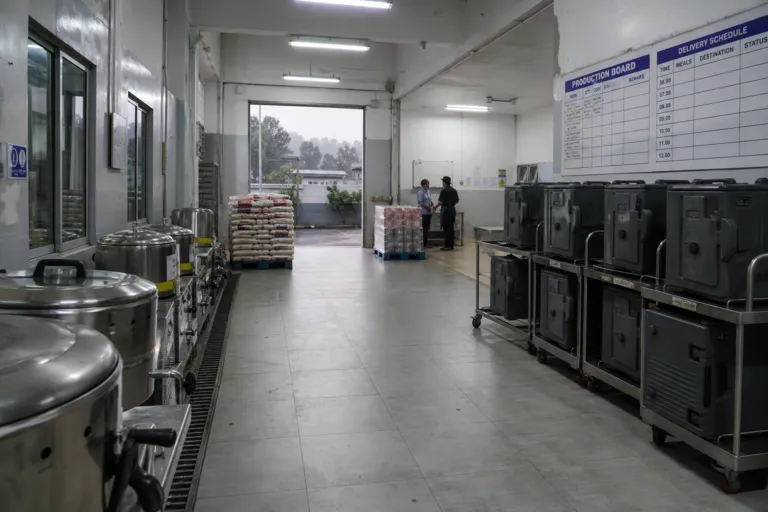
Indonesia’s Free Nutritious Meals (Makan Bergizi Gratis, MBG) program has moved from a campaign promise to a rapidly expanding national procurement engine. It officially launched nationwide on January 6, 2025, and it uses a “central kitchen” model, with meals prepared in dedicated hubs and distributed to schools. Wikipedia’s summary of the rollout notes an initial phase that targeted around 15 to 20 million beneficiaries using a budget of IDR 71 trillion, alongside pilots in late 2024 that estimated meal costs at about IDR 15,000 per portion. For FMCG suppliers, this matters because it reframes school feeding as continuous, institutional demand rather than occasional social assistance, with purchasing decisions flowing through program rules and kitchen networks.
By 2026, the operational scale being reported is significant. A USDA FAS report citing Indonesia’s National Nutrition Agency (NNA) says 61.62 million beneficiaries have received MBG meals distributed from more than 25,000 kitchens throughout Indonesia. ANTARA, also citing NNA statistics, reports 29,225 kitchens nationwide and says the program has involved more than one million workers, aligning with remarks quoted from President Prabowo about “1.2 million new jobs in kitchens.” ANTARA also records 142,387 suppliers participating in the program as of May 22, 2026. For consumer goods and food manufacturers, these figures point to a structured market with many entry points: direct ingredient supply, packaging, distribution support, and standardized products designed for kitchen-based menu execution.
What MBG Demand Means for Suppliers and Price Pressure
Protein and feed-linked commodities are an immediate watch area. The USDA FAS report states that MBG’s rapid expansion has resulted in increasing demand for approximately 1 MMT of chicken meat and 900,000 eggs as affordable protein sources, and that this has been a driving factor for feed demand growth. This is where FMCG suppliers can face both upside and risk: higher volume opportunities for poultry, eggs, and processed foods that fit program requirements, but also tighter upstream markets that can lift input costs. The same report also flags practical frictions that can add costs and hinder consistent supply, including lack of logistical and storage capacity and nontransparent trading mechanisms in the context of feed ingredient sourcing.
In parallel, governance and food safety can influence purchasing standards, supplier qualification, and therefore costs. A policy analysis in Jurnal Bina Praja argues that school feeding effectiveness depends heavily on governance quality, food safety, cross-sector coordination, and fiscal sustainability, warning that without strong design and accountability the policy can become costly and unsustainable. Public debate is also shaped by safety incidents. An ISEAS Perspective article notes reported food poisoning cases linked to MBG and cites a government office estimate that 48% of mass food poisoning incidents in Indonesia were due to the program. For suppliers, stricter controls can raise compliance costs, but they can also reward firms that invest in traceability, cold chain discipline, and consistent specifications.
Finally, the trajectory is not strictly one-way expansion, which matters for long-term contracts and capacity planning. Wikipedia notes that the government aims to scale MBG to reach 82.9 million people by 2029, yet it also reports that in March 2026 the government announced the program would be scaled down due to “fiscal efficiency” concerns linked to the 2026 fuel crisis. A UGM Faculty Insight piece argues MBG can continue on a smaller, more strategic scale by prioritizing high-need districts while refining procurement systems and food-safety protocols. For those evaluating the Indonesia free meals program as a demand anchor, the implication is clear: build flexible supply models that can serve the program’s kitchens when volumes surge, but also remain resilient if targets, budgets, or delivery models shift.
When did Indonesia’s Free Nutritious Meals (MBG) program launch nationwide?
How many people and kitchens have been reported in the MBG rollout so far?
What does the program imply for chicken and egg demand, and why can that affect prices?
How many suppliers are involved in the free meals supply chain?
What are key risks businesses should watch in the Indonesia free meals program?