
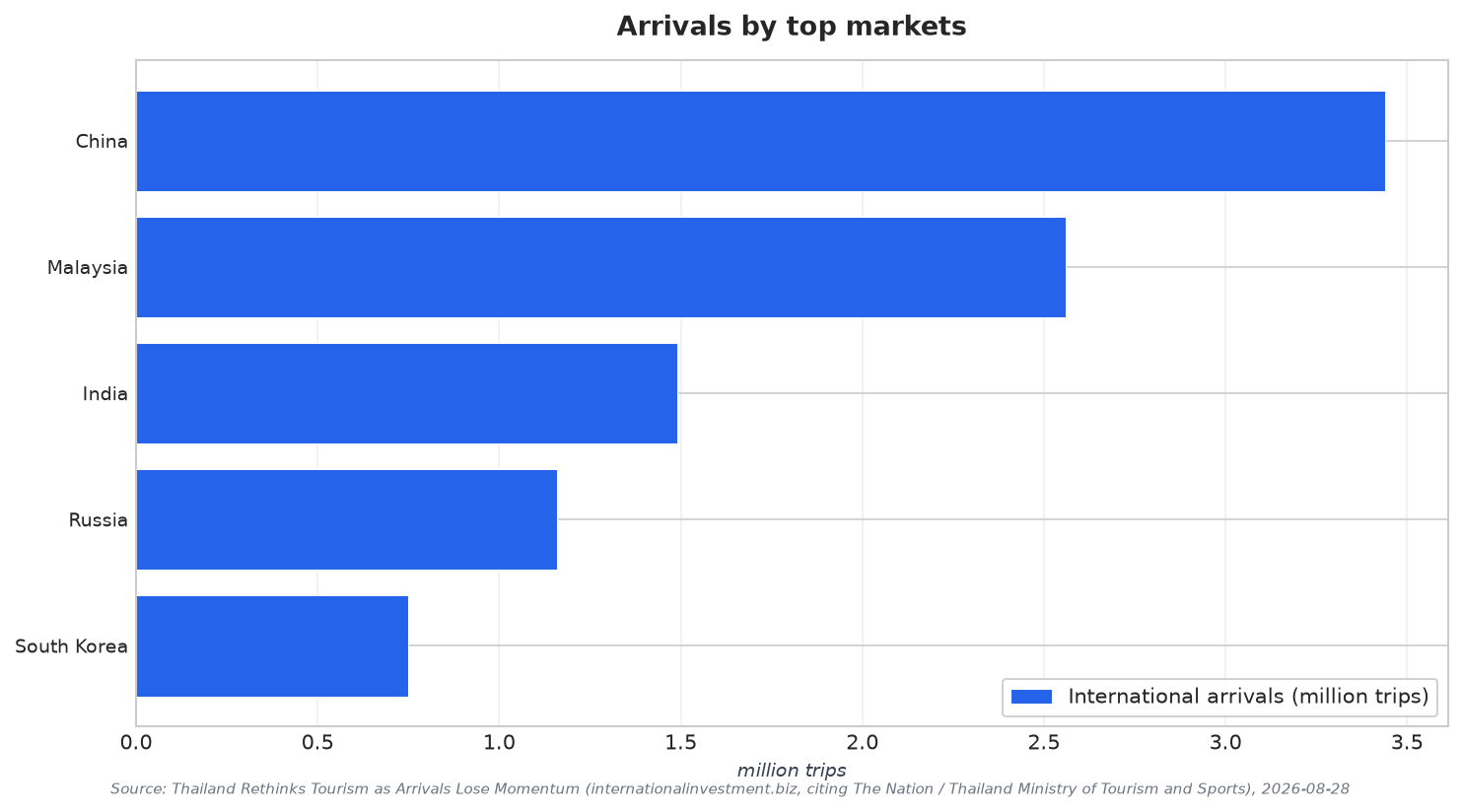
The current Thailand tourism decline is not about inbound travel disappearing. It is about momentum changing, and that shift is forcing hospitality and retail operators to rethink what “success” looks like. From January 1 through August 22, 2026, Thailand welcomed 20,316,055 international arrivals, down 2.96% year on year, with spending of 984.32 billion baht. The same data set shows China still matters in volume, with 3.44 million trips in that period, alongside Malaysia (2.56 million), India (1.49 million), Russia (1.16 million), and South Korea (around 749,000). Weekly volatility adds pressure too: arrivals during August 16–22 fell 9.18% from the previous week to 556,400, a move the Ministry of Tourism and Sports partly linked to the end of summer holidays in major Asian markets.
The strategic reset is rooted in 2025’s setback. Thailand recorded about 32.9 million international tourists in 2025, down 7.23% from 2024, and revenue from foreign visitors fell 4.7% year on year to about THB 1.53 trillion. Domestic tourism moved the other way, rising 2.7% to 202.37 million trips. Chinese arrivals were a key fault line. Official figures cited Chinese arrivals falling to 4.47 million in 2025, down 33.55%. Against that backdrop, the Tourism Authority of Thailand (TAT) cut expectations during 2026: an early target of 36.7 million international visitors was reduced by April to roughly 30–34 million, with about 206 million domestic trips and 2.58 trillion baht in total tourism revenue, before a later working target of about 33 million foreign arrivals and 2.65 trillion baht in total domestic and international tourism revenue.
What “Losing China” Really Means for Hotels and Shops
For operators built around Chinese group demand, “losing” the traveller can mean losing the entire operating model. One industry commentary reported that only about 2.265 million Chinese tourists entered during a period it analyzed, a year-on-year drop of 34.13%, and said Malaysia (2.299 million) overtook China as a source market in that snapshot. It also quoted ATTA’s honorary president warning that inbound agencies specializing in Chinese tourists face “existential crises,” along with hotels and transport providers tied closely to those flows. The same source said secondary cities such as Chiang Mai and Pattaya were particularly affected, with some Mandarin-focused local businesses reporting revenue drops exceeding 40%. For retail and dining, this kind of shock typically lands as fewer high-intent tour groups, lower conversion, and weaker performance for Chinese-language promotions and packaged commissions.
Even where Chinese arrivals improve, Thailand is being pushed to compete on perceived value. One report said TAT expects approximately 5.1 million Chinese arrivals during 2026, below an earlier ambition of 6.7 million, though described as growth from roughly 4.5 million in 2025 and about a 14% year-on-year increase. Another early-2026 briefing described nearly 12 million foreign arrivals in the first four months of 2026 and referenced a 31.9% rebound in the Chinese market, while also noting a 7% decline in April arrivals amid geopolitical tension and rising jet fuel prices. The practical takeaway for hospitality and retail strategy is that volume alone may not protect margins. TAT’s stated “value over volume” direction emphasizes spending per traveller and length of stay, which pressures hotels to upgrade product and pushes retailers to curate baskets that fit fewer, more deliberate shopping trips.
On the hotel side, distribution and positioning are becoming part of the defense plan. An industry market report valued the Thailand Hospitality Market at USD 24.53 billion in 2026, projecting growth at a CAGR of 8.13% to USD 36.26 billion by 2031. The same report said online travel agencies held the largest booking share at 53.66% in 2025, underscoring how dependent many properties are on intermediated demand when specific source markets wobble. In practice, the slowdown is reshaping playbooks: luxury and repositioned assets try to protect rate and capture higher-value stays, while mid-scale operators reliant on packaged demand must diversify feeder markets beyond China. For retail, the message is parallel. When traveler mix shifts, merchandising, language staffing, payment flows, and tenant strategy must shift too, because high footfall does not automatically translate into equally high receipts.
What do the latest figures show about Thailand’s 2026 arrivals and spending?
How big was the drop in Chinese arrivals during 2025?
How is the Thailand tourism decline changing strategy at TAT?
What does one hospitality report say about booking channels in Thailand?
What is Thailand’s current 2026 forecast for Chinese arrivals?