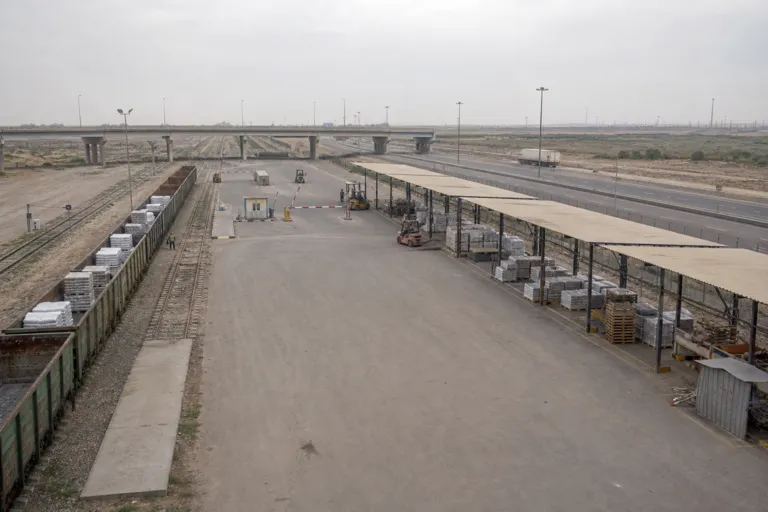
The idea behind Iraq’s Development Road is simple. Move Gulf cargo north through Iraq and into Turkey, then onward to Europe, instead of relying on the Red Sea and the Suez Canal. The project is frequently described as a “Dry Canal,” and it is designed to link the Grand Faw Port in Basrah to Europe via Turkey using a combined network of high-speed railways and multi-lane highways. Multiple sources describe the corridor length at 1,200 kilometres, and cost estimates range from about $17 billion to $17–20 billion, with some independent estimates pushing closer to $24 billion. The strategic promise is speed, redundancy, and a new logistics role for Iraq.
For Gulf-to-Europe shippers, the key question is whether this route is truly “faster than Suez.” In a Middle East Institute backgrounder, the Iraq–Turkey–Europe Development Road is described as promising transit that is 10–15 days faster than the Suez route, plus “bureaucratic advantages” due to Turkey’s EU customs integration. Middle East Nexus similarly frames a time advantage, positioning the corridor as offering roughly a 10-day edge versus the Suez Canal for Asia–Europe freight. The corridor is also being discussed in a wider environment of route risk, where alternative connectivity projects are under development alongside other trade, energy, and data links.
What Is Being Built and When It Could Matter
The corridor is planned in stages. Wikipedia describes completion targets in three stages by 2028, 2033, and 2050, alongside industrial hubs and telecommunications cables along the route. Tendify’s reporting adds detail about the integrated design, describing a 1,200-kilometre corridor from Grand Faw Port north to the Turkish border at Ovaköy/Faysh Khabur, passing through Basra, Diwaniyah, Najaf, Karbala, Baghdad, and Mosul. It also notes plans for 15 industrial cities or stations along the Iraqi stretch. Fox News reports that Iraq’s Prime Minister Mohammed Shia al-Sudani inaugurated the first 63-kilometer stretch in 2025, and that Phase 1 is due for completion by 2028.
Financing and regional buy-in are central to how quickly the trade impact could be felt. A quadrilateral memorandum of understanding was signed in April 2024 by Iraq, Turkey, Qatar, and the UAE, according to Wikipedia. The Middle East Institute also notes that Qatar and the UAE have pledged to support the project, while it describes Abu Dhabi Ports Group as the future manager of al-Faw Port once construction is completed. Tendify characterizes the funding mix as Iraqi government-led with heavy involvement from Qatar and the UAE, alongside Turkish investment commitments. Across sources, the route is consistently framed as a state-backed corridor meant to turn Iraq into a transit and logistics bridge between the Gulf, Türkiye, and Europe.
Beyond speed, proponents are selling scale and economic spillovers. Wikipedia cites a World Bank view that the Development Road could attract up to 13 million tonnes of international freight and 18 million tonnes of regional freight by 2040. Wikipedia also states the project is planned to generate US$4 billion annually and create at least 100,000 jobs. Fox News references the same US$4 billion per year figure while tying urgency to a regional context of disruption. At the same time, sources also flag challenges. Wikipedia notes the route navigates complex local security dynamics and has sparked domestic political disputes over inclusion and funding. In other words, the corridor’s promise is large, but execution risk remains part of the story.
How long is the Iraq Development Road corridor and where does it run?
Is the Development Road expected to be faster than the Suez route?
How much is Iraq’s Development Road project expected to cost?
What is the timeline for Phase 1 and full completion?
What freight volumes and economic benefits are associated with the project?