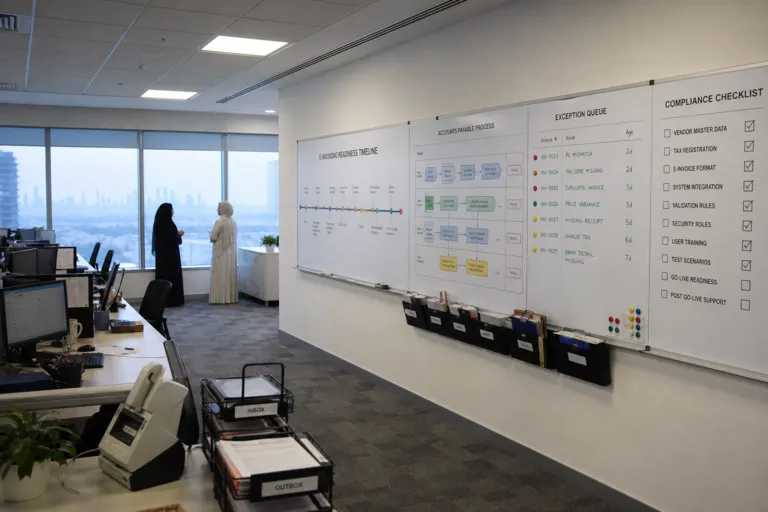
The UAE is rolling out an Electronic Invoicing System (EIS) under Ministerial Decision No. 243 of 2025 and Ministerial Decision No. 244 of 2025. The initial focus is on business-to-business (B2B) and business-to-government (B2G) transactions, with business-to-consumer (B2C) currently out of scope until a later phase is announced. Under the UAE framework, invoices in legacy formats are not treated as e-invoices, including PDFs, Word documents, scanned copies, images, or invoices sent by email. For invoices to qualify as valid e-invoices, they must be structured XML and transmitted through an Accredited Service Provider (ASP).
The phased timeline matters because the first mandatory deadline arrives fast. Voluntary adoption begins on 1 July 2026, aligned with the pilot and voluntary use window described in the rollout guidance. The first mandatory cohort starts on 1 January 2027 and applies to businesses with annual revenue of AED 50 million or more. For that cohort, the ASP appointment deadline is 30 October 2026. This date was extended from an earlier 31 July 2026 milestone, but the mandatory go-live date for the first cohort remains 1 January 2027, so the extra time is not a postponement of the main compliance obligation.
A Work-Back Plan From January 2027
Build readiness by working backward from your applicable mandate date and treating the ASP decision as the critical path. The readiness flow described for the EIS starts with selecting and onboarding an FTA-accredited ASP, then aligning your ERP data to the required invoice fields. The process includes mapping seller and buyer details, VAT registration numbers, item descriptions, taxable amounts, VAT rates, and total invoice values to the data dictionary. Where available, you also need to capture the buyer’s Participant Identifier (End Point ID) described as “0235 + 10-digit TIN.” This is where many projects slow down, so it helps to treat data review, mapping, and onboarding as a single integrated workstream rather than separate tasks.
Testing should be planned as production-grade validation, not a quick technical check. One readiness playbook recommends an end-to-end production test with real invoices in the final 2–4 weeks before the mandatory start date that applies to your tier. The goal is to confirm that XML invoices can be generated from your ERP, transmitted through the ASP, and exchanged in the structured framework without falling back to PDFs or email. Because the invoicing process becomes more standardised and less manual in a structured data model, your internal procedures and controls should also be updated so invoice creation, transmission, and record handling match the new operating reality.
Finally, treat enforcement risk as a planning input. One guide notes that non-compliance can trigger penalties of up to AED 5,000 per month for certain violations, which makes early readiness a practical necessity, not just a compliance goal. If you are below the AED 50 million revenue threshold, the published timeline includes a 31 March 2027 ASP appointment deadline and a 1 July 2027 mandatory start date, with government entities cited as mandatory from 1 October 2027. Even if your business enters later, the safest approach is to use the voluntary window starting 1 July 2026 to validate processes early, so the UAE e-invoicing mandate does not become a last-minute ERP and tax control scramble.
When does mandatory e-invoicing start for businesses with revenue of AED 50 million or more?
What counts as a valid e-invoice under the UAE framework?
How does the UAE e-invoicing mandate phase in for smaller businesses and government entities?
What is a practical testing step before the mandatory date?
What penalties are mentioned for non-compliance?