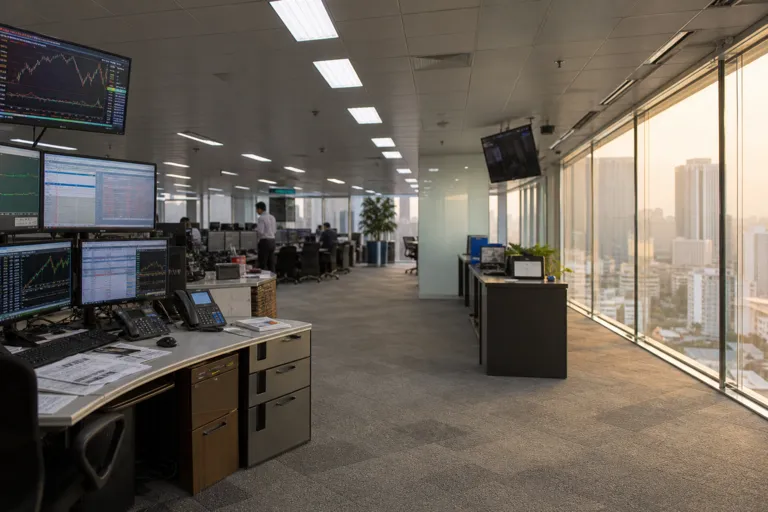
Vietnam has embarked on one of its boldest financial reforms in decades. In January and February 2026, it launched two international financial centres in Da Nang and Ho Chi Minh City, aiming to pull more global capital and offshore financial services into Vietnam. The push is tied to very large investment needs: meeting official development objectives requires nearly US$600 billion in infrastructure investment by 2040, with a US$100 billion funding gap that public finances and domestic banks alone cannot bridge. The system is also described as heavily bank-dominated. Between 2019 and 2023, banks mobilised an average of US$53.5 billion annually, while the stock market raised US$2.9 billion, highlighting why deeper capital markets and stronger links to global capital are central to the IFC strategy.
The policy design goes beyond incremental domestic reforms. Legislation passed in June 2025 established a 1200-hectare special regulatory zone across the two cities. Within this dedicated jurisdiction, investors are expected to have access to specialised commercial courts, foreign judges, English-language proceedings, greater foreign exchange flexibility, and more liberal rules on foreign ownership and professional employment. The stated objective is to attract long-term capital while also catalysing broader upgrades across the financial system. The intent is also to bring back activity that is currently arranged offshore. One example cited is that goods worth more than US$1 trillion pass through Ho Chi Minh City’s ports each year, yet much of the related financing, insurance, and risk management is arranged through centres such as Singapore, Hong Kong, or London.
Early Signals: Commitments, Members, and a Deadline to Transact
Six months into the dual-city experiment, reported traction looks uneven across locations, but measurable. In Ho Chi Minh City, the Vietnam IFC authorities said the hub has attracted about US$21 billion in capital commitments, and some of the country’s largest lenders are preparing to set up wholly owned units. Da Nang, by comparison, is still building its investor pipeline, with 12 official members, 11 prospective investors that submitted expressions of interest, and more than 90 others exploring opportunities. Structurally, Vietnam describes this as “one centre, two destinations”, with common institutions, incentives, governance, and supervisory standards while separating roles: Ho Chi Minh City covering capital markets, banking, asset management, and green and digital finance, and Da Nang focusing on fintech and innovation such as digital assets, tokenisation, specialised trading platforms, and regulatory sandboxes.
Execution is now a central credibility test. Vietnam’s Deputy Prime Minister Nguyen Van Thang ordered the operating agencies to have concrete financial products and investment deals in place by November, and urged direct work with investment funds and businesses to turn viable proposals into transactions. The framework is new: Decree 323/2025/ND-CP of 18 December 2025 established the centre as a single entity in two locations, and the National Assembly passed a law on a specialised court for the IFC on 11 December 2025. Vietnam News also reported six proposed product groups, ranging from investment funds and asset management to asset-backed digital assets, international carbon credits, and bonds issued through the centre. Cost is part of the pitch too, with reporting that Ho Chi Minh City’s operating costs are around one-fifth of those in Singapore or Dubai, and also estimated at one-fifth of those in Singapore, Hong Kong, or Dubai.
Whether the new hub can truly compete with established centres is framed in the sources as an open question, and comparison points underscore the scale challenge. India’s GIFT City, conceived in 2007 and operational since 2017, reported more than 1,100 registrations, over US$111 billion in banking assets, more than US$112 billion in average monthly exchange turnover, and over US$39 billion in cumulative fund commitments as of March 2026, alongside more than 400 leased aircraft and ships. This is the type of depth and deal flow new entrants are implicitly measured against. For Vietnam, advocates describe the effort as a bold step toward supporting investments into higher-growth opportunities in an emerging market, but the near-term task is practical: consistently deliver transactions, institutions, and a clear niche proposition, rather than trying to be a direct replica of Singapore or Dubai.
What problem is Vietnam trying to solve with its new IFCs?
What early traction has been reported in Ho Chi Minh City and Da Nang?
How is the two-city model structured?
How does Vietnam’s new hub compare with India’s GIFT City as a benchmark?
Can the Vietnam International Financial Centre compete with Singapore and Dubai right away?