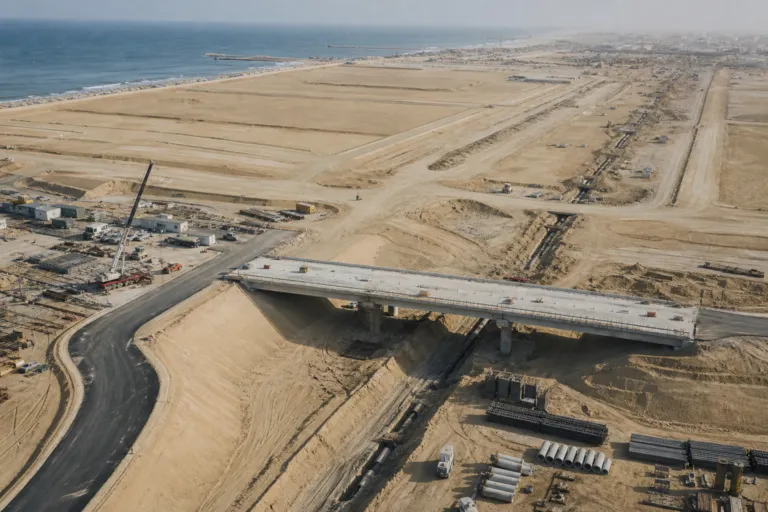
Two years into construction, Ras El Hekma has become a practical case study in how Gulf-Egyptian megaprojects move from announcement to execution. Property News Africa describes early 2026 site indicators that signal delivery rather than hype: a fenced perimeter, fresh earthworks, surveyor stakes for a spine road, and an active developer compound. The core deal still frames expectations. It was an ADQ-led USD 35 billion investment signed in February 2024, described as the largest foreign direct investment in Egyptian history. Developers are also projecting cumulative investment that could exceed USD 110 billion by 2045, with the wider development phase pitched at up to USD 150 billion.
Execution progress is now being measured in contracts and components. Egypt Business reports the award of a construction contract to Hassan Allam Construction for the Montage Hotel and branded residences inside the masterplan. That package is defined: a 200-room hotel, 96 branded villas, a clubhouse, and related infrastructure and external works. The same update notes that Prime Minister Mostafa Madbouly met Jassem Al Zaabi of Modon Holding to review progress and confirm the first phase remains on schedule, with hospitality, commercial, and entertainment facilities expected to begin operations as planned. Property News Africa adds a timetable signal: the first residential phase is targeted for completion around 2028, and a new international airport is planned to open in stages.
What Two Years Reveal About Delivery: Sequencing, Sales, and State Capacity
Dailynewsegypt provides a granular snapshot of what “delivery” looks like on the ground when officials tour specific assets rather than renderings. During a 2026 site visit, Madbouly toured the Portaluna Hotel and the Wadi Yam project, both linked to Modon Holding. Portaluna is described as having 73 suites, seven restaurants, and a beachfront boutique resort. Wadi Yam is presented as a mixed-use cluster with 13 residential communities, six hotels, two 18-hole golf courses, a 10,000-seat amphitheatre, a sports club, a 1.3-kilometre tourist promenade, a 2.5-kilometre beach, a coastal park, and five lagoons. Modon Holding officials also reported sales of over 3,500 units, which is an early demand signal that developers can reference when financing and phasing decisions tighten.
At the same time, the two-year mark highlights the enabling-infrastructure burden that can define timelines and returns. Property News Africa cites an Atlantic Council framing of Ras El Hekma as part of a “land monetization” strategy executed under financial distress, warning that long-term upside may disproportionately accrue to foreign investors while Egypt funds much of the enabling infrastructure such as water, power, and transport. Dailynewsegypt details the state’s coordinating role in adjacent resettlement-linked works: for the “Shams El Hekma” city project, the Housing Ministry reported 100% completion of drinking water, sanitation, and road networks in urgent Phase A, B, and C areas, with electricity and lighting networks completed and energised. Work is ongoing in Area D, covering 1,400 feddans, where the sanitation network is 85% complete and drinking water installations are underway.
The macro context explains why delivery discipline matters beyond real estate marketing. The Middle East Insider describes the deal mechanics as including a USD 24 billion upfront cash payment and an USD 11 billion equity conversion, and links the investment to shifts in IMF projections and reserves. It reports pre-deal IMF growth projections for Egypt at 3.6% for fiscal 2025, moving post-deal to a 4.0% to 4.5% band. It also reports reserves moving from approximately USD 35 billion at end-2023 to over USD 47 billion by mid-2024, with continued accumulation through 2025 to a band of USD 50 to 53 billion at end-2025. For investors assessing Ras El Hekma megacity development, the lesson after two years is clear: the story is now about construction packages, infrastructure handovers, and operational openings—because those are the proof points that determine whether a landmark deal becomes a functioning city.
What was the size of the Ras El Hekma deal signed in February 2024?
What delivery milestones are visible two years into construction?
What does Wadi Yam include, and what unit sales were reported?
How far along is infrastructure work in the Shams El Hekma areas?
What do the first two years suggest about Ras El Hekma megacity development risks?