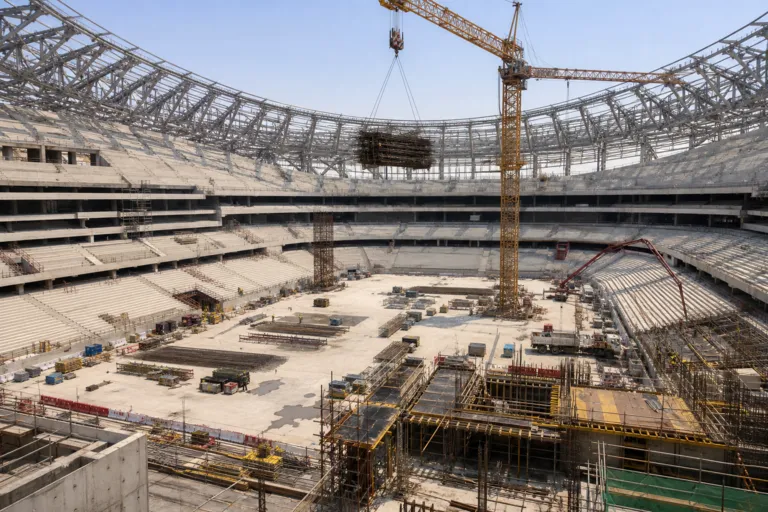
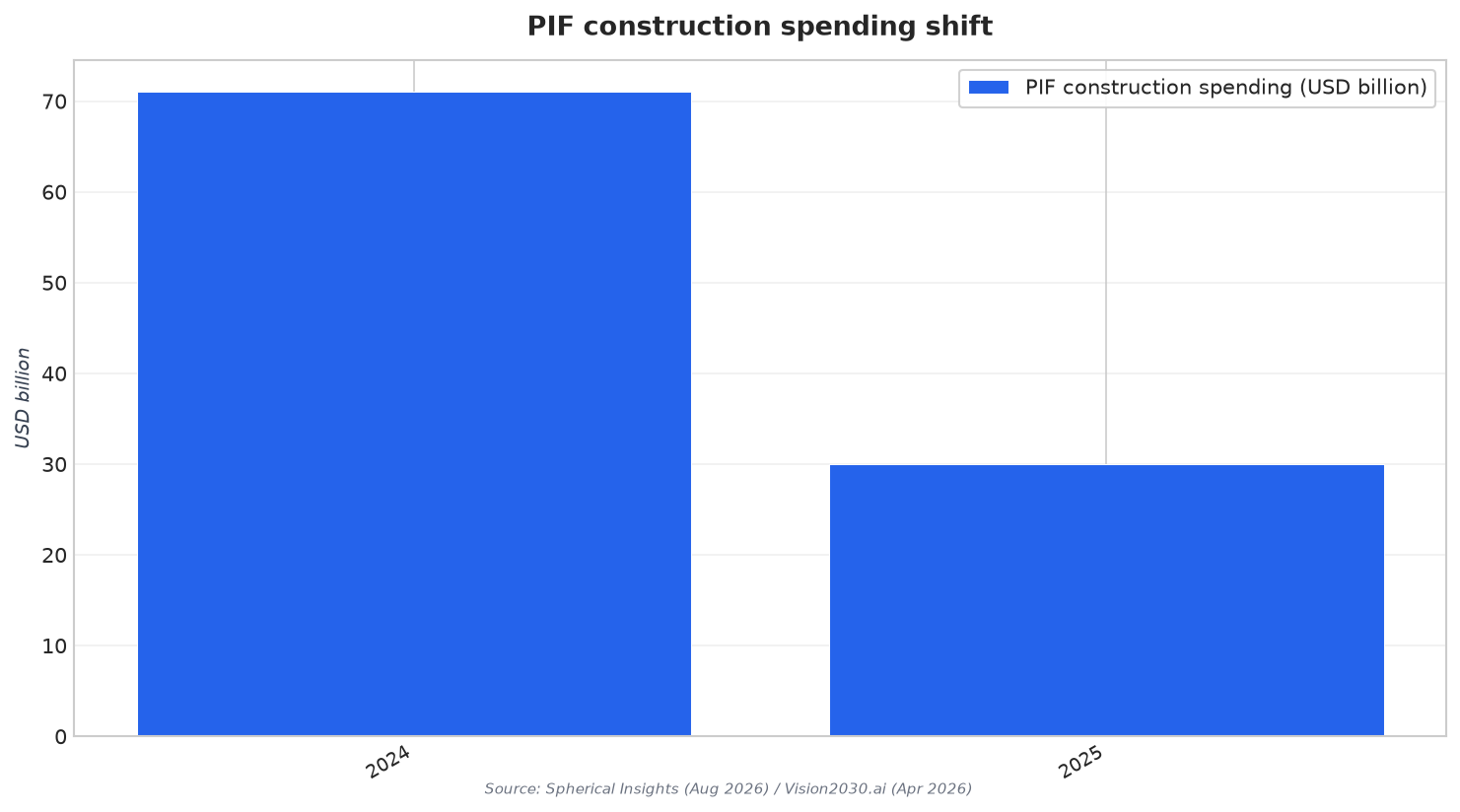
Saudi Arabia’s construction agenda is becoming more deadline-driven as Expo 2030 Riyadh and the 2034 FIFA World Cup rise to the top of national mega-project priorities. At the February 2026 PIF Private Sector Forum in Riyadh, former Investment Minister Khalid Al Falih said the two events had moved ahead of projects such as NEOM and The Line in the investment hierarchy. Multiple sources frame this as a reallocation of capital rather than a retreat. PIF construction spending fell from around USD 71.0 billion in 2024 to below USD 30.0 billion in 2025, and the emphasis shifted toward assets that must be delivered on a fixed, internationally binding schedule.
Those firm dates are driving what gets built, where, and in what sequence. FIFA confirmed Saudi Arabia as the 2034 World Cup host in December 2024. The tournament is planned across five cities and 15 stadiums. One source specifies the five cities as Riyadh, Jeddah, Al Khobar, Abha, and NEOM. The stadium program is described as 15 venues comprising four renovations, three currently under construction, and eight planned new builds. In parallel, the event-led pipeline is accelerating investment in transport networks, hotels, airports, utilities, and urban development across Riyadh and other host cities, tying construction activity to non-negotiable delivery milestones.
Hospitality Becomes the Bigger Pipeline Than Stadiums
While stadiums attract attention, the hotel buildout is positioned as the larger volume story. According to Saudi Arabia’s official bid book and follow-up industry reporting cited by Kanzotech, the Kingdom is targeting more than 230,000 hotel rooms and serviced apartments across the five host cities by 2034. The same source notes that different reports also cite a 180,000 room figure, underscoring that targets are still evolving as projects move from planning to construction. Omnia adds another layer of pipeline visibility, stating that around 99,500 keys were under construction or planned for delivery by 2030, with 78% in upscale, upper-upscale, and five-star categories.
This shift is also changing how investors and contractors evaluate risk and timing. Omnia argues that a market building toward a fixed, government-backed target tends to move with more conviction than one driven by sentiment, and it links that momentum to an events pipeline that includes Riyadh Season each winter, the 2029 Asian Winter Games at NEOM’s Trojena, Expo 2030 in Riyadh, and the 2034 FIFA World Cup. In that context, property is described as “the spine” of the ambition, spanning hotels, homes for the domestic travel plan it envisages, and whole districts staged for 2034 delivery, while acknowledging competition from Dubai, Doha, and the wider Gulf.
For the construction and hospitality supply chain, the practical implication of Saudi 2034 World Cup infrastructure is prioritization: projects tied to the tournament and Expo timeline can crowd into the front of the queue for planning, procurement, and delivery capacity. The sources describe this as a move away from attempting to advance multiple open-ended mega-projects at once, toward time-specific infrastructure with nearer-term economic implications. The event-driven cycle is framed as a multiplier across construction, tourism, hospitality, logistics, retail, and professional services, with post-event use also highlighted if venues and districts continue to support tourism, entertainment, business activity, and real estate development.
When did FIFA confirm Saudi Arabia as the 2034 World Cup host?
How many cities and stadiums are planned for the 2034 tournament in Saudi Arabia?
What hotel-room target is linked to the 2034 host-city plan?
What does the pipeline look like for hotel keys by 2030?
How is Saudi 2034 World Cup infrastructure influencing capital allocation?