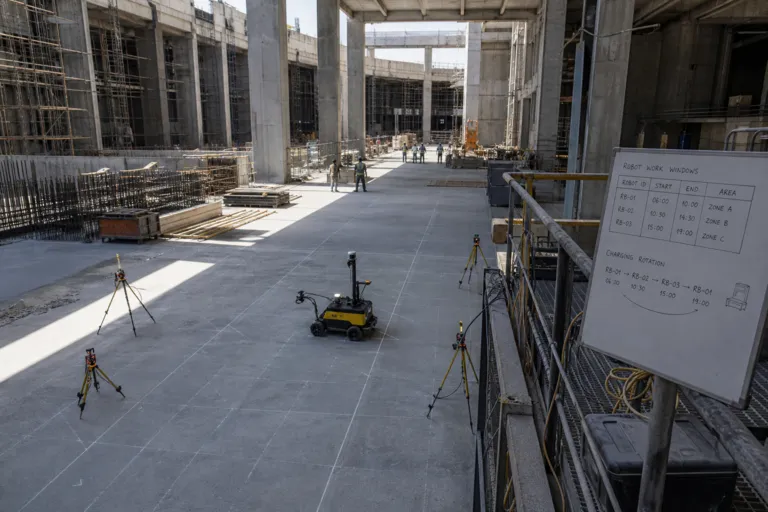
Across live Gulf projects, the conversation is shifting from “digital visibility” to “field automation.” A Gulf contractor example reported by 1Arabia describes robots being used to reduce time spent on repetitive documentation, lower the need for manual site walks in harsh conditions, and improve safety by sending machines into zones where access is difficult. The same source also notes that while BIM, drones, and site-management software are becoming more common on major projects, ground robots operating inside active work zones are still early-stage. That combination—clear operational value, but early adoption—helps explain why project leaders now treat robotics as something to plan for, not a showcase.
Saudi Arabia’s construction layout robots are a concrete example of this operational shift. A market analysis focused on the Kingdom says layout robots are emerging as a vital part of construction automation, helping improve accuracy, efficiency, and productivity by integrating automation, laser guidance, and AI-powered navigation. It frames adoption as a response to the rising complexity of mega construction projects, where minimizing human error and improving precision can reduce rework costs and enhance safety. The same source forecasts the Saudi Arabia Construction Layout Robots Market to reach USD 25.1 million in 2026 and approximately USD 116.4 million by 2035, with a CAGR of 18.6% during the period.
What’s Really Driving Automation on Gulf Giga-Projects
The strongest delivery argument is not a single robot, but an automation stack that connects design to execution. The Saudi layout-robot source links adoption to digitized workflows and the use of BIM, IoT-enabled devices, and autonomous robotics as “standard components” of modern construction. In parallel, a global construction robotics report from ZACUA Ventures describes the market as being at the beginning of an adoption S-curve and notes that analysts disagree on boundaries (on-site robots versus factory automation, and whether drones are included). It still characterizes on-site construction robotics as a small but real global market in the low single-digit billions of dollars—large enough to matter, but immature enough that execution discipline can become a differentiator.
Saudi Arabia’s broader industrial automation context also matters for construction delivery capacity. IndexBox reports that the Kingdom’s industrial robot market is structurally import-dependent, with over 90% of equipment sourced from Japan, Europe, China, and South Korea, leaving supply chains exposed to shipping costs, lead times, and currency fluctuations. It estimates that demand is concentrated in oil & gas, petrochemicals, and automotive, together accounting for about 55–65% of installed robotic systems, while adoption is emerging in logistics and construction. It also flags practical constraints: procurement lead times of 8–16 weeks for imported equipment plus 4–8 weeks for integration, and mid-range articulated systems priced between USD 45,000 and USD 120,000.
The takeaway for Gulf construction robotics adoption is that “robots on the megasite” is a delivery program, not a gadget purchase. The 1Arabia report stresses that contractors still must assess integration costs, maintenance demands, worker training, data governance, and the reliability of autonomous systems around people and heavy equipment. IndexBox reinforces the workforce constraint, calling technical workforce scarcity the single largest constraint, with a limited pool of robotics engineers, programmers, and maintenance technicians to support installed systems in Saudi Arabia. Put together, the near-term winners will be teams that treat robotics as a managed rollout—governed, integrated, and supported—so automation can consistently remove friction from schedule, quality, and safety.
Why is construction robotics moving from pilots to operations on Gulf projects?
What are the key Saudi Arabia market figures for construction layout robots?
What practical constraints slow robotics rollouts in Saudi Arabia?
How should teams think about Gulf construction robotics adoption on giga-projects?