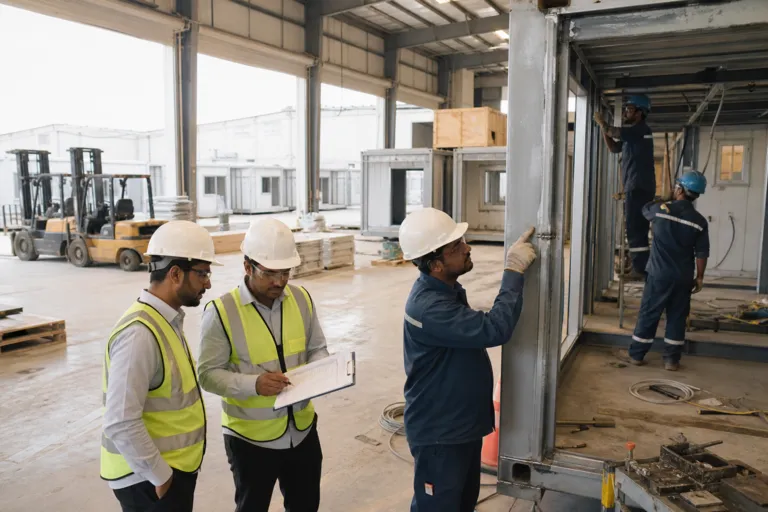
In 2026, modular construction Saudi Arabia stories are being shaped by one word: schedule. Multiple sources describe off-site fabrication as a way to move work into controlled environments and reduce on-site uncertainty. Modular units are built offsite and prefabricated in a factory setting using precision manufacturing. The approach is positioned as quicker than traditional “bricks and mortar” because modules can be designed, manufactured, transported, and installed, sometimes in a matter of weeks. That faster cycle matters when projects face unpredictable site conditions, changing scopes, and pressure to deliver.
A key advantage is risk control through process discipline. One offshore-focused source stresses that solutions must comply with industry codes and regulations, starting with a detailed engineering and design plan submitted for customer and third-party review and approval before fabrication begins. Designs are evaluated against industry and safety standards to ensure full compliance. During fabrication, hold points are implemented for inspections to maintain material traceability, quality control, and regulatory compliance. Document control is described as critical. After fabrication, final acceptance testing (FAT) is conducted with the customer and third-party surveyors, following an agreed inspection and testing plan (ITP), before final certification letters are issued.
Why Speed Now Means Pre-Approved, Factory-Built Capacity
Speed is not only about manufacturing faster. It is also about removing repeated approvals and redesign loops. For rental or fleet sale packages, one provider highlights a large inventory of ready-to-deploy assets that help keep projects on schedule. These pre-approved temporary living quarter (TLQ) units can be delivered quickly, bypassing delays associated with engineering and regulatory review for new builds. This aligns with broader descriptions of modular delivery: less time needed onsite can minimize delay risks from unforeseen circumstances, including adverse weather. In practice, “off-site” becomes a schedule strategy built on repeatability and readiness.
Saudi Arabia’s megaproject environment adds urgency to scalable delivery. A Reuters report describes the kingdom conducting a comprehensive review of several Vision 2030 mega projects, alongside examples of reassessment and delay. In this context, modular approaches are being marketed as a response to systemic problems in traditional building practices, including labor shortages and volatile material costs. One press-release source frames modularity as shifting more than 90% of the building process from the unpredictable environment of a construction site to a controlled factory setting, with waste reductions supported by precisely calculated materials and recycled off-cuts within the factory environment.
NEOM is cited as a proving ground for harsh-site deployment. A case study states that providing labor housing for NEOM required massive volume and the ability to withstand extreme desert climates. The modules delivered are described as offering superior thermal insulation and structural durability. This is paired with a wider industry message that modular buildings can support flexible internal layouts, integrate mechanical–electrical and plumbing, and include sustainability features such as solar panels, rainwater harvesting systems, or smart plugs. Rental-based use is also described as supporting re-use and redeployment, contributing to a circular economy.
Finally, modular is being positioned as permanent, bankable construction rather than temporary accommodation. One source claims a modular product line engineered for a 50-year lifespan and able to support structures up to 20 stories high, explicitly challenging the “temporary” stereotype. In parallel, Saudi development continues at vast scales, with one heritage-meets-modernity megaproject receiving a $56m five-year design and supervision contract that includes more than 55km of streetscapes. Together, these signals point to a breakthrough year defined less by novelty and more by modular construction’s role in keeping delivery steady when timelines and feasibility are under constant scrutiny.
What does modular construction Saudi Arabia mean in practice?
How can modular delivery help projects stay on schedule?
How is compliance managed in modular fabrication?
Where has modular housing been applied in Saudi megaprojects?
Are modular buildings treated as temporary structures?