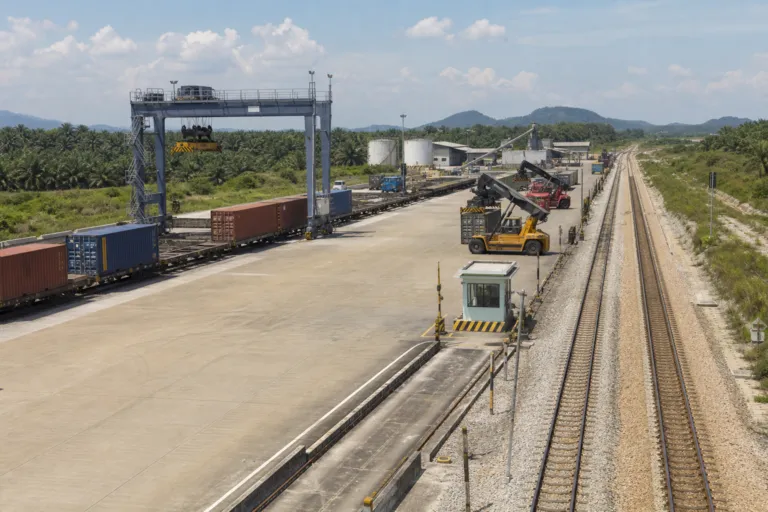
Malaysia’s freight and logistics system is heavily concentrated in the Central Region, where Selangor, Kuala Lumpur, and Port Klang account for roughly 44.6% of total freight throughput. That gravity has shaped where factories, warehouses, and transport services cluster. The East Coast Rail Link is designed to change those flows by creating a direct cross-peninsular connection that ties Kuantan Port on the South China Sea to Port Klang on the Strait of Malacca. The line stretches 665 km, and government-linked sources describe it as a “land bridge” that can broaden route options and reduce reliance on a single maritime approach.
On the logistics side, the value proposition is speed, scale, and modal shift. Multiple reports cite more than MYR 9 billion committed to the rail link, and the project’s cost was finalised in 2021 at RM50.27 billion. Once complete, it is expected to cut freight transit time between Kuantan Port and Port Klang by roughly 50%. Another projection estimates about 53 million tons of freight per year could move between the east coast and Port Klang via the dual-track alignment. This matters in a market where road haulage handles around 55% of total freight tonnage, and where shifting bulk and manufactured goods from road to rail is explicitly framed as a way to ease bottlenecks.
From Port-to-Port Time Savings to New Nodes of Growth
Progress markers suggest the corridor is moving into its final stretch. One forecast states the 665 km project is 78.5% complete, with Phase 1 slated to start in January 2027. Separately, Malaysia’s Transport Minister said the line was nearly 92% complete and reiterated a 2027 launch timeline after a preview run using trains delivered from China. As construction advances, reports already link the project to new warehousing and logistics investment around Kuantan Port. That pull is reinforced by Kuantan Port’s deep-water expansion, which raised annual handling capacity to 52 million metric tonnes through a joint venture between Malaysia and a Chinese consortium.
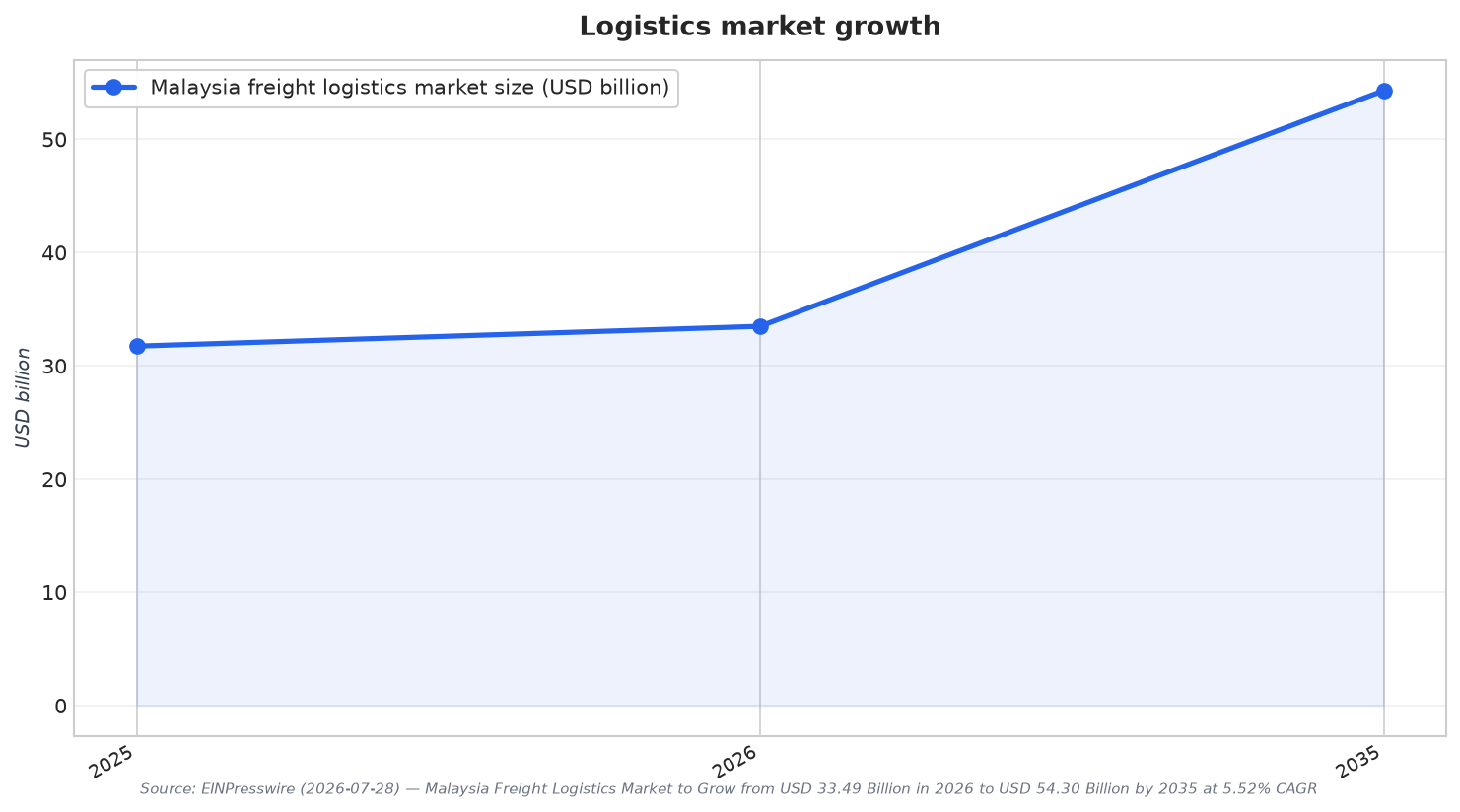
The demand backdrop is also changing, which raises the stakes for better inland connectivity. Since 2023, the logistics divisions of Shopee and Lazada have spent more than MYR 1.2 billion on automated sorting centers, reflecting pressure for faster and more resilient distribution. Another dataset notes domestic parcel volumes exceeded 1.8 billion pieces in 2024, up 22% from 2022, while courier, express, and parcel services are forecast to expand at a 6.30% CAGR through 2035. At the same time, manufacturing-led freight is being supported by large investment approvals, including MYR 378.5 billion in 2024 in one report and approvals topping MYR 400 billion in another.
Rebalancing, however, is not only about moving containers faster. It is about where value-added logistics can relocate. With a faster land bridge between the east coast and Port Klang, firms can consider alternative sites for distribution, bonded storage, and industrial supply chains, rather than defaulting to Central Region footprints. The wider policy context points in the same direction, from megaproject pipelines that include the Pan-Borneo Highway to financing signals such as a MYR 4.5 billion SDG sukuk for infrastructure. If the rail link delivers the projected time reductions and freight volumes, it could help Malaysia diversify logistics growth away from a single dominant corridor while strengthening inter-port connectivity across Peninsular Malaysia.
What is the Malaysia East Coast Rail Link meant to connect?
How much could the rail link cut freight transit time between Kuantan Port and Port Klang?
How much freight could be carried on the ECRL corridor each year?
When is ECRL revenue service expected to start?
Why does the ECRL matter if road haulage is still dominant?