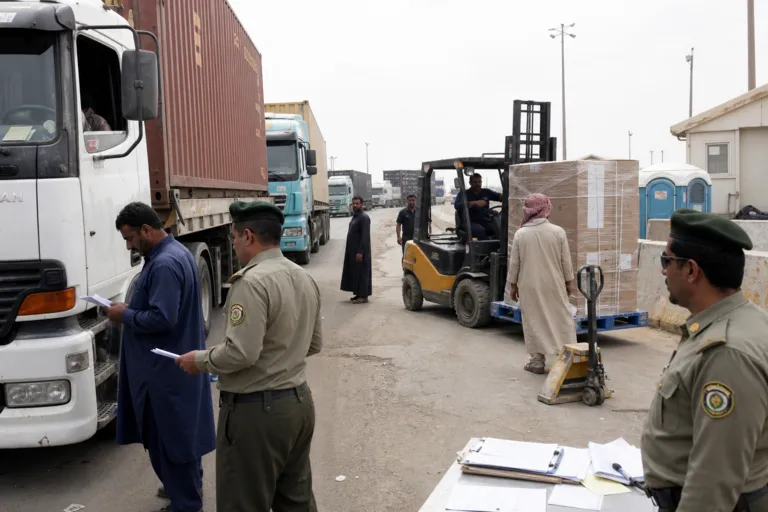
In the GCC, resilience has started to outrank efficiency as the core measure of competitiveness. When access through Hormuz is disrupted, trade flows get redirected through accessible gateways and inland routes, often at higher cost and with longer transit times. That reality has pushed governments and industry to treat land connectivity as a strategic asset, not just a contingency plan. The shift is not only about protecting energy exports. It is also about ensuring the steady movement of food, inputs, and capital goods into economies that remain deeply connected to global supply chains.
The incentive is structural. Even with industrial localization efforts, the GCC still sources much of its raw, intermediate, and capital goods from international markets. A KPMG-cited estimate put overall trade volume at $1.5 trillion in 2024, underlining exposure to global shocks. Food supply is another pressure point, with imports accounting for around 85% of food supply in GCC states, and some states depending on imports for up to 85%. In that context, GCC overland logistics corridors reduce reliance on single access points and give planners more options when maritime routes face binding physical constraints.
One visible proof is the opening of Highway 95. It runs from the Saudi-Qatari border crossing at Salwa, passes through the Shaybah oilfield and the Empty Quarter, and enters Oman at the Ramlet Khelah border crossing, which opened in January 2023. The route links through Ibri to ports such as Sohar and Muscat, and to Duqm and Salalah. It has been popular because it is shorter and can cut out often 24-hour delays at UAE-Saudi border crossings that no longer need to be traversed. In trade terms, the value of goods crossing through Ramlet Khelah nearly trebled to $830m in March, from $300m in February.
From Workaround to Networked Resilience
Road corridors are only one layer. Consultancy analysis argues resilience can be increased by diversifying sourcing strategies, accelerating investments in multimodal connectivity such as rail integration, and embedding countries within a more interconnected GCC logistics network. It points to strengthening hinterland integration through Etihad Rail, Hafeet Rail, and bonded corridor systems to support efficient sea-rail-land flows linking ports to inland demand centres across the UAE and into Saudi Arabia. Saudi Arabia is also positioned to expand Red Sea access through integrated sea-land corridors linking its western ports to domestic and GCC markets.
Energy logistics strengthens the same “land over sea” logic. One report notes Saudi Arabia’s Petroline to Yanbu already moves 5–7 million barrels per day and is actively used to bypass the strait. The same source describes a broader framework that would carry 7–8 million barrels per day into Aqaba, with total westbound capacity reaching 15–16 million barrels per day, and frames these land options as reducing dependence on Hormuz. Separately, The Atlantic argues that only new infrastructure can provide a long-term solution, noting that just two major pipeline systems can move Gulf energy to markets without transiting Hormuz, and that they are running near or at maximum capacity.
In practice, the strategy is becoming permanent because the risk environment is not treated as temporary. A Maritime Executive editorial proposes a defended corridor in Hormuz designed with a fixed six-month duration to restore confidence, but that model implicitly reinforces the value of parallel overland options that do not rely on naval scheduling. The direction of travel is clear in policy language: build integrated corridors, strengthen regional connectivity, and anchor roles in more resilient global supply chains. As the Gulf continues to invest and expand even amid uncertainty, GCC overland logistics corridors function as day-to-day capacity, not just an emergency detour.
What are GCC overland logistics corridors?
Which GCC route saw a sharp rise in cross-border goods value?
Why is resilience now prioritized over efficiency in GCC logistics planning?
How do rail and bonded corridors fit into the resilience strategy?
What does the Highway 95 corridor change for traders?