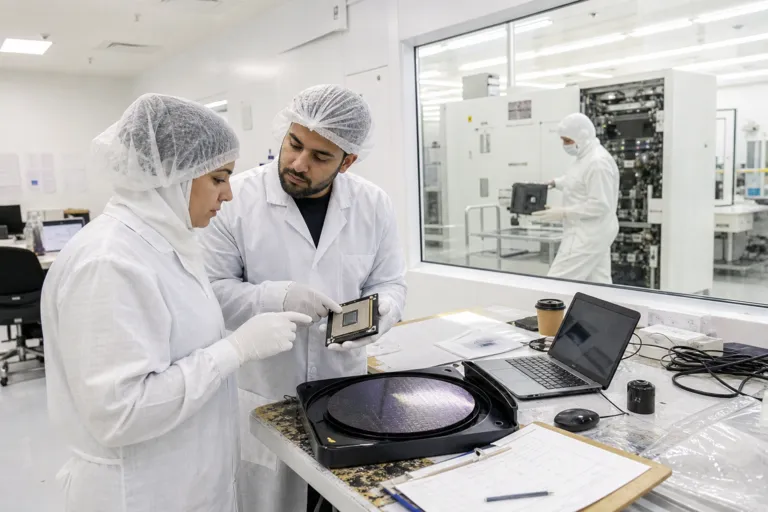
The Gulf semiconductor strategy is increasingly framed as a compute sovereignty play, not only a data-centre expansion story. Governments in the region are pushing to strengthen local compute ecosystems across the full stack, from semiconductor design and manufacturing to data-centre setup and operations. This approach is tied to risk management. The same sources note concerns about supply chains and the need for access resilience. It is also tied to policy. Data sovereignty mandates require much of the Gulf’s compute demand, especially in government, regulated industries, and critical infrastructure, to be met locally.
Demand signals help explain the urgency. In the GCC, data usage is projected to surge 400% between 2022 and 2028, a pace that raises pressure on power, hardware, and operations. Globally, data center investment nearly doubled since 2022 to reach $500 billion in 2024, while electricity consumption is set to more than double by 2030, fueled by AI demand. In the UAE, Abu Dhabi is linked in reporting to OpenAI’s largest project outside the US, described as a 5 GW hyperscale complex, alongside record-breaking chip imports to power next-gen AI models.
From Hyperscale to Chips: Building Local Capability
The Gulf’s push is not limited to buying capacity abroad. The region is making moves to anchor hyperscale capacity on domestic soil through initiatives such as KSA’s HUMAIN AI data center and the UAE’s Stargate project. At the same time, the compute sovereignty agenda is expanding into semiconductors. One Gulf-focused analysis explicitly calls for investment programs, targeted incentives, and regulatory support to build capabilities from semiconductor design and manufacturing to data-centre operations. It also points to KSA’s Alat and National Semiconductor Hub initiatives as examples aimed at building semiconductor design and manufacturing capabilities.
Supply resilience is treated as a practical necessity, not a slogan. A recommended strategy is to secure supply chains by maintaining GPU reserves, diversifying global vendors, and deepening partnerships with chipmakers through long-term contracts and strategic investments. Within the Gulf, HUMAIN and G42, working in collaboration with their governments, are developing partnerships with chipmakers such as NVIDIA, AMD, and Cerebras to enhance access resilience. The same analysis says the region is on track not only to meet local GPU demand, but also export compute power, underscoring the ambition to turn local build-out into external capability.
The Gulf context sits inside a wider global race where self-sufficiency is hard. One industry commentary argues that building an entire modern chipmaking supply chain end-to-end in a single country is “not likely,” and highlights dependencies on ultra-pure wafers, specialty chemicals, and rare gases. It cites 2019, when Japan’s export bans on a few chemicals sent Samsung scrambling, with three missing compounds nearly stalling the world’s top memory chip producer. For Gulf planners, this reinforces why a Gulf semiconductor strategy must combine domestic capability-building with global partnerships rather than assuming full independence.
What emerges is a two-track approach. First, expand local data-centre and hyperscale capacity that can meet local mandates and AI-driven demand. Second, develop semiconductor design and manufacturing capability via initiatives and partnerships that strengthen supply access and resilience. The Gulf semiconductor strategy, as described in the sources, is therefore less about one mega-factory headline and more about building the ecosystem: incentives, regulation, long-term chipmaker relationships, and local infrastructure that can keep critical workloads running inside national borders when external conditions tighten.
What does “Gulf semiconductor strategy” mean in practice?
Why is compute sovereignty a priority in the Gulf?
Which Gulf initiatives are cited for semiconductor capability building?
How are Gulf players improving access to chips and GPUs?
What demand and infrastructure signals are mentioned for the GCC and UAE?