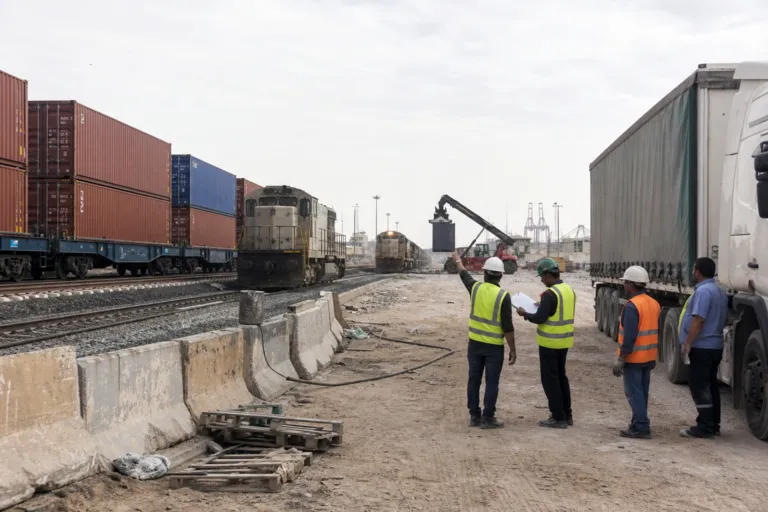
Persistent security risks in the Red Sea have pushed Saudi Arabia to accelerate an overland alternative designed to protect trade flows. The Saudi Landbridge rail project is planned to connect Red Sea ports such as Jeddah to the Arabian Gulf via Riyadh, with links to Dammam and major industrial hubs. Multiple sources frame it as a practical response to supply chain stress rather than a distant concept. The Landbridge’s logic is straightforward: create a land-based corridor that can keep cargo moving when maritime choke points become unreliable, and shift logistics planning toward rail in a way that supports intermodal operations.
Project descriptions converge on a main Landbridge line of about 950 km linking Riyadh and Jeddah, with extensions that tie into the existing rail network and key Gulf-side nodes. One update describes a broader corridor spanning more than 1,500 km, including a 900 km Riyadh–Jeddah segment, and explicitly positions this route as a bypass to stressed sea lanes. The same source says container trains could cross the Kingdom in under 10 hours once targeted upgrades and links are in place, including work tied to the Riyadh Rail Link and improvements to the 115 km Dammam–Jubail line. The emphasis is on predictable schedules, fewer weak points, and a mode shift away from trucks and vulnerable sea routings.
From Concept to Construction: Cost, Timeline, and Modular Delivery
Cost and delivery timelines are now part of the public debate around execution. Engineering News-Record reports the project is expected to be completed in 2034 at a total cost of USD 7 billion, while also noting the entire program is seen as requiring USD 26.6 billion in investment. It adds that the project evolved from a public-private partnership approach into a phased strategy, with Saudi Arabian Railways (SAR) dividing work into modular segments to increase flexibility and speed up delivery. Specific works cited near the capital include a 22.7 km single-track section, plus a 265 m bridge over Highway HW615 and a 118 m bridge over Saudi Aramco pipelines.
The risk-hedge argument is reinforced by the way the Landbridge interacts with industrial geography and maritime choke points. Engineering News-Record notes the aim to reduce the need to move products from the Kingdom’s two main industrial regions, Jubail and Yanbu, through the Strait of Hormuz to reach global markets. A Vision 2030-focused explainer argues the overland corridor could attract transhipment volumes that currently bypass Saudi Arabia entirely, by enabling cargo discharge at eastern ports, rail transfer across the peninsula, and reloading at western ports. In this framing, the Landbridge is not only a domestic freight project; it is also a platform for route choice when maritime lanes impose higher uncertainty.
Freight capacity targets and logistics-node development are central to how stakeholders are planning around the corridor. A 2026 update says the railway is expected to move over 50 million tons of freight per year once operational, with annual capacity described as exceeding 50 million tons. The same source says officials project USD 4.2 billion in annual transportation cost savings when fully operational and expect around 200,000 jobs. It also points to nearly 20 modern logistics hubs along the corridor, including seven logistics centers stretching from Yanbu to Riyadh, and describes heavy industry already pre-booking rail capacity for 2026 to avoid maritime delays and reduce exposure to Red Sea risks.
What is the Saudi Landbridge rail project designed to connect?
How long is the Landbridge line between Riyadh and Jeddah?
What cost and completion timing have been reported for the Landbridge?
What freight volumes and savings are projected once the corridor is operational?
Why is the Landbridge described as a hedge against Red Sea and chokepoint disruption?