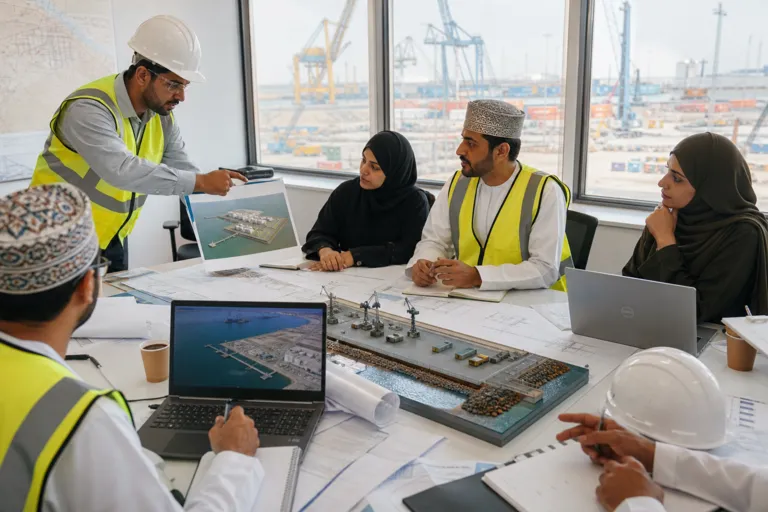
Turning awarded clean-fuel projects into exports is a logistics story as much as it is a power story. In green hydrogen Oman discussions, the big question is what happens after a mandate is awarded: which ports will load products, where will they land, and what timelines are credible. Oman’s strategy is increasingly framed around open-ocean access and scalable port nodes. CleanTechnica argues Oman is the Gulf region’s “strategic exception” because its hydrogen buildout around Duqm, Sohar, and Salalah is oriented to open-ocean access outside the Strait, which it describes as a hedge against recreating chokepoint risk in a green-molecule economy.
Duqm is a centerpiece because it is being linked to European demand via a defined maritime concept. The Maritime Executive reports Oman is promoting a green hydrogen maritime corridor from a loading terminal in Duqm to the port of Amsterdam, positioned as support for the International Maritime Organisation’s net-zero greenhouse gas targets by 2050. The same report says the corridor concept also embraces offload points in the Port of Antwerp, with an onward shipment network to the Port of Duisburg on the Rhine. It notes the initiative was the subject of an agreement between the Netherlands and Oman in May, during a state visit by Sultan Haitham.
From Pre-Engineering to Export Schedules
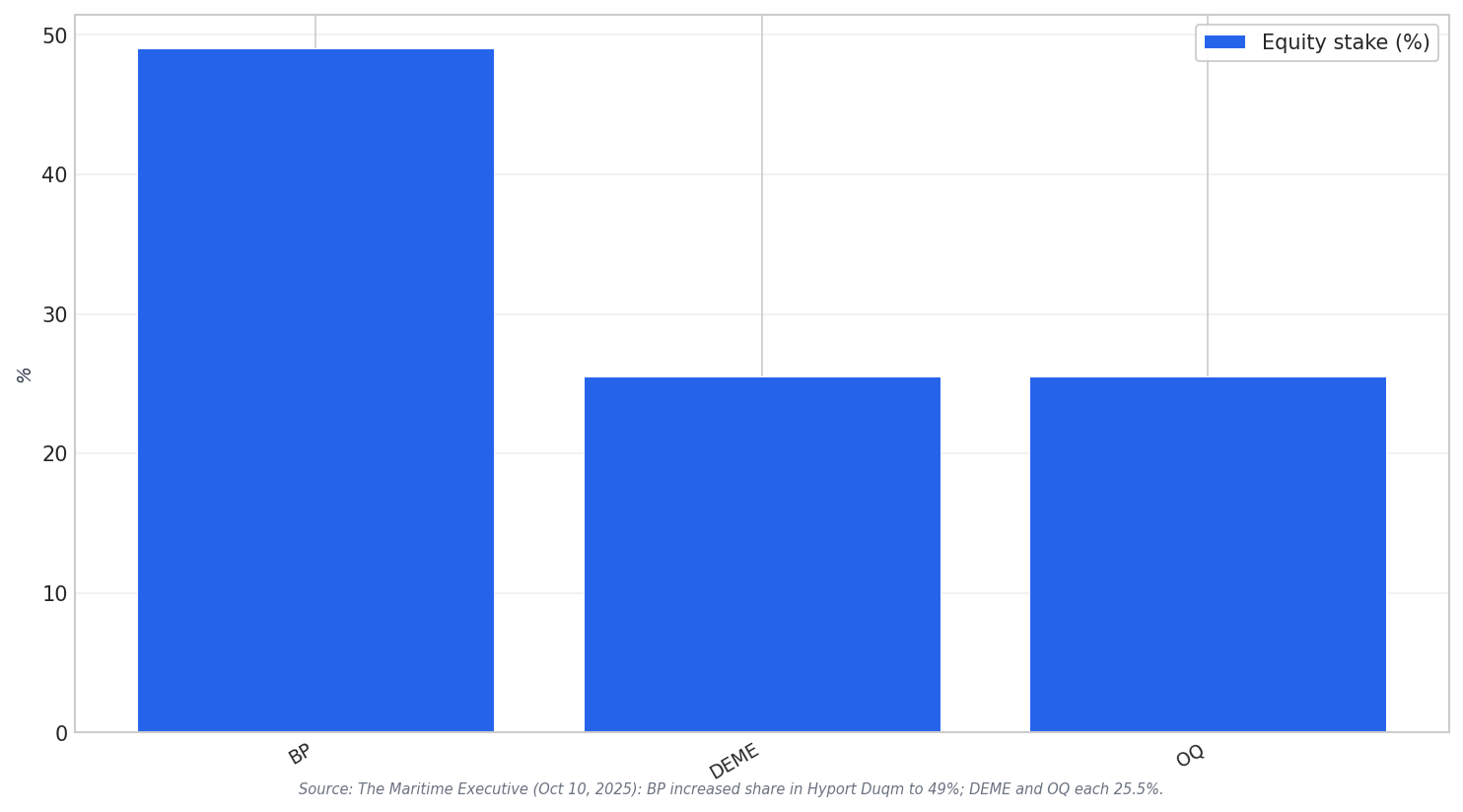
Awarded projects still need design maturity, counterparties, and shipping pathways. In Duqm, that conversion is happening in stages. The Maritime Executive states the Hydrom Duqm project is in the pre-engineering design phase, and that commercial operations utilizing the green hydrogen maritime corridor to Europe are scheduled to commence in 2030. It also reports that BP increased its share in the Hyport Duqm green hydrogen project to 49 percent, while Belgium’s DEME and the Omani sovereign wealth fund OQ each retain 25.5 percent. The same source says it is too early to estimate which awarded consortia will be first into production, but it frames BP’s move as a signal of confidence in Oman’s overall strategy.
Salalah adds a second export-and-bunkering pathway, focused on a derivative fuel rather than direct hydrogen. The Maritime Executive reports HIF Global and Acciona Nordex Green Hydrogen signed a deal with Oman’s Ministry of Transport, Communications and Information Technology to explore building an e-methanol production and bunkering hub in the port of Salalah. It says the project leverages vast wind and solar farms being built in the hinterland behind Salalah, in projects involving EDF, Fortescue, J-Power, Marubeni and Samsung. The same report explains HIF Global’s model combines captured CO2 and hydrogen—produced by solar and wind energy—to produce e-methanol, which can be refined into synthetic substitutes for petrol, diesel and aviation fuel.
Execution also depends on industrial readiness and port throughput. Salalah’s existing trade growth provides context for why bunkering and exports are being prioritized there. The Maritime Executive reports container traffic at Salalah grew 21% in 1H25 versus the same period last year, reaching 2.03M TEUs, and general cargo grew 11%, largely driven by increased gypsum dry bulk cargo. After a recent expansion, it says Salalah can now handle 6M TEUs annually. In parallel, Oman’s broader energy policy is signaling transition intent: Omanet quotes an Integrated Gas Company framework that evaluates new projects based on gas efficiency, emissions intensity, and compliance with energy transition objectives, with a stated goal to attract industries that can gradually transition to alternative energy sources like green hydrogen and other cleaner fuels.
What does “green hydrogen Oman” export readiness depend on most right now?
Who owns the Hyport Duqm green hydrogen project stake mentioned in the sources?
Which European ports are named in Oman’s Duqm maritime corridor concept?
What clean fuel project is being explored in Salalah?
What recent throughput signals support Salalah’s role as an export hub?