Oil price swings and geopolitical disruption are forcing portfolio rewrites. In the U.S., the energy sector was expected to post the lowest profit growth among 11 market sectors at -24%, with lower oil prices cited as the main driver. Average oil in Q2 2025 was $63.68, which was 21% below Q2 2024’s $80.66. That kind of compression matters globally, because Gulf national oil companies (NOCs) are exposed to the same cycles. Their response is visible in where they place capital and how they frame resilience: more gas, more LNG, more low-carbon technologies, and more renewables exposure beyond their home markets.
In 2025, investors looking at the region saw two forces at once: national diversification initiatives and geopolitical volatility. The same lens captured Gulf NOCs expanding into global energy projects and low-carbon technologies. Even during market shocks, some NOCs showed strong earnings. ADNOC Gas reported record net income of $1.385 billion, and Saudi Aramco earned $24.5 billion in Q2, supported by global demand and upstream and downstream projects. The strategic message is not just “grow.” It is “build staying power,” including investments in LNG and carbon capture technologies to support longer-term energy security amid oil price volatility.
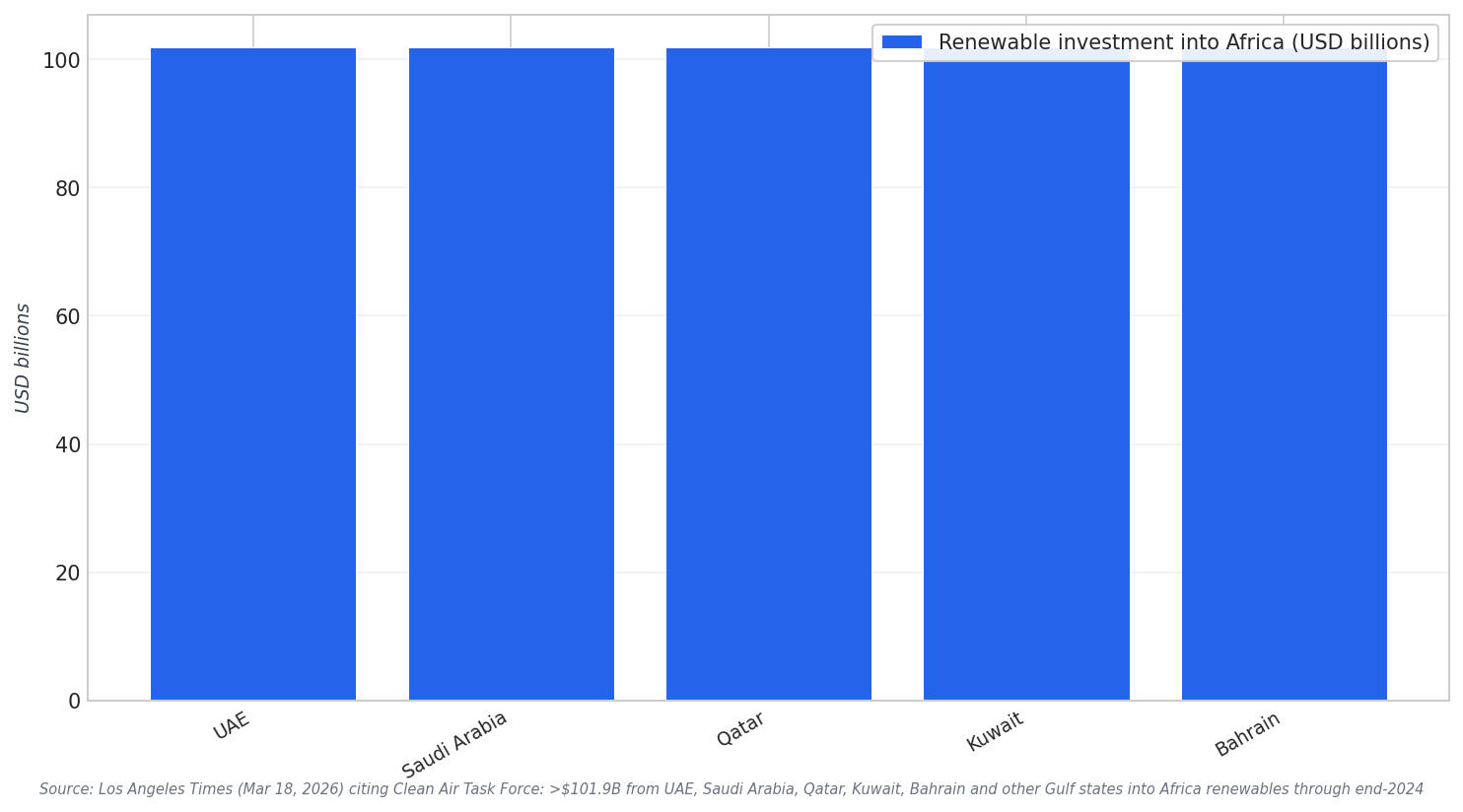
The pivot is also leaving the Gulf through capital flows into clean energy abroad. A Clean Air Task Force report cited by the Los Angeles Times found that more than $101.9 billion had flowed into Africa’s renewable energy sector from the United Arab Emirates, Saudi Arabia, Qatar, Kuwait, Bahrain, and other Gulf states through the end of 2024. The same reporting noted that much of the funding went to North Africa, Southern Africa, and parts of East Africa, while West Africa attracted relatively limited funding. This is diversification by geography as well as technology, aimed at positioning for “the energy systems of the future.”
Gas and LNG: The Bridge That Becomes a Portfolio
Gas is a core pillar in the Gulf portfolio rebuild. Reuters reported Saudi Aramco’s long-term ambition for LNG capacity of 20 million tons per annum (mtpa). The same report compared regional targets and capacity: Qatar has 77 mtpa, expected to reach 142 mtpa by 2030, while ADNOC targets 20 to 25 mtpa by 2035. Aramco is also tying that ambition to project execution. It announced around $26 billion worth of contracts for Jafurah’s first two phases since 2018, as it works on unconventional shale gas development supported by bespoke approaches, from treated seawater injection to ultra-strong drill bits.
Geopolitics is accelerating the case for optionality. During the conflict described by Bloomberg, the Strait of Hormuz was shut soon after late February, pushing Riyadh to activate a cross-country pipeline to the Red Sea coast. Exports were described as around 5 million barrels a day, or about 70% of the kingdom’s total prewar levels. Meanwhile, Oil & Gas 360 described how prolonged instability reshapes capital decisions, noting estimates pointing to a billion-barrel disruption tied to the Strait of Hormuz. In this environment, national oil company energy diversification becomes a practical risk tool, not only a branding line.
What does “national oil company energy diversification” mean in the Gulf context?
Which Gulf NOC earnings figures show resilience in 2025?
How much Gulf capital has flowed into Africa’s renewable energy sector?
What LNG capacity targets are stated for Qatar, Aramco, and ADNOC?