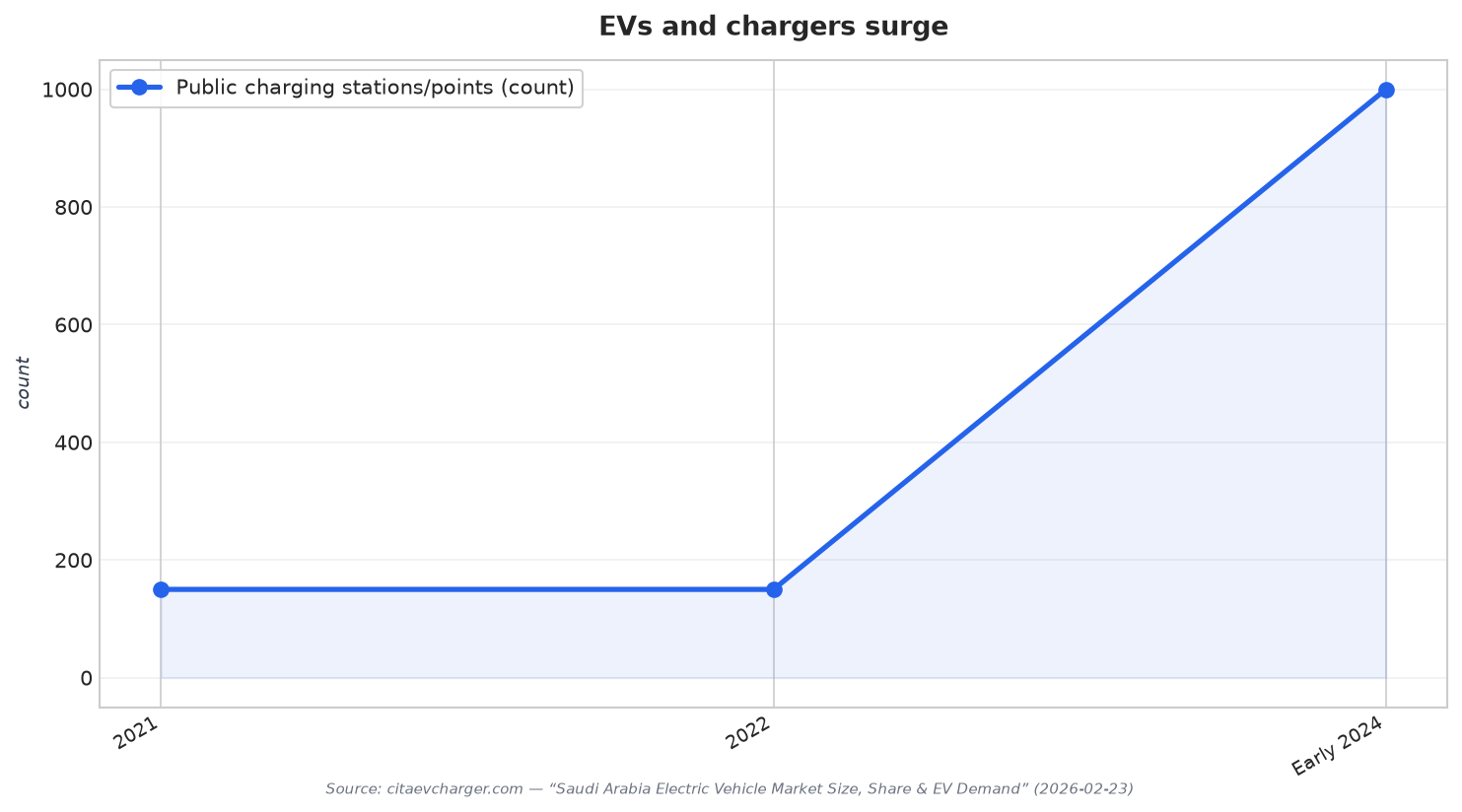
Saudi Arabia’s push into electric mobility is no longer only about selling imported EVs. It is about building an industrial base that can design, engineer, assemble, and eventually localize more of a vehicle’s value. The numbers behind adoption help explain the urgency. The Saudi Ministry of Investment reported a 425% increase in EV registrations between 2021 and 2023, rising from 375 EVs on the road in 2021 to over 12,000 by the end of 2023. Meanwhile, public charging stations grew from 150 in 2022 to over 1,000 by early 2024, and the network reached 2,803 public charging points as of early 2026.
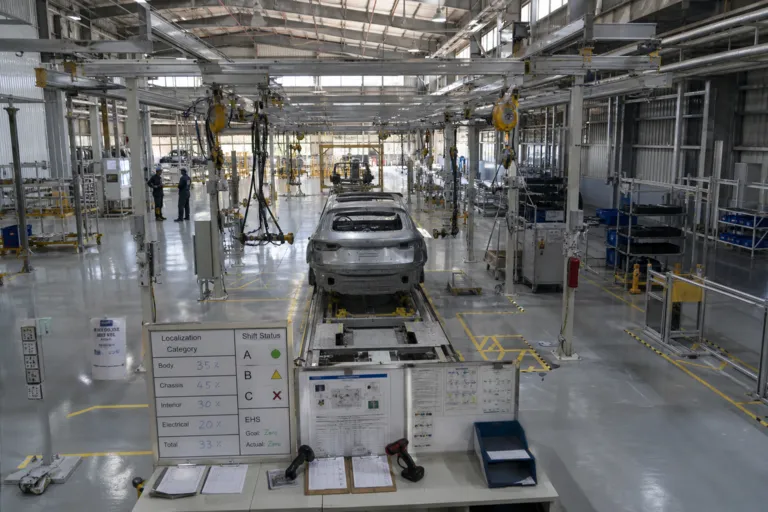
Factory plans are scaling alongside the charging rollout. Arab News reported Saudi Arabia is targeting up to 300,000 units of annual EV production capacity by 2030, with Ceer and PIF’s majority stake in U.S. EV maker Lucid described as central to that plan. Mordor Intelligence also frames the manufacturing backbone around three anchors: Lucid’s AMP-2 plant, Ceer’s 1 million m² complex, and the Hyundai–PIF joint venture at King Abdullah Economic City (KAEC). This is where the story of Saudi EV manufacturing becomes practical: the question is not only whether factories exist, but whether they translate into consistent output and deeper supply chains.
Ceer vs. Lucid: One Investor, Two Mandates
Ceer is Saudi Arabia’s first homegrown EV brand, majority-owned by the Public Investment Fund (PIF) and launched in November 2022 as a venture with Foxconn. Rest of World reported Ceer revealed two models on September 21, with deliveries promised for March 2027, and said the EVs were designed and engineered in Saudi Arabia and will be built at Ceer’s plant in KAEC north of Jeddah. At launch, Ceer’s CEO said production will begin early next year, after an earlier target of 2025 for its first cars. Ceer also set a localization aim to make almost half the components of its cars locally by 2034.
Lucid is the parallel bet, but with different risks. Rest of World reported PIF has put about $8 billion into California-based Lucid and holds about 58% of the company. It also noted Lucid’s market value has shrunk to about $1.6 billion, and described operational steps including cutting about a fifth of its U.S. workforce, ending its second production shift in Arizona, and recalling 27,000 sedans over a fire risk. In Saudi Arabia, Lucid’s sales fell 57% in the first seven months of 2026, while BYD’s rose 369% over the same period, according to estimates cited by the same report. The rivalry is awkward because Ceer’s first Exobot products were positioned as high-powered premium EVs, a segment adjacent to Lucid’s Air and Gravity.
The Kingdom is also building demand-side and infrastructure conditions meant to support local output. One source cites a $20 billion government investment package targeted at EV infrastructure development through 2030. Another says the Saudi Electricity Company plans to install an additional 3,500 charging points across 1,000 locations by the end of 2025, representing an investment of SAR 500 million ($133 million). Separately, the EV market report for 2026 references a push toward 5,000 fast chargers and 30,000 total charging points by 2030, and a Vision 2030 target of 30% of vehicles in Riyadh running on electric power, backed by a 10-year government commitment to purchase up to 100,000 Lucid vehicles. Together, these measures set the test: can industrial capacity, charging access, and customer trust rise at the same pace?
What is Saudi Arabia’s EV production capacity target by 2030?
When are Ceer’s first vehicles expected to reach customers?
How does Ceer plan to localize its supply chain over time?
What do recent figures suggest about the wider Saudi EV manufacturing environment?