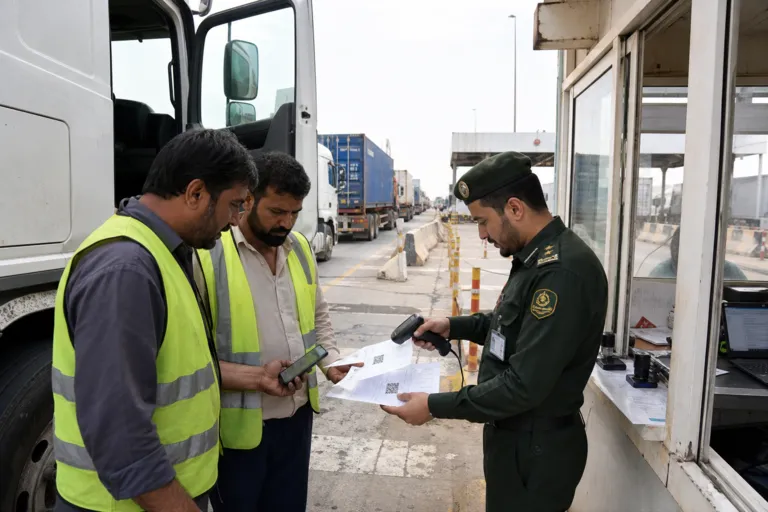
Customs delays inside the GCC have “always been an impediment to truck movements,” and they become more painful when traffic is forced onto road corridors that link ports to inland markets. A recent logistics shift has highlighted the real cost of bottlenecks at borders, where delays can stack up for drivers, forwarders, and time-sensitive cargo. In this environment, customs digitalization Saudi Arabia matters because it targets the friction points that slow movement: paperwork, visibility, and inconsistent clearance processes that ripple across the region’s connected supply chains.
One clear example of why corridors matter is Highway 95. It runs from the Saudi-Qatari border crossing at Salwa through the Shaybah oilfield and the Empty Quarter into Oman at the Ramlet Khelah border crossing point, which opened in January 2023. From there, it links via Ibri to Gulf of Oman ports like Sohar and Muscat, and Arabian Sea ports like Duqm and Salalah. The route is popular not only because it is shorter, but because it can cut out often 24-hour delays at UAE-Saudi border crossings that no longer need to be traversed.
Trade volumes on the new crossing also show how quickly freight can pivot when time savings appear. The value of goods crossing through Ramlet Khelah nearly trebled to $830m in March, from $300m in February. That surge underlines a simple freight reality: when borders flow, shippers follow. The challenge is making that flow reliable across more lanes and more stakeholders. Digital tools and harmonized procedures can help by reducing manual documentation cycles and improving certainty for operators planning routes between Saudi Arabia and Omani ports.
What Digital Customs Corridors Look Like in Practice
In Saudi Arabia, private-sector tools are also aligning with the push for faster clearance. FedEx highlighted the launch of its FedEx Import Tool (FiT) in Saudi Arabia, describing it as a digital platform designed to simplify the import process by providing real-time visibility and centralized documentation. FedEx said that by automating and centralizing these elements, the tool facilitates faster customs clearance. The same webinar emphasized how data and AI support early disruption identification, better routing and inventory decisions, and simplified compliance for global trade requirements.
Government platforms are moving in the same direction. Saudi Arabia’s minister of industry and mineral resources announced the launch of a digital services platform for exporters by the Saudi Export Development Authority. The platform will unify government export services under a single digital umbrella, with the stated aim of streamlining the exporter’s journey and accelerating the growth of national exports. For GCC freight, that kind of single-window logic supports corridor speed by lowering process variation, reducing repeated submissions, and helping exporters coordinate requirements before cargo hits a border.
Trade reforms also influence corridor performance by changing the economics of cross-border movement. On May 20, the GCC signed a comprehensive Free Trade Agreement with the United Kingdom, removing a further raft of customs duties and tariffs, and it was expected to ease tariff barriers within the GCC as well. Separately, Saudi-UK trade was reported at $21.6 billion in 2023, with a shared target of $37.5 billion by 2030. As trade lanes grow, the case strengthens for customs digitalization Saudi Arabia to keep pace with higher volumes and more complex, time-sensitive regional routing.
What does “customs digitalization Saudi Arabia” mean in GCC freight terms?
Which route is reducing exposure to long border waits?
What evidence shows the new corridor is attracting freight?
How can AI and data support customs and compliance?
How do broader trade reforms connect to customs speed?