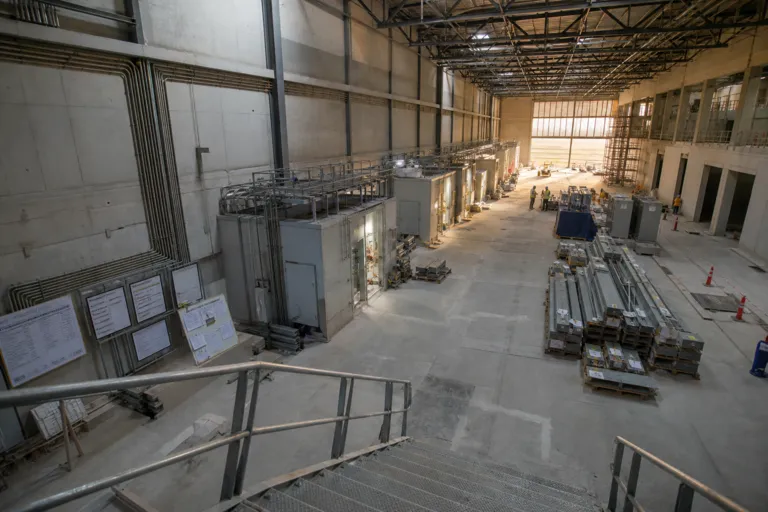
Across the GCC, the construction wave around data centres is being driven by data and AI infrastructure that has become national policy in Saudi Arabia and the UAE. In this environment, facilities are no longer described as peripheral IT assets. They are being built to gigawatt scale, including 10-square-mile campuses, with power demands that rival small cities. That shift changes what “good delivery” means for Gulf contractors. It is less about standalone building works and more about sequencing, interfaces, and proving performance under power and cooling constraints that can decide whether projects move from announcement to execution.
The pipeline is also too large to treat as a handful of showcase projects. MEED’s GCC Data Centre Projects Market 2026 tracks 174+ major active and planned projects across Saudi Arabia, the UAE, Qatar, Oman, Kuwait and Bahrain, with a combined value of more than USD 93bn. A separate industry view frames the same challenge as an “execution problem,” arguing the USD 93bn buildout will be won or lost on the critical path rather than on capital. For contractors, that implies that coordination between design, construction, commissioning, and operations is not optional; it is the delivery differentiator as schedules tighten.
What “Gigawatt-Scale” Means on Site: Interfaces, Not Icons
Landmark projects illustrate why delivery capacity matters. In Abu Dhabi, the Stargate initiative involving G42 with OpenAI, Oracle, NVIDIA, and others is building toward a multi-gigawatt AI campus, with the first 200 MW slated to come online in 2026. In Saudi Arabia, Oracle has committed USD 1.5 billion to expand cloud infrastructure, including the opening of its second public cloud region in Riyadh. At the policy-and-capital level, Saudi Arabia’s PIF has committed up to USD 100 billion to Project Transcendence, and Google has committed between USD 5 billion and USD 10 billion to AI projects in the Kingdom under that initiative. These programmes put intense pressure on contractors to integrate civil, MEP, and commissioning scopes without handoff friction.
Regulation and localisation also reshape contracting requirements, because compliance is becoming a demand engine. Saudi Arabia’s Data Centre Services Regulations require operators to register with the national commission, while localisation mandates across banking, healthcare, energy, and government are pushing enterprises toward in-country colocation and private facilities. In the UAE, Du’s AI Park in Warsan is designed to function as a sovereign AI hub that complies with UAE national AI data and security policies, and Du signed a USD 544.54 million deal with Microsoft in April 2025 to develop a separate hyperscale data centre in the UAE, with Microsoft as the primary tenant. In Qatar, sovereign AI cloud ambitions are described as scaling past 120 MW, while the Birkat Al Awamer logistics zone is a 9.4 million square metre industrial park attracting digital and AI infrastructure investment.
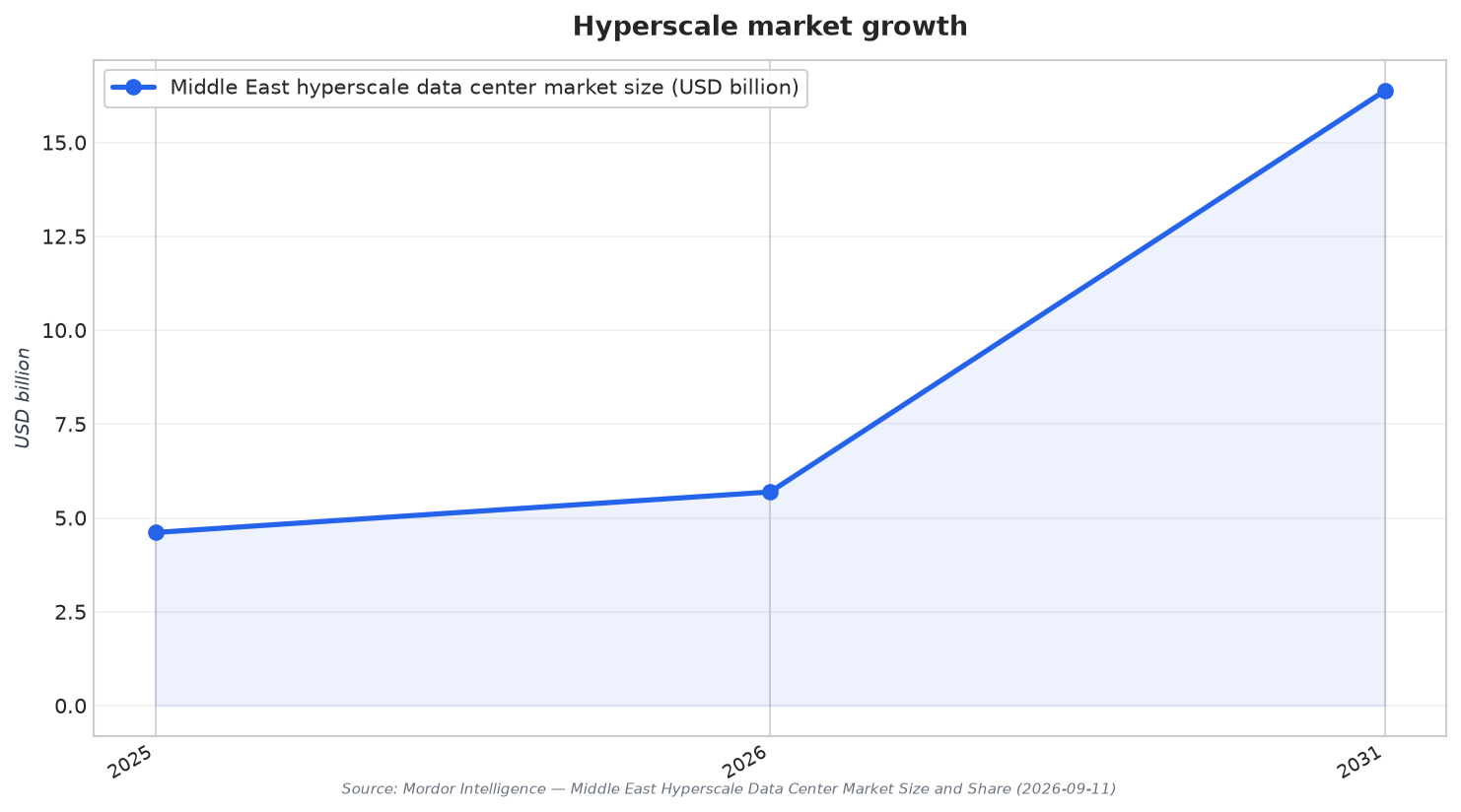
Market indicators underline why contractors cannot treat these builds as conventional. Mordor Intelligence projects the Middle East hyperscale data center market at USD 5.69 billion in 2026, reaching USD 16.38 billion by 2031, and notes production volume expected to grow from 2.16 thousand megawatt in 2026 to 27.63 thousand megawatt by 2031. It also reports Tier III captured 75% of the Middle East hyperscale data center market size in 2025, and hyperscale colocation led with 62% revenue share that year. In Saudi Arabia, a National Data Center Strategy unveiled in June 2025 targets up to 1.5 gigawatts of data center capacity by 2030, implying USD 4–6 billion in construction expenditure over five years. For GCC data center construction, the practical contractor takeaway is simple: execution capacity, power-ready delivery, and end-to-end ownership of the critical path are becoming the core product.
How large is the GCC data centre project pipeline by value and project count?
What capacity milestone is Saudi Arabia targeting under its National Data Center Strategy?
What is the near-term milestone for the Stargate initiative in Abu Dhabi?
Which facility tier dominated the Middle East hyperscale market in 2025?
What does the GCC data center construction “critical path” problem mean for contractors?