Indonesia’s housing push is designed to run at high volume. One framing used in market reporting is an annual target of three million construction and renovation interventions, and another is split into 2 million rural houses and 1 million urban apartments per year. Both views underline the same point: the initiative is meant to be industrial in rhythm, not incremental. It also lands in a market where demand pressure remains visible. BPS reported 82.38% of households lived in owner-occupied dwellings in 2025, while the national ownership backlog was cited near 9.9 million units in one 2025 reference and about 9.29 million households in 2026, down around 350,000 from 2025.
Price and location dynamics add context for where new supply may concentrate. Bank Indonesia monitors primary residential prices across 18 cities, reflecting what one report described as a multi-city development structure. It also noted that Greater Jakarta satellite cities attract households seeking lower land costs. In Q4 2025, the national Residential Property Price Index (RPPI) rose 0.83% year-on-year, which was described as supportive of volume-led suburban expansion. For construction and materials companies, that kind of demand migration matters because it changes logistics, land development needs, and the economics of standardized housing formats.
Prefabrication, Automation, and the Capacity Gap
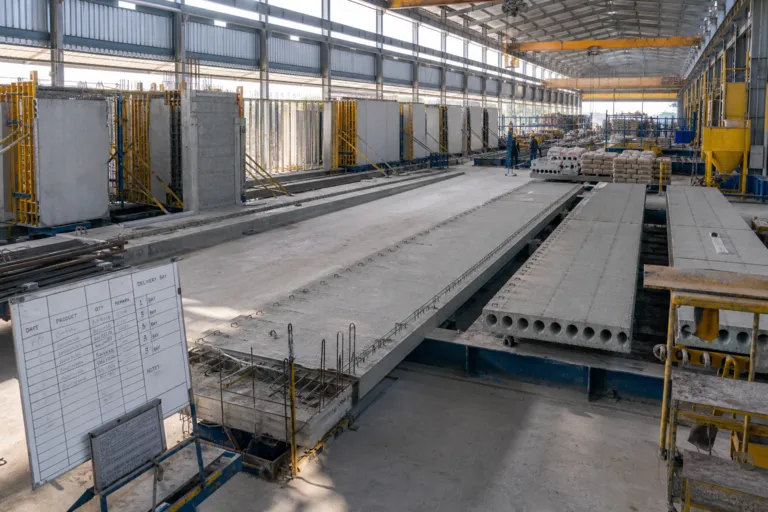
The big constraint is production capacity. A Scientific Reports study described the national housing backlog as reaching 40% of national demand, alongside population growth of 1.1% and an annual house deterioration rate of 2%. It also emphasized a “large gap” between a three million homes per year target and actual capacity on the ground, arguing mass housing at this scale cannot rely on craft-based, labor-intensive, on-site approaches. This is where prefabrication and automation become less like optional innovation and more like a throughput requirement, especially if standardization is expected to compress cycle times and simplify delivery across multiple regions.
Multiple market studies show prefabrication is already positioned to ride the demand curve. One forecast valued Indonesia’s prefabricated buildings market at USD 8.0 billion in 2024, projecting USD 13.23 billion by 2032 at a 6.5% CAGR (2026–2032). Another analysis estimated growth from USD 8.38 billion in 2025 to USD 8.99 billion in 2026, reaching USD 12.73 billion by 2031 at a 7.22% CAGR (2026–2031). That same analysis tied momentum to clearing a 9.9 million-unit housing backlog and stated concrete held 47.55% share in 2025, residential applications 54.65%, and modular buildings 50.60% of revenue, with Jakarta at 21.85% share in 2025.
The upside for a broader construction-and-materials wave depends on financing and delivery mechanics as much as demand. One residential market report said developer construction was 80.14% internally funded, adding working-capital pressure, while bank partnerships were described as critical because housing loans dominate consumer financing. On the construction side, Mordor Intelligence valued Indonesia’s construction market at USD 329.4 billion in 2026 and forecast USD 466.9 billion by 2032, while also stating new construction represented 79.02% share in 2026. In practice, programs and execution still matter: on October 1, 2026, the housing ministry reported Himperra had realized more than 22,000 subsidized homes against a 47,000-home target under the FLPP subsidized-mortgage program—an example of how quickly targets translate into measurable supply-chain pull.
What is the annual target behind Indonesia’s 3 million homes program?
How large is Indonesia’s housing ownership backlog in recent sources?
What does the Q4 2025 RPPI figure suggest about housing market conditions?
Which prefab segments were largest in 2025, according to one market analysis?
What financing friction could affect delivery of large housing targets?