Riyadh’s World Expo plan is moving from preparation into a more visible building cycle. Saudi Arabia won the bid on November 28, 2023, after receiving 119 votes, compared with 29 for Busan and 17 for Rome. The event is scheduled to run from October 1, 2030 to March 31, 2031. Multiple sources describe a purpose-built Expo site to the north of Riyadh, adjacent to the future King Salman International Airport, with direct links to the Riyadh Metro. The program scale is anchored by a pavilion count of 226 and participation of over 195 nations, framing why the market is watching the transition into the pavilion phase so closely.
The shift matters because the contracting mix is changing. Early awards focused on program management, design, earthworks, utilities, and core infrastructure. Bechtel was appointed as project management consultant for the overall program, and Buro Happold was appointed lead design consultant for detailed master planning and for public realm, landscape, infrastructure, and utilities design. The Expo 2030 Riyadh Company has broken infrastructure into phased packages. In December 2025, the Main Utilities and Infrastructure Works package went to Nesma & Partners, covering roads, water and sewage networks, EV charging stations, and electrical and communications systems across about 50 kilometers. That sequence sets the platform for the next, more contractor-intensive wave: vertical works tied to pavilions, hospitality, transport interfaces, and specialist systems.
Why the Pavilion Phase Signals the Next Award Cycle
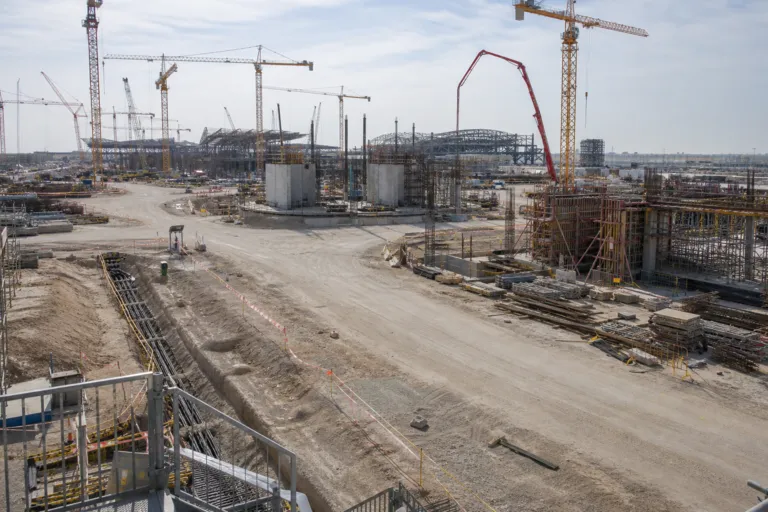
Groundbreaking for the pavilion construction program is scheduled for mid-2026, around four years before the October 2030 opening. The Q3 2026 milestone is also positioned as the start of construction for key buildings including the Saudi Pavilion and the Iconic Pavilions. In parallel, site preparation has already advanced: more than 1.5 million square meters have been leveled, representing 25% of the total Expo site area, according to comments reported by Argaam. This is why the market narrative is turning to Expo 2030 Riyadh construction readiness: enabling works and infrastructure packages are now directly feeding schedules for above-ground structures, where procurement volumes typically rise.
For international and local firms, the pavilion program is also structurally different from the first wave. Self-built pavilions are assembled by the participating country’s chosen contractors, drawing on international specialists alongside local Saudi and expatriate labor. Rented-space structures are delivered by contractors engaged by the Expo company, described as primarily Saudi and regional construction firms with large-scale building experience. This split can widen the vendor universe and create multiple entry points across architecture, engineering, construction, fit-out, and specialist services. Some major national pavilions may need 30 to 36 months from groundbreaking to completion, which compresses decision timelines and increases the importance of early procurement discipline.
The new wave is also tied to the project’s legacy case. The Expo site is described as spanning 6 million square meters, with post-event transformation plans into a “Global Village,” positioned as a permanent hub for innovation, knowledge exchange, and cultural engagement. ERC, which MEED says is wholly owned by PIF, expects the construction phase and legacy development to contribute around $64 billion to Saudi GDP and generate about 171,000 direct and indirect jobs, with the live event contributing a further $5.6 billion. Sources also state Saudi Arabia set aside $7.8 billion for the event in 2023. With packages expected to come to market through 2027, the pavilion phase is less a standalone build and more a trigger point for broader contracting momentum.
When does pavilion construction for Expo 2030 in Riyadh start?
How far has site preparation progressed on the Expo 2030 Riyadh site?
Which major infrastructure contract has been awarded so far?
What does the pavilion phase mean for Expo 2030 Riyadh construction contracting?
What economic impacts are stated for the construction and legacy development phase?