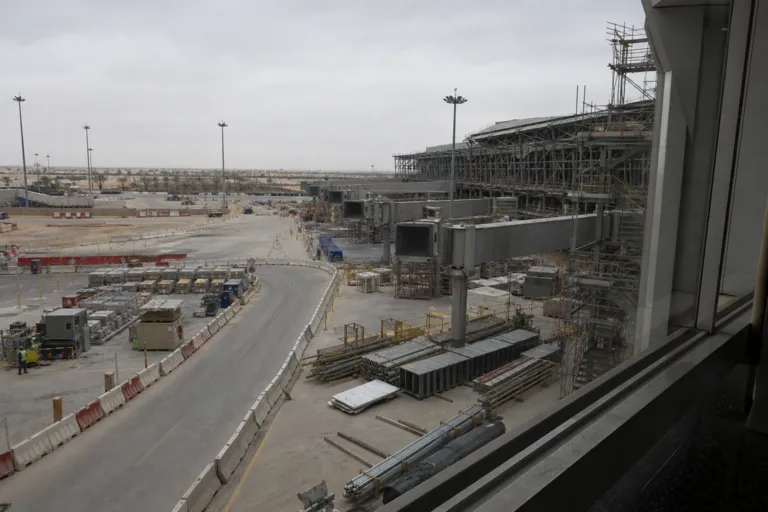
King Abdulaziz International Airport (JED) is not a normal growth story. It is Saudi Arabia’s primary air gateway for Hajj and Umrah travel to Mecca and Medina, and it is also a high-volume commercial hub. In 2025, the airport handled 53.4 million passengers, a national record, and accounted for 38% of all passenger traffic in the Kingdom. That pace shows up in day-to-day operations: the airport averaged roughly 146,000 travellers per day and processed more than 310,000 aircraft movements in 2025. Saudi authorities have also acknowledged current infrastructure is running at roughly 107% of designed capacity, making delivery speed and operational continuity central to every scope decision.
For contractors and suppliers, the expansion narrative is increasingly defined by measurable demand signals inside the terminal and airside system. Baggage volumes reached 60.4 million pieces in 2025, up 12% on 2024, and early 2026 indicators point to further growth. January 2026 alone saw 5.45 million passengers, up 7.3% year on year, while flight movements rose 11% to 29,200. The 2019 opening of Terminal 1—developed as a public-private partnership with Jeddah Airport Company (JEDCO)—created a modern baseline, with an initial capacity of 30 million passengers annually and design provisions for expansion to 80 million by 2035. The next works therefore land on an operating airport already under stress and must be planned as “build while running,” not “build then open.”
Where the Next Wave of Procurement Will Land (2026–2028)
Jedco has now put a public marker down on timing and structure. The company is planning to bring six large contractor opportunities to market between 2026 and 2028, using a six-package approach to phase delivery and match specialized contractors to distinct categories of airport infrastructure. The stated targets cover terminal capacity, runway operations, landside access, and baggage handling systems. For the supply chain, that packaging matters as much as the budget headlines, because it shapes qualification strategies, local partnerships, and procurement sequencing. It also gives lead time for mobilization and project delivery planning, which is critical on an airport whose peak six-week throughput can rival the annual traffic of mid-sized European airports.
Suppliers should also read the expansion through the lens of national targets and systems integration. Saudi Arabia’s National Aviation Strategy targets 330 million passengers annually by 2030, connectivity to more than 250 destinations, and 4.5 million tonnes of annual air-cargo capacity, backed by approximately $100 billion in government and private-sector investment across the aviation ecosystem. While those are national figures, they explain why procurement is not limited to concrete and steel. Opportunities flagged across the sector include air-traffic systems, ground infrastructure, digital check-in, biometrics, baggage handling, and cybersecurity—categories that align directly with the KAIA packages focused on throughput and processing efficiency.
The Jeddah airport expansion story also includes logistics and surface connectivity, which changes what “airport scope” means for vendors. Saudi airport expansion coverage notes that Jeddah’s cargo facilities have been expanded with cold-chain and e-commerce fulfilment capabilities, supporting the airport’s role as a logistics gateway for the western region. Ground-transport connectivity has also been enhanced via integration with the Haramain High-Speed Railway, linking the airport directly to Makkah, Madinah, and King Abdullah Economic City. For contractors, that raises the value of interface management, staging, and systems commissioning. For suppliers, it increases demand for equipment and services that keep passenger and cargo flows stable during construction, especially where terminal, baggage, road, rail, and security systems meet.
What is driving the next phase of works at King Abdulaziz International Airport?
When will the biggest contractor opportunities be tendered?
Which scopes are most relevant for contractors and suppliers in this expansion?
How does the Jeddah airport expansion connect to Saudi Arabia’s national aviation targets?
What logistics and connectivity upgrades matter for suppliers around the airport?