Two of the world's major growth regions are developing an economic relationship that could reshape cross-regional trade, investment and business expansion over the next decade.
ASEAN–Africa merchandise trade reached US$59 billion in 2024, more than eight times its level in 2000. Yet the corridor accounts for only 0.2% of global merchandise trade, highlighting considerable potential for deeper economic integration.
Beyond trade volumes, companies are establishing local production, developing integrated value chains and building regional business platforms.
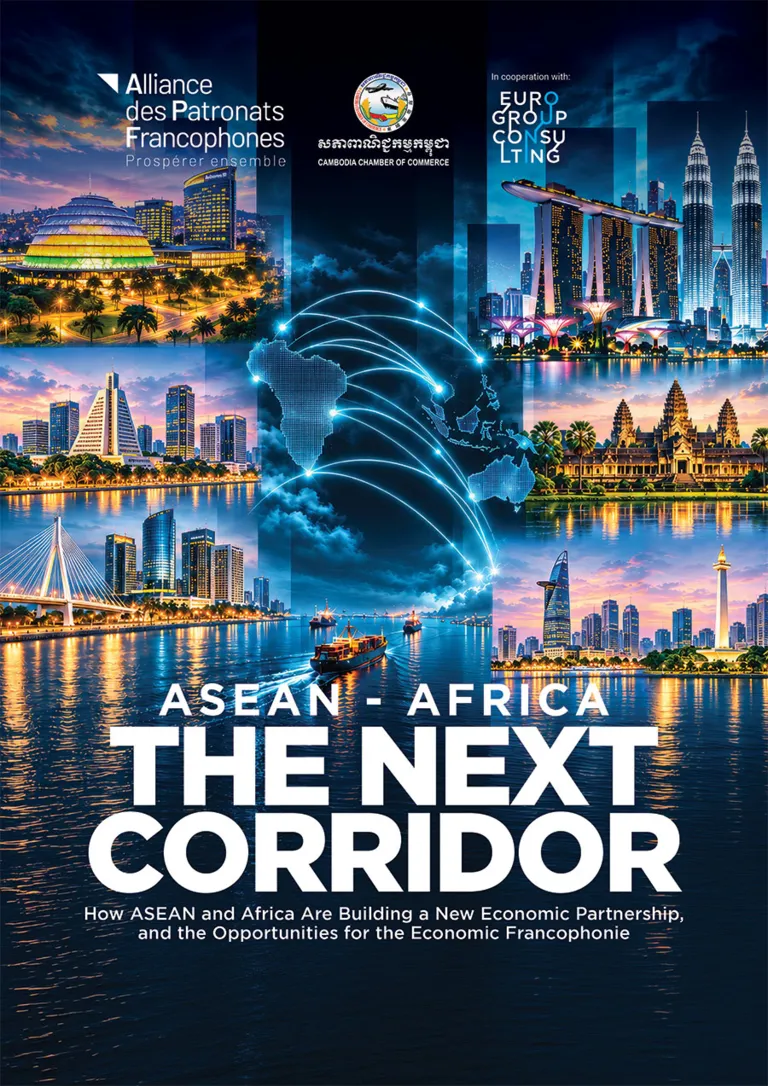
ASEAN–Africa: The Next Corridor | How ASEAN and Africa Are Building a New Economic Partnership, and the Opportunities for the Economic Francophonie, developed by the Alliance des Patronats Francophones and the Cambodia Chamber of Commerce in cooperation with Eurogroup Consulting, examines the investment opportunities, sector dynamics and strategic shifts shaping this emerging economic partnership through 2035.
The whitepaper was launched on 14 November 2026 at the Rencontre des Entrepreneurs Francophones (REF) 2026 in Phnom Penh, Cambodia. Co-organised by the Alliance des Patronats Francophones and the Cambodia Chamber of Commerce, this sixth edition of the annual meeting of Francophone business leaders is the first to be held in Southeast Asia.
Why Is ASEAN–Africa Becoming a Strategic Growth Corridor?
Africa's resource base, youthful demographics and industrial development needs complement ASEAN's manufacturing ecosystems, processing capabilities and international business networks. Yet commercial integration remains limited:
- 2.2 billion people: Africa and Southeast Asia together combine complementary resources, industrial capabilities and expanding consumer markets.
- 4.1%: Only this share of Africa's merchandise exports goes to ASEAN.
- 1.7%: Africa receives just this share of ASEAN's merchandise exports.
- A more balanced relationship: In 2024, ASEAN exported US$32.7 billion to Africa and imported US$26.3 billion, narrowing the export-to-import ratio from 2:1 in 2000 to approximately 1.2:1.
For businesses exploring international expansion, these figures reveal an established but still underdeveloped commercial relationship with opportunities to diversify supply chains, expand market access and strengthen industrial partnerships.
Could ASEAN–Africa Trade Reach US$112 Billion by 2035?
The whitepaper examines three potential trajectories for ASEAN–Africa economic integration.
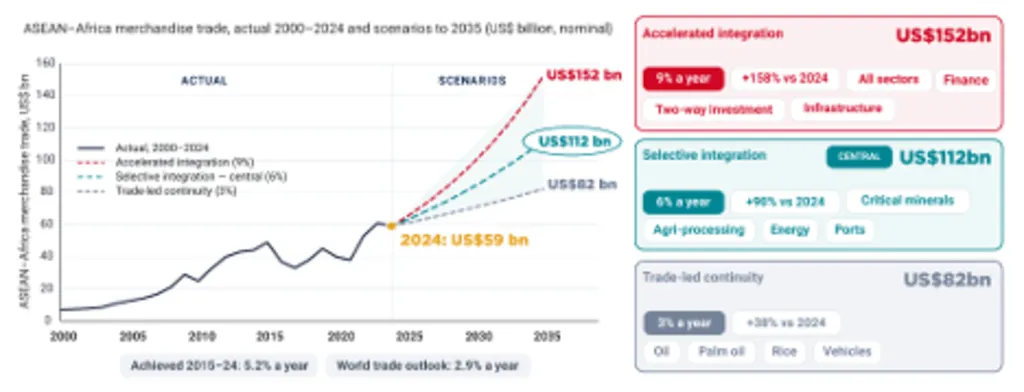
Under its central selective integration scenario, merchandise trade could reach US$112 billion by 2035, representing approximately 90% growth compared with 2024.
Achieving this trajectory would require annual growth of around 6%, supported by stronger industrial partnerships, local production and improved regional market access.
The opportunity extends beyond higher trade volumes. Companies could progressively shift from exporting finished products toward establishing production capabilities and building long-term investment positions.
For decision-makers, the priority is identifying where cross-regional integration can create sustainable competitive advantages.
Seven Value Pools Shaping Cross-Regional Investment
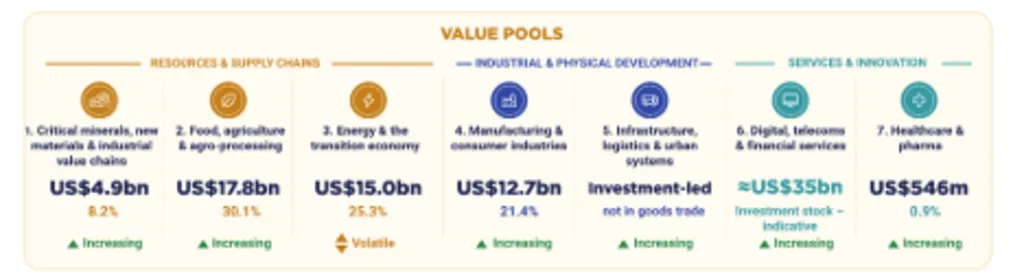
The corridor's commercial potential spans seven priority value pools across resources, industrial development and services.
Three established sectors account for approximately 77% of merchandise trade: food, agriculture and agro-processing (US$17.8 billion), energy (US$15.0 billion) and manufacturing and consumer industries (US$12.7 billion).
Critical minerals and new materials represent another US$4.9 billion, linking African resources with Southeast Asian processing and manufacturing capabilities.
Other opportunities are increasingly investment-led, including infrastructure and logistics, digital and financial services, and healthcare and pharmaceuticals.
Investment is already strengthening these connections. ASEAN's direct investment stock in Africa was estimated at approximately US$30–35 billion at the end of 2024, led by Singapore and Malaysia.
These sectors offer distinct pathways to growth, from established trading relationships to technology transfer, local manufacturing and long-term operating partnerships.
What Does the Shift Beyond Trade Mean for Businesses?
The corridor's next phase is increasingly defined by how companies operate, rather than simply what they export.
The whitepaper identifies five emerging structural shifts:
- From exports to local production: ASEAN companies are building industrial positions in African markets.
- From commodities to integrated value chains: African production is increasingly connected with ASEAN processing capabilities and markets.
- From concentrated Asia–Africa ties to a more diversified Asian footprint: ASEAN is emerging as an additional economic partner for Africa, offering capabilities that complement China's scale.
- From bilateral markets to regional platforms: Shared business networks allow companies to serve multiple markets at once.
- From opportunistic deals to organised business ecosystems: Business relationships are moving beyond introductions and missions towards mechanisms that can originate, finance and execute transactions.
What this means for businesses:
- Opportunities: stronger supply chains, more processing value captured locally and multiple markets served through coordinated operating networks.
- Challenges: regulatory requirements, financing, infrastructure reliability and partner selection in unfamiliar markets.
- Key decision: whether exporting, strategic partnerships, local production or regional platforms offer the strongest commercial proposition.
Turning Economic Potential Into Commercial Opportunities
The emergence of the ASEAN–Africa corridor presents significant opportunities, but stronger economic connections will not automatically translate into profitable investments.
Successful expansion requires reliable market intelligence, credible commercial partners, appropriate financing structures and operating models adapted to local conditions.
Francophone business networks can contribute by connecting companies, investors and institutions across Africa, Southeast Asia and Europe. Their long-term value will depend on translating these connections into concrete projects and sustainable partnerships.
Drawing on quantitative trade analysis, company examples and interviews with business leaders, the whitepaper examines how companies can position themselves within this evolving economic landscape.
Download the full whitepaper "ASEAN–Africa: The Next Corridor" to explore the seven value pools, five emerging business shifts, regional gateways and six strategic enablers shaping ASEAN–Africa economic cooperation through 2035.