Saudi Arabia’s logistics buildout is turning “location” into an operating advantage. The national logistics market increased from USD 55.29 billion in 2025 to USD 57.88 billion in 2026, and is expected to reach USD 83.41 billion by 2034 at a 4.67% CAGR from 2026-2034. Within that expansion, special zone models near ports and airports are reshaping how operators plan flows, contracts, and compliance. One example is the Special Integrated Logistics Zone (SILZ) near Riyadh’s King Khalid International Airport, positioned around streamlined import-export operations and regional distribution. These zone mechanics change the playbook because they pull customs, storage, and handling into a single, engineered process.
For operators, bonded and duty-suspended logic is becoming central, not optional. The SILZ in Riyadh is described as spanning 32 million ft² and offering duty-deferred storage with automated clearance that can push average e-parcel customs release times below two hours. Another reference also describes SILZ as offering a 50-year tax holiday and 4-hour customs clearance. These conditions can turn an airport-adjacent facility into a high-velocity distribution and light-processing platform rather than a pure transit point. That shift matters because it changes service design: operators can stage inventory in a compliant footprint, trigger release with faster clearance, and support re-export patterns without forcing every step into a mainland structure.
What Changes in the Operator Playbook Inside Bonded Zone Rules
Rules and incentives also reshape who can operate and how quickly they can start. An Integrated Logistics Special Bonded Zone (ILBZ) framework states that non-resident merchants can conduct logistics activities and store goods without needing a Saudi Commercial Registration (CR) or a mainland permanent establishment. The same framework describes a 50-year tax holiday and states 0% VAT on simple manufacturing, with exemptions maintained when goods are exported outside the Kingdom or moved to another bonded zone. For 3PLs, that can simplify onboarding for international shippers and enable postponement-oriented workflows that rely on bonded storage and re-export. It also supports multi-client setups where operators monetize shared, compliant infrastructure rather than building one-shipper facilities.
The market indicators around warehousing show why zone-led models are moving from pilot to scale. One analysis tracks the Saudi Arabia 3PL warehousing market at USD 3.53 billion in 2025, estimated to grow from USD 3.74 billion in 2026 to USD 4.94 billion by 2031. Storage led with a 60.21% share in 2025, while bonded warehousing is identified as the fastest-growing warehouse type with a projected 7.72% CAGR through 2031. Central Saudi Arabia held 42.5% of the market in 2025, aligning with Riyadh’s consolidation role. In November 2025, DHL Supply Chain signed a strategic land lease with SILZ to build a EUR 130 million (USD 150.25 million) hub with 53,000 m² of multi-user warehouse space, a configuration that fits duty-suspended, multi-shipper demand.
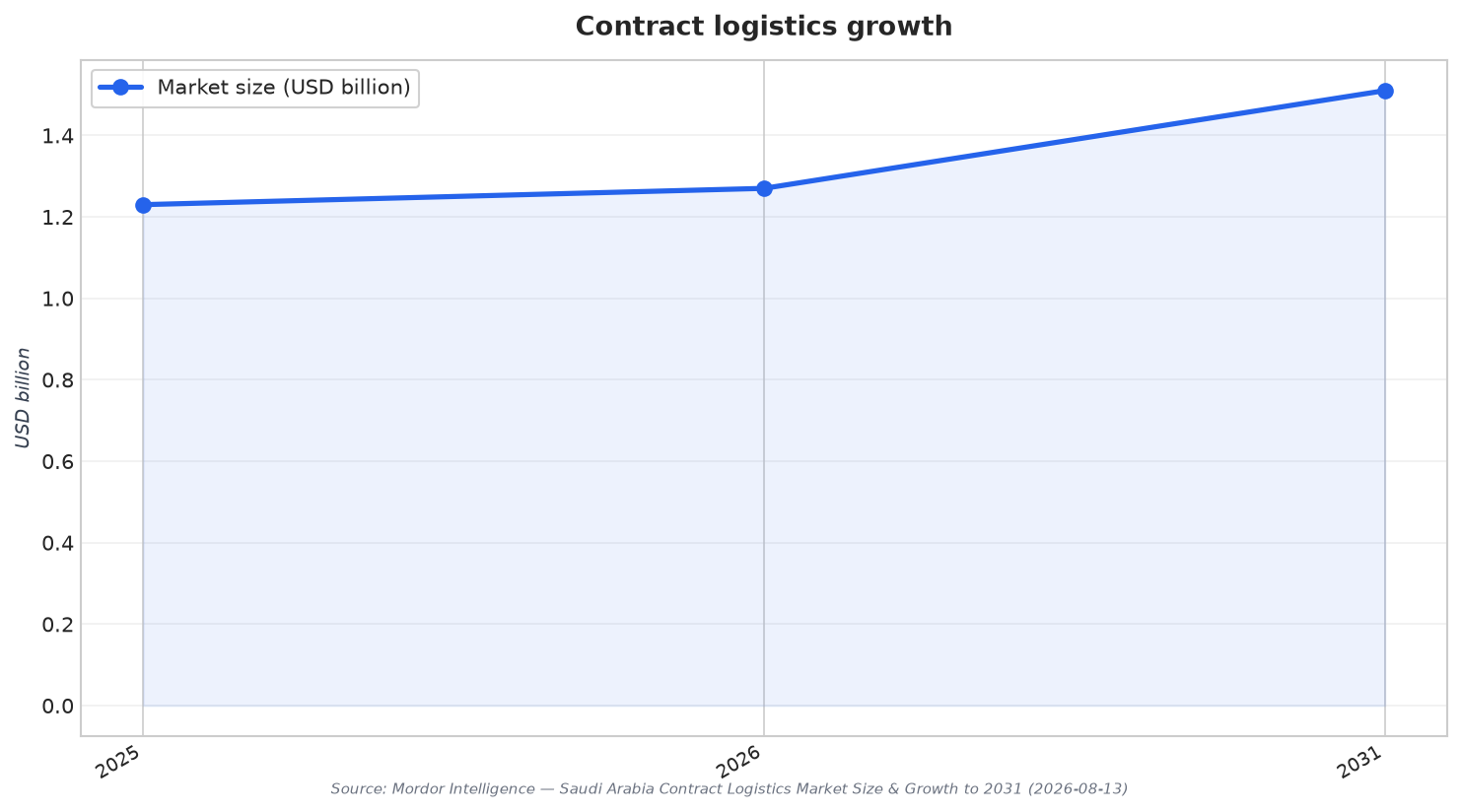
Ports and inland corridors add another layer: the zone is increasingly the “switching yard” that converts infrastructure into throughput. Saudi Arabia operated 23 activated logistics centres spanning approximately 34.6 million m², and the Makkah Region alone accounted for around 20.4 million m² across six centres tied to Red Sea gateways. Operational momentum is visible in port activity too: in September 2025, Saudi ports handled 22.52 million tonnes of cargo, an 8.6% increase year-on-year. Against this backdrop, the Saudi contract logistics market was valued at USD 1.23 billion in 2025 and is estimated to grow from USD 1.27 billion in 2026 to USD 1.51 billion by 2031 at a 3.52% CAGR. Transportation captured 64.30% share in 2025, but value-added work is building, reinforcing why Saudi special logistics zones are becoming the place where inventory, customs, and handling are designed as one system.
How are Saudi Arabia’s special logistics zones changing 3PL operations?
What incentives and rules are highlighted for the SILZ or ILBZ model?
What do the warehousing numbers suggest about bonded facilities in Saudi Arabia?
What footprint do activated logistics centres represent in Saudi Arabia?
Why do these zones matter for contract logistics service mixes?