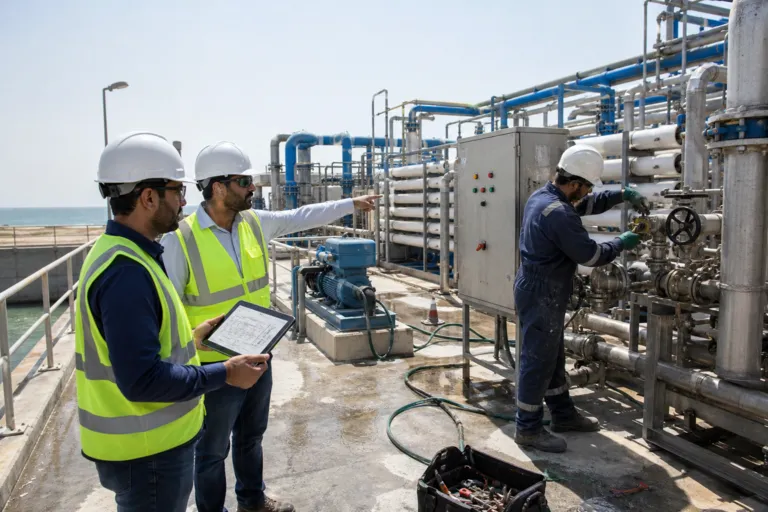
In the GCC, water is no longer treated as a quiet, back-office utility. It is becoming a strategic asset tied to social protection, urban growth, and economic resilience. Desalination has become the backbone of urban water security as groundwater is described as non-renewable and over-extracted in many cases, and treated wastewater reuse still depends on networks, regulation, and public acceptance. This shift is happening at global scale too. Desalination plants operate in 186 countries and produce about 140 million cubic metres of clean water daily, and the GCC is responsible for nearly half of that output despite representing less than 1% of the world’s population.
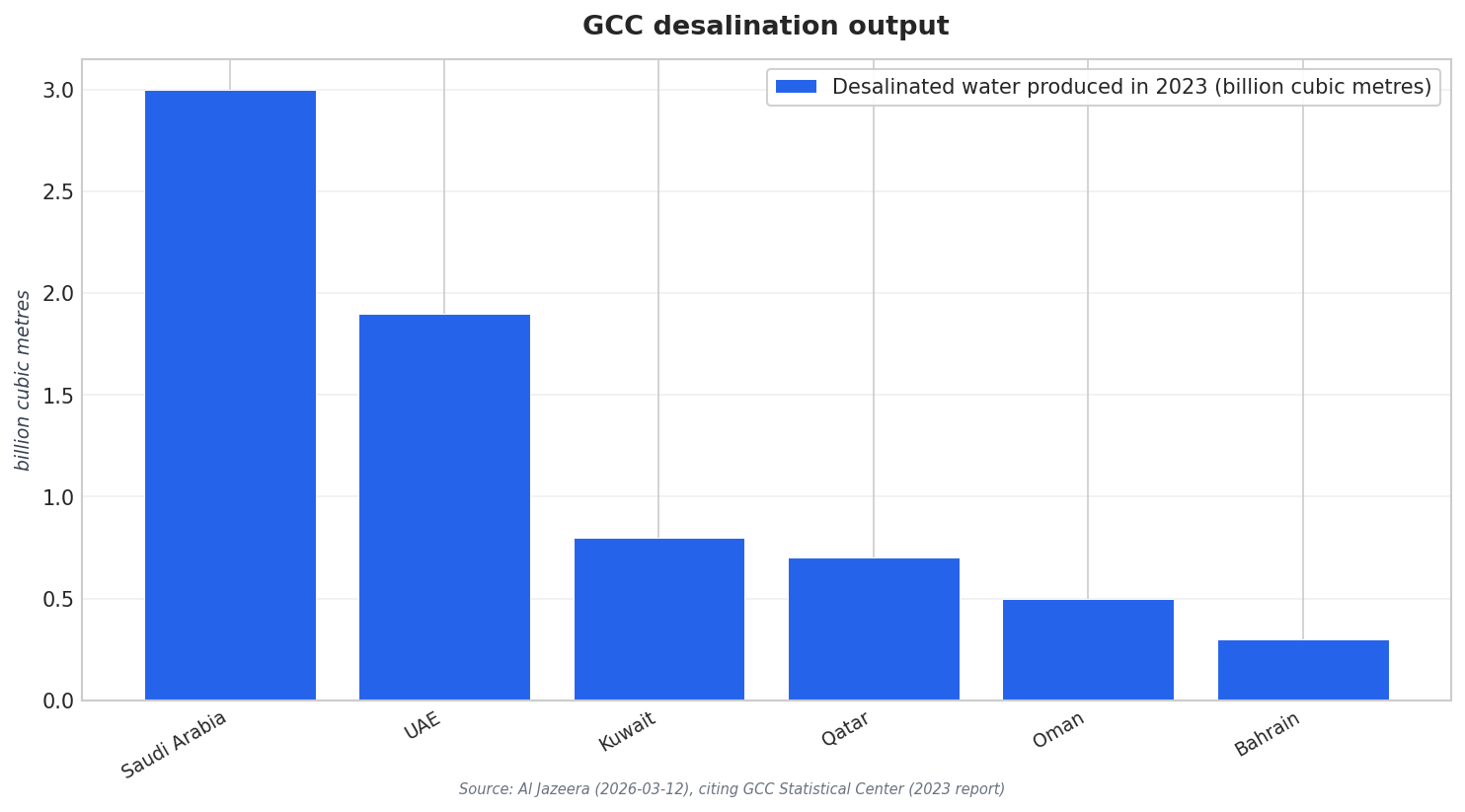
The region’s dependence is visible in both shares and volumes. The GCC countries generate about 40% of the world’s desalinated water from over 400 plants, according to TIME. Al Jazeera, citing the GCC Statistical Center, reports the six Gulf states produced 7.2 billion cubic metres (1.9 trillion gallons) of freshwater through desalination, with an average per-capita share of natural freshwater of only 120 cubic metres per year. In 2023, Saudi Arabia produced 3 billion cubic metres of desalinated water, followed by the UAE at 1.9 billion, Kuwait at 0.8 billion, Qatar at 0.7 billion, Oman at 0.5 billion, and Bahrain at 0.3 billion. These figures help explain why desalination is increasingly framed as an investment platform, not only a service.
From Utility Spend to Technology-and-Industry Strategy
Policy and capital are also shifting the narrative. The Global Economics describes the GCC as entering a chapter where climate resilience and water security are strategic investment sectors, with governments deploying “hundreds of billions of dollars” across areas that include desalination and climate-resilient infrastructure. Within this broader push, Saudi Arabia is described as investing heavily in next-generation plants powered by renewable energy rather than oil and gas, with new facilities increasingly relying on reverse osmosis and integrated solar systems. The commercial layer extends beyond producing water: the same source points to a technology ecosystem involving advanced membranes, AI-driven water management systems, energy storage integration, and mineral extraction from brine waste.
Operators and investors are tracking how these systems are evolving in practice. IQ Network highlights three near-term themes shaping desalination growth: technology integration, cost reduction, and capacity ramp-up, including AI-driven monitoring and solar-powered reverse osmosis scaling. It also underlines that Saudi Arabia is leading “by sheer volume,” pointing to reverse osmosis initiatives in the Eastern Province and the pace created by broader infrastructure ambitions such as NEOM. Qatar is described as taking a different route, with nearly every power plant running as a combined cycle that captures waste heat through a heat recovery steam generator to power the desalination process, reflecting a diversified approach to energy inputs.
For GCC water security, desalination investment is also intersecting with circular-water thinking, where treated wastewater reuse becomes more valuable for landscaping, district cooling, agriculture, and industrial uses. Yet, as AGBI notes, the economics depend on networks, regulation, and public acceptance, which means infrastructure design and governance matter as much as plant capacity. The stress is amplified by demand trends cited by TIME: the region’s population has nearly doubled in 20 years, and Saudi Arabia is described as the third highest per capita water consumer in the world, behind only the U.S. and Canada. In this context, desalination, reuse, and efficiency are being treated as development industries meant to attract capital and export solutions.
How much desalinated water did the six GCC states produce in 2023?
Which GCC country produced the most desalinated water in 2023?
How reliant are GCC countries on desalination for water supply?
What technologies are shaping GCC desalination expansion?
What does GCC water security and desalination investment mean in practice?