Vietnam is translating rising arrivals into a larger, more investable visitor economy. In the first nine months of 2026, Vietnam welcomed 17.7 million international visitors, up 14.5% year on year. Another benchmark frames the momentum: this pace is described as about 71% of the country’s full-year target of 25 million visitors. Against a global backdrop where the United Nations Tourism Organization cited only 0.4% growth in international tourist arrivals in the first six months of 2026 and revised full-year growth to 1–2%, Vietnam’s acceleration stands out and raises the bar for visitor services, shopping, and dining.
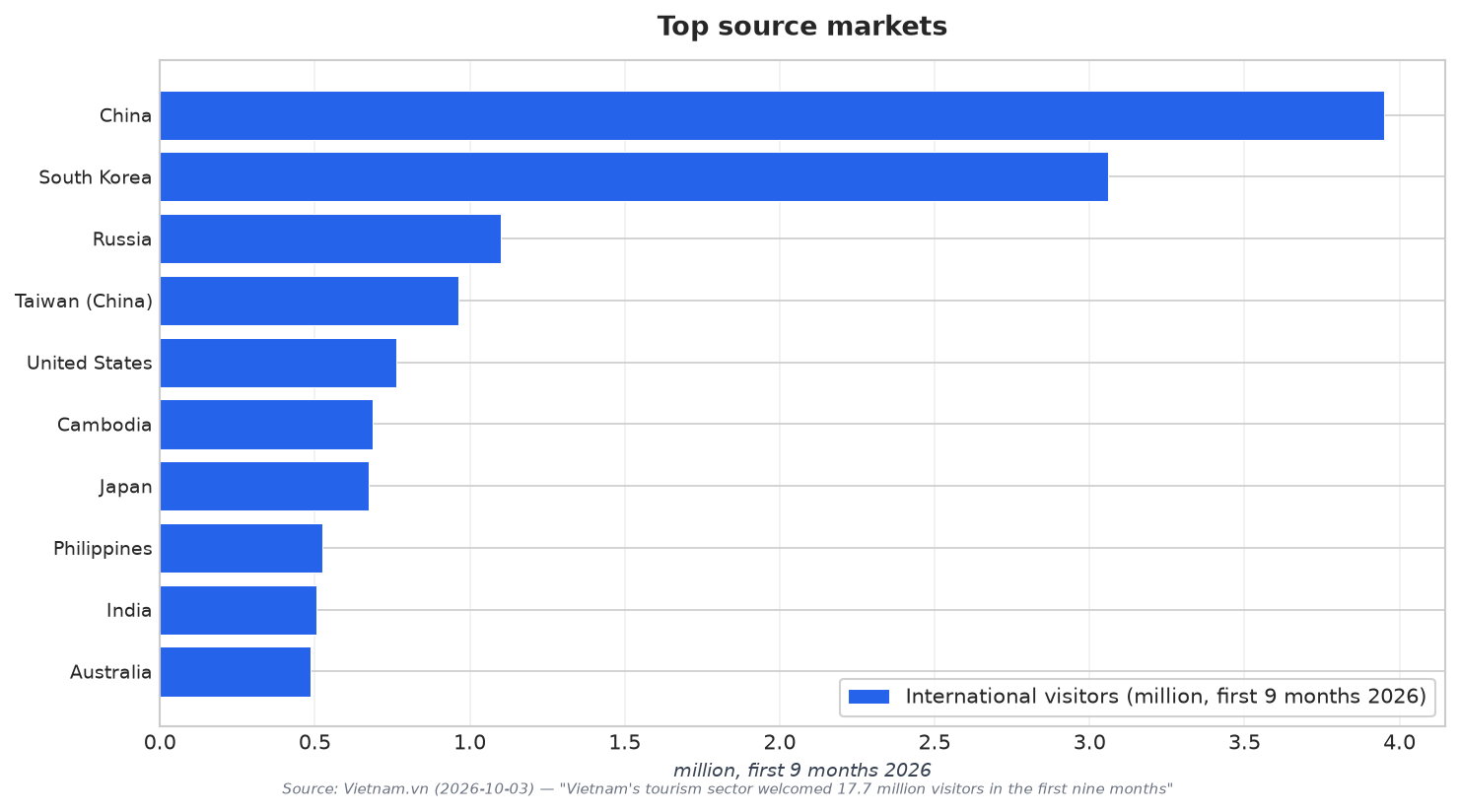
Demand is also becoming more diversified, which matters for retail, hospitality, and F&B planning. In the first nine months of 2026, China led with nearly 3.9–3.95 million visitors, while South Korea followed with around 3.0–3.06 million; together they accounted for nearly 40% of total arrivals, even as South Korea slipped 5.5% year on year and China grew about 1.5%. Russia reached approximately 1.1 million, becoming Vietnam’s largest European market. The US was at 764,000, Taiwan (China) at 964,000, Cambodia at 688,000, Japan at 674,000, the Philippines at 523,000, India at 505,000, and Australia at 485,000, with the Philippines up 55.2% and Australia up 21%.
Where the New Spend Will Land: Hotels First, Then High-Frequency Retail and F&B
Hospitality is an early beneficiary of the Vietnam tourism boom 2026 because more arrivals and a broader long-haul mix lift room-nights and service demand. Mordor Intelligence valued the Vietnam Hospitality Market at USD 23.73 billion in 2025 and estimated growth from USD 25.67 billion in 2026 to USD 38.01 billion by 2031, a CAGR of 8.17% for 2026–2031. In 2025, independent hotels held 69.88% share, while chain hotels are forecast to expand at an 11.65% CAGR to 2031. Mid and upper mid-scale made up 48.79% of the market in 2025, while luxury is projected to be the fastest-growing class at a 13.35% CAGR.
For retailers and F&B operators, the opportunity is less about one-off spikes and more about repeatable flows across channels and regions. Online Travel Agencies accounted for 58.85% of hospitality booking share in 2025, and direct digital bookings are projected to grow fastest at a 14.36% CAGR, supporting pre-booked dining, vouchers, and experience-led shopping. Regionally, southern Vietnam held 51.47% of hospitality market share in 2025, while the central coast and highlands are projected to grow fastest at a 13.36% CAGR. Travel and tourism scale is also visible in capacity: Vietnam had about 38,000 tourist accommodation establishments and 780,000 rooms by 2023, including 247 five-star properties.
The next phase is monetization, and that is where retail, hospitality, and F&B strategies converge. Ken Research reported 21.17 million international arrivals and 135.5 million domestic trips in 2025, underscoring a “two-engine” demand structure. Its forecast projects the Vietnam Travel & Tourism Market rising from USD 40,061 Mn in 2025 to USD 70,200 Mn in 2031 (9.8% CAGR), with an official 2026 objective of 25 million international arrivals, 150 million domestic trips, and about USD 46,500 Mn in tourism revenue. The same forecast expects average visitor spend to increase from USD 255.7 per trip in 2025 to USD 349.3 in 2031, aligning with premium accommodation, culinary products, and branded experiences that keep visitors spending longer and more often.
What do 2026 arrival trends suggest about the Vietnam tourism boom topic?
Which source markets led Vietnam’s inbound growth in the first nine months of 2026?
How large is Vietnam’s hospitality market, and what is the growth outlook?
What hotel segments and channels are shaping near-term opportunity?
What signals point to stronger retail and F&B monetization over time?