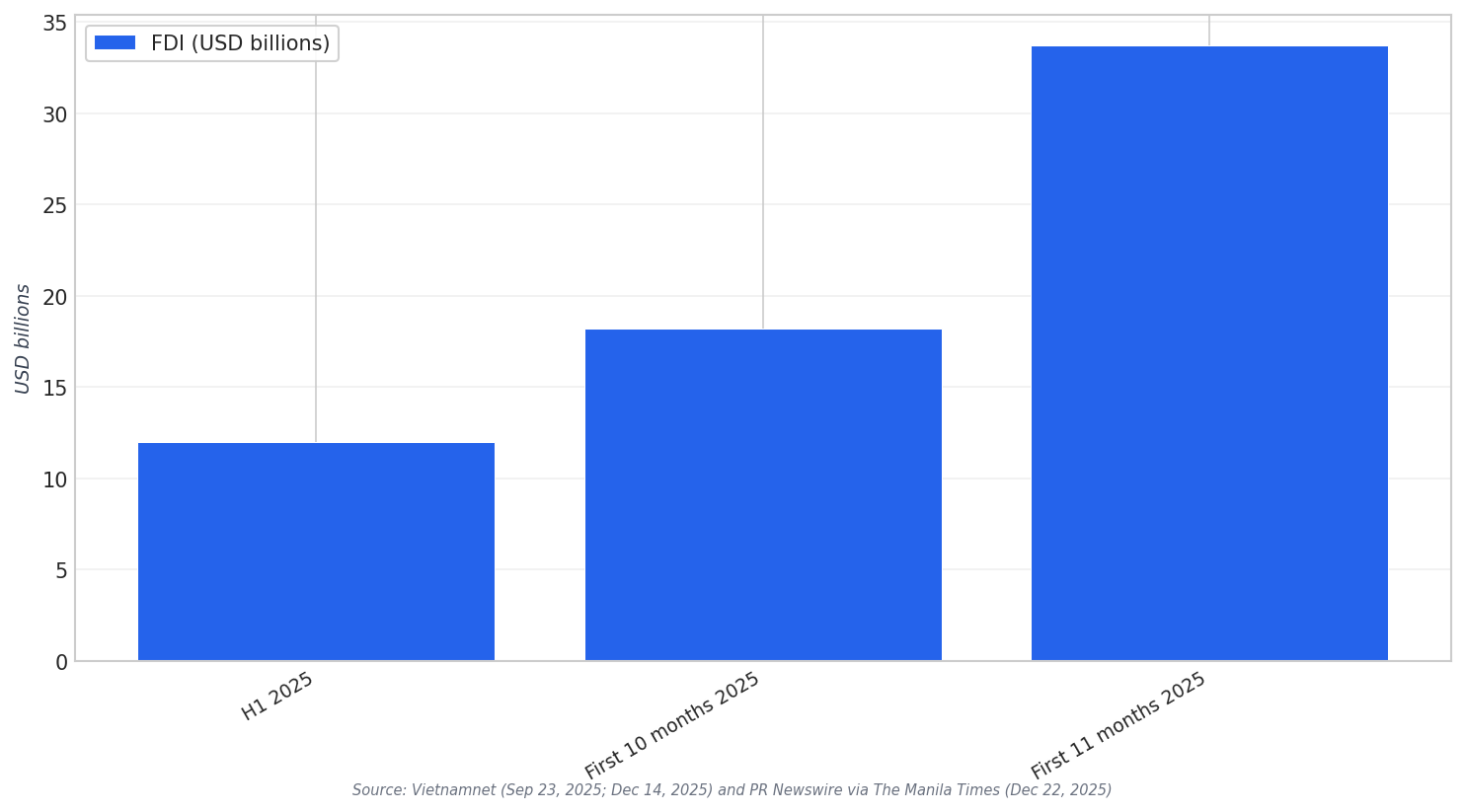
Vietnam industrial real estate is moving from a cyclical upswing to a more structural expansion. Savills’ John Campbell tied the momentum directly to the “China + 1” diversification strategy, as multinationals respond to US–China trade tensions and broader tariff pressures. In the first half of 2025, foreign direct investment (FDI) into Vietnam’s manufacturing sector reached nearly USD 12 billion. That was a 32% year-on-year increase and accounted for over 56% of total registered capital. Campbell said the jump in project numbers shows Vietnam is becoming a prioritized link in global production chains, not a passive recipient of relocation.
The manufacturing rebound is translating into concrete demand for industrial land, infrastructure, logistics, and ready-built space. Campbell noted that value-added output of Vietnam’s manufacturing sector rose by over 10% year-on-year, contributing nearly 2.6 percentage points to national GDP, supporting the view that the shift is not temporary. Across 2025, developers and occupiers expanded industrial land portfolios and added logistics and ready-built factories. Vietnamnet also reported a new US tariff regime on Asian exports taking effect on August 1, with duties set at 20%, which was seen as manageable and helped restore investor confidence after slower capital flows in the second quarter.
Ready-Built, Green Standards, and New Formats Redefine Demand
Demand is also changing in shape and specification. Cushman & Wakefield Vietnam’s Trang Bui said many firms are considering relocating entire supply chains, lifting the premium ready-built factory segment. Vietnamnet highlighted that high-tech firms are increasingly turning to ready-built factories with strict technical and ESG standards. On the sustainability side, a Cushman & Wakefield survey reported that “sustainability” is now among the three most important criteria for investors, with over 70% willing to pay 7–10% higher rents for green infrastructure to reduce emissions and comply with ESG requirements. This pushes Vietnam industrial real estate beyond land leasing into certified buildings and modern park operations.
Developers are responding with certified and higher-density products. PR Newswire reported KCN Vietnam brought projects into operation that achieved LEED Gold certification, including the second phase of a 23.2-hectare ready-built project in DEEP C Industrial Zone in Hai Phong and a 14.5-hectare project in Nhon Trach 6D Industrial Zone in Dong Nai. The same update said new product formats such as two-storey factory buildings were introduced to expand options for small and medium-sized enterprises. It also said projects including KCN An Phat in Hai Phong and a new subdivision of KCN Ho Nai in Dong Nai were expected to add about 100,000 square meters of factory and warehouse space by mid-second quarter of 2026.
Geographically, investment is spreading while core hubs remain anchors. Vietnamnet’s Q4/2025 Marketbeat data showed northern industrial land supply reached nearly 23,990 hectares, up 42.8% year-on-year, with average rent at USD 135 per sq.m for the lease term and occupancy at 65.74%. In that same dataset, ready-built factory (RBF) occupancy climbed to 86% and ready-built warehouse (RBW) reached over 83%, reflecting logistics demand. The article described a shift from core hubs to satellite localities such as Hung Yen, Ninh Binh, Hai Phong and Phu Tho, forming a production–logistics belt, while Hai Phong and Bac Ninh remain key anchors.
FDI breadth and infrastructure-linked projects are reinforcing the backbone narrative. In the first 11 months of 2025, PR Newswire reported registered FDI of nearly USD 33.7 billion and disbursed capital of approximately USD 23.6 billion, the highest level in five years. A Savills Vietnam report cited by Vietnamnet said manufacturing FDI reached about USD 18.22 billion in the first ten months of 2025, nearly 60% of total FDI inflows of USD 31.52 billion. Investor origin and sector mix also show depth: China ranked first with 406 new manufacturing projects (33%) valued at USD 2.6 billion, while electronics attracted USD 1.5 billion across 148 projects. In 2026, a Vietnamnet update highlighted an AI data centre project at Tan Phu Trung Industrial Park with about USD 2.1 billion in total investment, signalling that industrial parks are hosting more diverse, higher-value assets.
What is driving Vietnam industrial real estate growth?
How strong were Vietnam’s FDI inflows in 2025?
Are investors paying more for green industrial infrastructure?
Which ready-built formats are expanding in Vietnam’s industrial market?
What do northern Vietnam occupancy figures show?