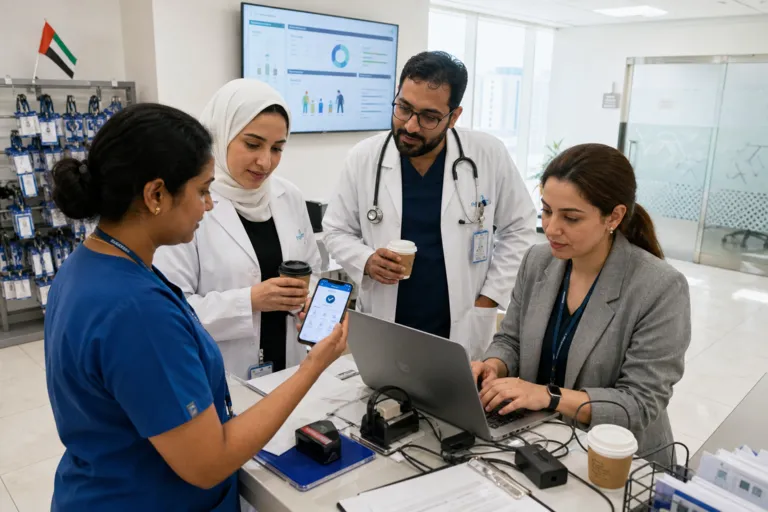
Unified digital licensing is not described as a single named program in the provided sources. But the direction is clear in 2026: UAE government services are shifting toward integrated digital platforms that combine licensing, visas, and compliance. A February 2026 brief describes a technology-driven government services platform that supports business setup, licensing, visas, and compliance across the UAE. It also stresses that selecting the appropriate business activity is critical to securing a valid trade license, because accurate classification and regulatory alignment matter from the outset. For healthcare employers and service providers, this integrated approach changes how quickly they can set up, stay compliant, and activate staff mobility pathways.
Mobility in regulated healthcare also depends on the surrounding government processes that sit next to licensing. The same February 2026 update that highlights integrated platforms also notes that platforms supporting business formation assist applicants in navigating approvals through Dubai Economy and Tourism (DED), including healthcare among other sectors. Separately, Dubai is reported to have launched a one-stop “Unified Health Screening” for residency and work visas, framed as a move to slash residency-visa processing time. Taken together, these developments point to a workflow where healthcare workforce movement is less fragmented: business activity alignment, licensing steps, and visa-related checks are increasingly treated as connected stages rather than separate errands.
What Changes in 2026: Mobility Runs on Digital HR and Compliance Automation
Healthcare workforce mobility is also being rewired by the tools employers use to plan, schedule, and document work. A 2026 global market report describes expanding adoption of cloud-based workforce platforms, rising use of predictive staffing analytics, growing integration of automated scheduling tools, and expansion of compliance and payroll automation. While this is global in scope, the operational implications are local: if licensing and visa steps are increasingly digital and integrated, then workforce systems that are auditable and automation-ready fit the same direction of travel. The report also references vendor management systems (VMS) and managed service programs (MSP) as technology and advisory approaches to tackle labor shortages.
At the frontline, the UAE’s 2026 workforce digitization story is not only about healthcare-specific systems. Payroll apps in the UAE are described as evolving into full-service “workforce super-apps,” layering non-financial services onto payroll tools and becoming everyday utilities. The same source reports HR teams using integrated payroll ecosystems have seen employee satisfaction increases of up to 25%. It also notes the Wage Protection System (WPS) has delivered near-universal digital salary coverage, while behaviour is shifting away from cash. These shifts matter for healthcare mobility because employment readiness, payroll setup, and compliance documentation increasingly live inside connected digital workflows, especially for workers with limited digital experience.
AI-enabled workforce infrastructure is also being positioned as part of the 2026 mobility stack. A February 2026 press release says TERN Group will showcase an AI-powered workforce infrastructure platform at World Health Expo (WHX) 2026 at the Emirates Health Services (EHS) pavilion. The platform is described as enabling workforce continuity, cost predictability, and care capacity expansion across regulated healthcare systems, with governed, auditable access to global healthcare talent and AI-enabled decision support. In practical terms, that language aligns with what unified digital licensing aims to reduce: uncertainty and friction. When licensing, screening, compliance, and workforce decisioning become more governed and auditable, cross-entity mobility becomes easier to manage.
The bigger 2026 takeaway is that “unified” is becoming a design principle across the UAE’s workforce-facing systems. Integrated government services platforms emphasize getting licensing right from day one through correct activity classification and regulatory alignment. Visa-related steps are being reframed as one-stop health screening. Employers are adopting cloud workforce platforms, automated scheduling, and compliance automation. And payroll apps are turning into workforce super-apps, with measurable employee satisfaction gains reported up to 25% in integrated ecosystems. In this environment, UAE digital licensing healthcare becomes less about a single portal and more about connected, end-to-end pathways that support mobility without losing regulatory control.
What does “UAE digital licensing healthcare” mean in 2026?
Which 2026 trend most supports healthcare workforce mobility?
How do workforce management systems relate to licensing and mobility?
What measurable workforce outcome is reported for integrated payroll ecosystems?
What role does AI play in regulated healthcare workforce infrastructure in 2026?