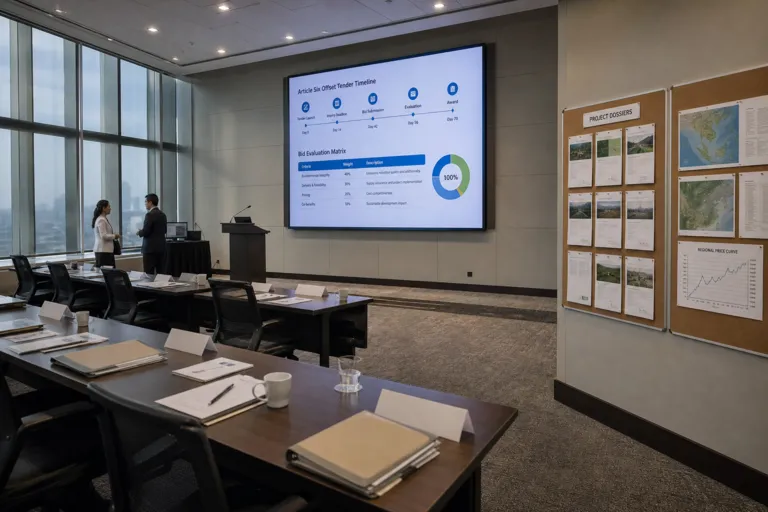
Article 6 carbon trading is moving from concept to contracts in Asia Pacific, and Singapore is becoming a visible buyer. OPIS reported that Singapore’s first public government procurement specifically for Article 6 credits closed on Feb. 14 and attracted 17 bidders, including commodities traders and energy companies. The highest bid came from Trafigura at S$299.19 million (US$224 million). The tender focus was nature-based solutions, and Singapore confirmed in early March that it would continue sourcing Article 6 credits through additional tenders, with eligibility expanding beyond nature-based solutions. These steps help explain why Singapore carbon credit agreements now sit at the center of regional discussions about price, quality, and cross-border accounting.
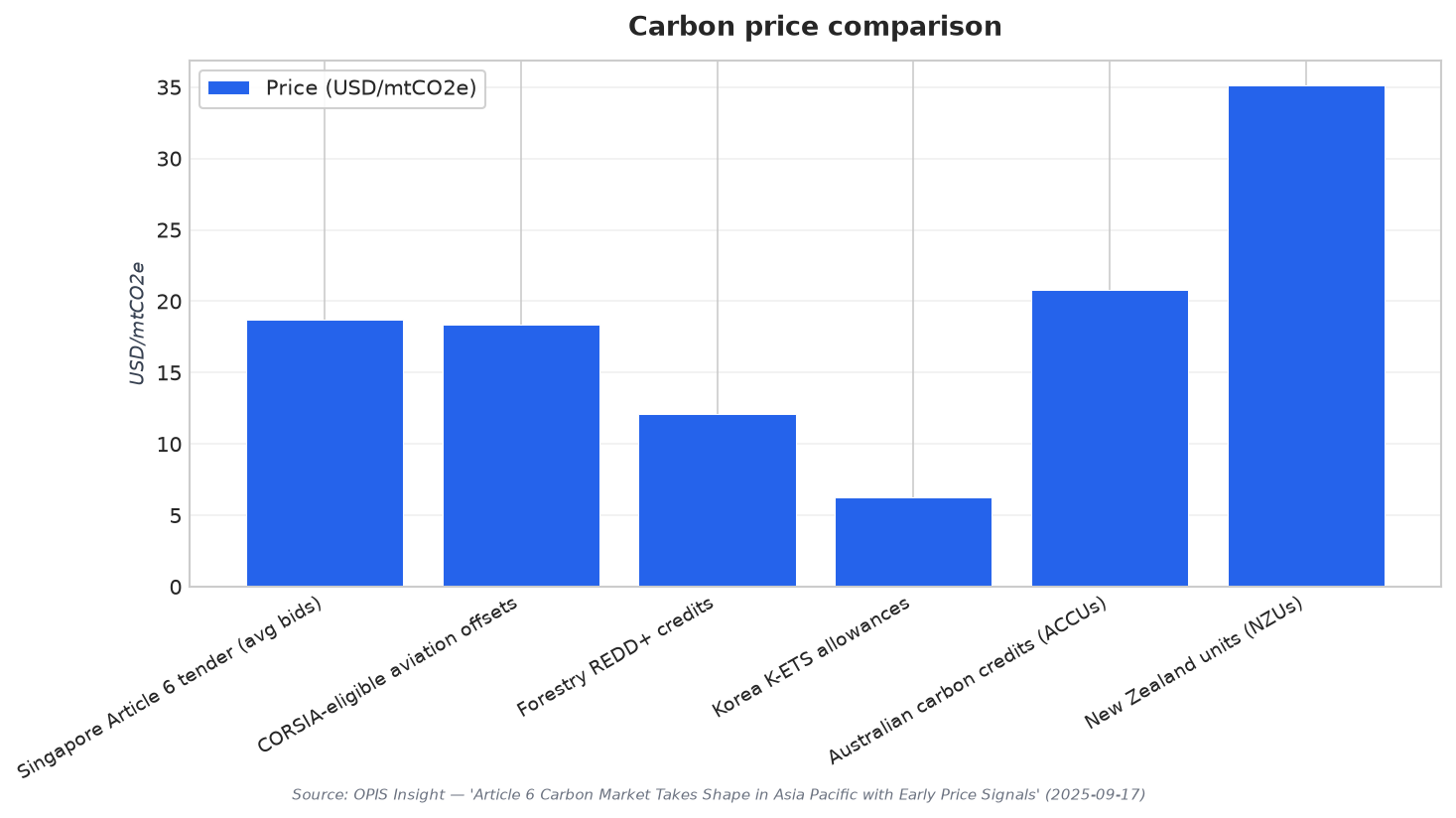
The early price signals from Singapore’s bidding process were also notable. OPIS disclosed that average per-unit bid prices ranged from S$25 to S$55 per metric ton (US$18.70 to US$41.20/mt), placing these Article 6 units above several voluntary benchmarks cited in the same report. For comparison, CORSIA-eligible aviation offsets were assessed at US$18.35/mt, while forestry REDD+ credits were calculated at US$12.125/mt. OPIS also described why Article 6 units can price differently, pointing to requirements such as formal “corresponding adjustments,” host country fees, and additional risks as these markets develop. The result is a clearer view of what buyers may be willing to pay when credits come with intergovernmental authorization and accounting controls.
From Bilateral Frameworks to Corporate Demand Signals
A second track is bilateral cooperation under Article 6.2, where credits can be transferred as “internationally transferred mitigation outcomes” (ITMOs). In May 2026, CarbonCredits.com reported that Singapore and the Philippines signed an Article 6 carbon credit agreement described as the first bilateral partnership between the two countries under Article 6. The framework allows Singapore to buy carbon credits from projects in the Philippines, while channeling funding to emissions reduction and climate programs. Project types mentioned include renewable energy, mangrove restoration, reforestation, and waste management, among other mitigation actions. The Philippine government is expected to authorize selected projects and oversee safeguards and emissions accounting rules, while Singapore’s Ministry of Trade and Industry said the deal would diversify Singapore’s decarbonization strategy and support climate action in the region.
Singapore’s domestic policy design helps create predictable demand for international credits. OPIS noted that Singapore’s carbon tax allows companies to offset up to 5% of emissions with international credits, and that some bidders structured tender pricing around the tax. OPIS also stated the tax is set to rise from S$25 currently to S$45 in 2026, with projections for it to reach S$50 to S$80 by 2030. Separately, EDB Singapore reiterated that firms can offset up to five per cent of carbon tax liabilities using high-quality Article 6 carbon credits, and said the government is actively procuring credits through Requests for Proposals (RFPs). EDB reported that an RFP launched in September 2024 for high-quality, nature-based Article 6 credits has since contracted about 2.175 million tonnes of credits at a total value of around S$76 million from four projects, and that a second RFP was launched in October 2025 to source both nature-based and technology-based Article 6 credits from partner countries.
Quality and market plumbing are becoming just as important as volumes. EDB said Singapore has set quality benchmarks through its International Carbon Credit (ICC) framework, requiring credits to meet principles demonstrating high environmental integrity, and that it has also whitelisted methodologies that take reference from reputable international standards. DevelopmentAid flagged market-wide concerns such as double-counting and data inconsistency across registries, and noted that market groups are pushing for high-integrity standards, citing work by Singapore’s SCMA with registries to adopt best practices. Yet liquidity can still lag: DevelopmentAid wrote that Indonesia’s exchange trades under 2 million tons per year and that Singapore’s traded volumes are small relative to global markets. Carbon Pulse added in May 2026 that Singapore will again allow companies under its carbon tax to carry over unused international carbon credits into the following year, citing a shortage of eligible units under Singapore’s Article 6 framework.
What did Singapore’s first public Article 6 tender reveal about pricing?
How do Singapore’s Article 6 purchases compare with some voluntary-market benchmarks?
What is included in the Singapore–Philippines Article 6 framework?
How are Singapore carbon credit agreements connected to the carbon tax?
What volumes has Singapore contracted through government RFPs for Article 6 credits?