In Southeast Asia, the trillion-dollar narrative is no longer just about a destination. It is about the timetable. Some projections have framed a US$1 trillion outcome as an early-2030s milestone, but other reporting says the region’s US$1T digital dream has slipped by five years. That kind of delay matters because it changes how founders, investors, and policymakers measure progress. It also changes what “on track” should mean, using current-year benchmarks rather than only long-range promises.
The most concrete recent checkpoint comes from the e-Conomy SEA reporting cited across multiple sources. A 2025 outlook said Southeast Asia’s digital economy was expected to surpass USD 300 billion, described as arriving three years earlier than expected. In the same 2025 context, e-commerce was expected to reach USD 185 billion in GMV, with USD 41 billion in revenue. Another summary of the 2025 e-Conomy SEA estimates also referenced more than USD 300 billion in GMV and about USD 135 billion in revenue, emphasizing that GMV and revenue are different measures and should not be added together.
What Slower Timelines Change for Execution
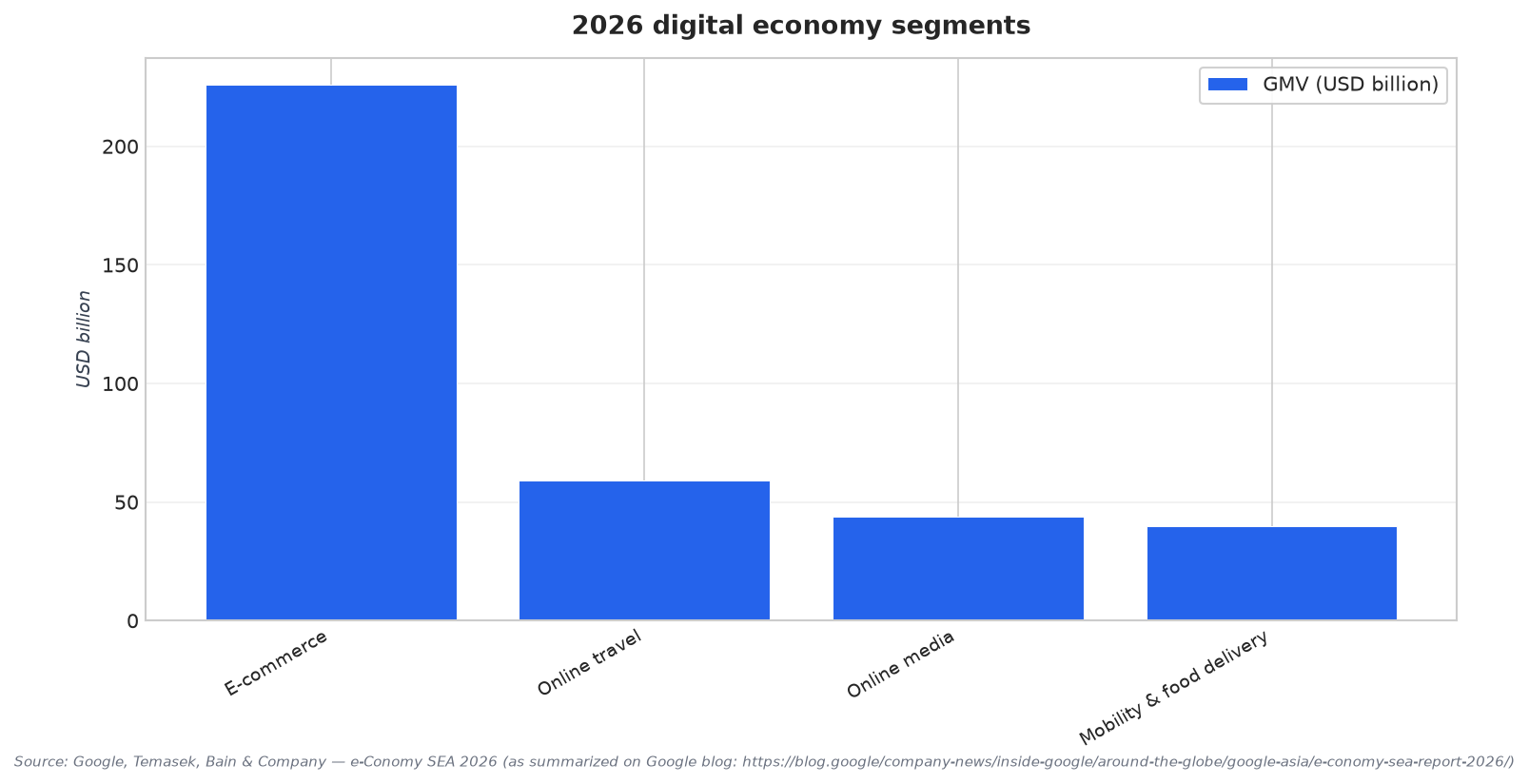
A delay does not automatically mean demand is collapsing. It can mean growth is being re-scored against tougher requirements, especially around trust, skills, and integration. The 11th e-Conomy SEA report said the region’s digital economy is projected to grow 17% year-on-year to reach USD 368 billion in GMV in 2026. It also broke out 2026 segment benchmarks: e-commerce at USD 226B GMV (+18% YoY), online travel at USD 59B GMV (+10% YoY), online media at USD 44B revenue (+22% YoY), mobility and food delivery at USD 40B GMV (+15% YoY), and digital financial services at USD 1,650B GTV (+16% YoY). These details shift the conversation from a single headline target to the operating health of each engine.
AI is increasingly used as the reason to keep believing, even when timelines stretch. In Southeast Asia, generative AI was reported as actively used by 243 million people, or 58% of the working population, and described as scaling four times faster than the rollout of the mobile internet. Automation familiarity is also high: 72% of users rely on everyday features like price tracking. Trust signals matter for conversion and commerce depth too, with 75% expressing willingness to let AI agents compare prices and complete transactions, and 62% reporting greater trust in AI tools than a year ago, driven by proven track records (56%), rising familiarity (55%), and output accuracy (53%).
For a Southeast Asia digital economy 2035 outlook, the practical takeaway is to treat trillion-dollar scenarios as scenarios, then manage toward measurable annual progress. One source argues long-range trillion-dollar scenarios should not be treated as inevitable outcomes, and that future performance should be assessed through updated regional data rather than recycled forecasts. In parallel, sector metrics show where execution can compound: for example, the 2026 report links personalized experiences to 10% higher conversions and order volume uplifts as large as 75%. The region may be slowing its calendar, but it is still producing hard numbers that can anchor strategy.
What is the most recent benchmark for Southeast Asia’s digital economy size?
Which sectors are driving GMV and revenue in 2026?
How widespread is generative AI usage in Southeast Asia?
What do trust and willingness metrics suggest about agentic commerce?
What does the Southeast Asia digital economy 2035 outlook depend on, based on these sources?