ASEAN’s export story has been reshaped less by new trade deals and more by shifting tariff incentives and enforcement. By 2024, for the first time since 2007, the United States overtook China as ASEAN’s largest export market. In 2025, ASEAN shipments to the U.S. posted strong growth, with overall exports reported up 29% and also described as about 30% year-on-year in separate reporting. Asia Society also notes that ASEAN exports to the United States rose 37.5% between 2022 and 2025. This demand pull is real, but it is arriving alongside rising scrutiny of how products qualify for origin.
Washington’s tariff playbook has broadened into strategic value chains. Under Section 301 measures, tariffs on Chinese electric vehicles reached 100%, duties on solar cells climbed to 50%, and lithium-ion batteries were taxed at 25% in 2024; semiconductor imports will face tariffs of up to 50% in 2025. The U.S. is also discussing widening coverage to clean-energy inputs, battery materials, and semiconductor assemblies sourced from third countries. In parallel, Rhodium Group notes that major manufacturing-oriented emerging markets such as Vietnam and Thailand appear to be settling at 19–20% U.S. tariff levels, and Al Jazeera cites preliminary duties set at 17% to 49% for Cambodia, Indonesia, Malaysia, the Philippines, Thailand, and Vietnam.
Rules of Origin Are Now the Real Battleground
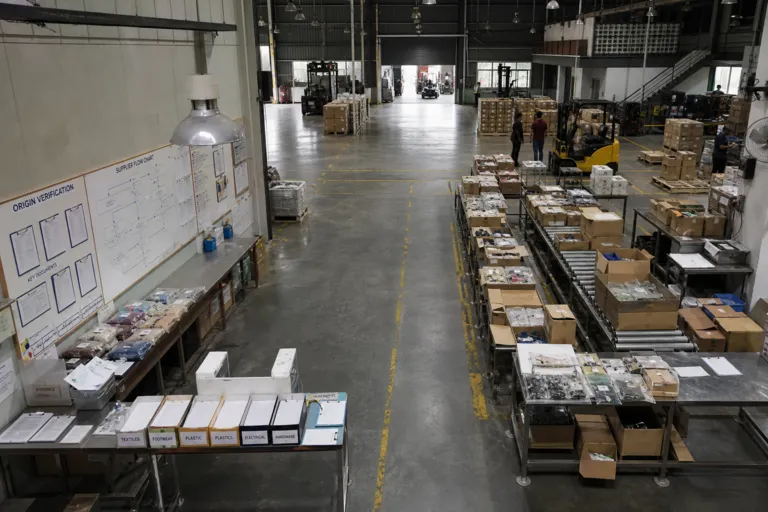
As the U.S. hardens its stance, the compliance bar for ASEAN-routed exports is rising. CBP has intensified circumvention probes under the Enforce and Protect Act, with cases involving ASEAN economies rising from 6 in 2021 to 20 in 2024. In April 2025, the U.S. Department of Commerce issued anti-dumping and countervailing-duty rulings on solar modules from Cambodia, Malaysia, Thailand, and Vietnam, with some duties exceeding 100%. Rhodium also describes a threatened 40% “transshipment tariff” on goods that inappropriately change their country of origin. In practice, manufacturers are being pushed to show “substantive transformation,” not administrative re-exports.
This is where ASEAN transshipment tariff rules become a strategic constraint, not just a legal checklist. ASEAN has become a key production base for companies seeking access to Western markets, and U.S. goods imports from ASEAN reached US$352.1 billion in 2024. But the same supply chains that support this surge often rely on Chinese machinery, electronics, and intermediate inputs. Asia Society describes China as ASEAN’s largest trading partner—roughly one in every five dollars of ASEAN trade—and highlights that much of ASEAN’s manufacturing boom is built on Chinese inputs. Al Jazeera likewise argues that rerouting exists but is not the main driver; instead, ASEAN is importing more machinery and intermediate goods from China to produce exports sent to the U.S.
The pressure to re-localise is therefore about resilience and proof, not only politics. Asia Society reports ASEAN’s trade deficit with China hit a record US$296 billion in 2025, and widened another 24% to US$166 billion in the first half of 2026. The Lowy Institute adds that China’s trade surplus with ASEAN has reached new heights, with the bloc absorbing 18% of Chinese exports. Yet ASEAN governments are also focused on capturing more value from exports, and Lowy suggests that carefully tightened origin rules could help host governments demand more technology transfer and local content, while giving a reprieve to regional makers of intermediate goods such as steel and plastics. For firms, the message is clear: build deeper local capability and documentation, because the era of simple rerouting is effectively over.
What is changing in ASEAN transshipment tariff rules and origin enforcement?
How fast are ASEAN exports to the U.S. growing in the current tariff environment?
Which sectors are most exposed to U.S. value-chain tariffs and related actions?
Why does reliance on Chinese inputs complicate origin claims for ASEAN exporters?
What does “re-localising supply chains” mean for ASEAN manufacturers under tighter scrutiny?