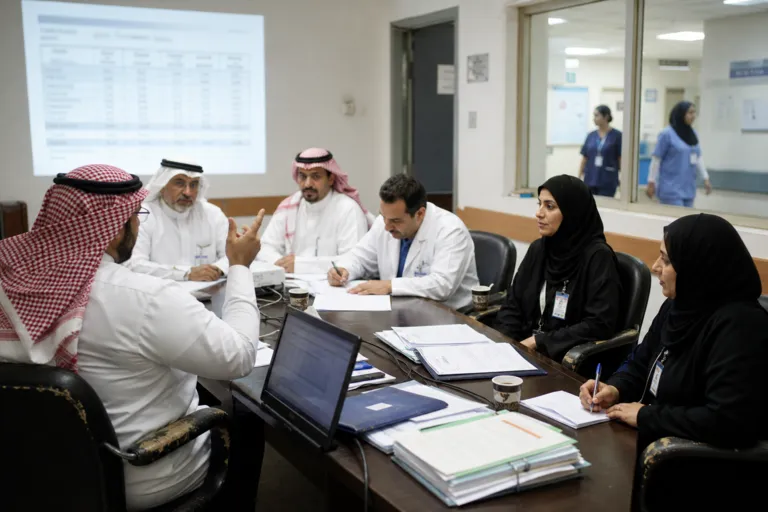
Saudi Arabia’s privatisation drive is increasingly framed as a redesign of how public services are delivered, not a retreat from funding them. In one budget-related briefing, a minister indicated that spending on health and education will exceed SR460 billion next year, and stressed that this does not conflict with privatization. That matters for hospital operations. The same source explains that when a hospital is privatized, an asset that provided free services to citizens moves to the private sector, which then requires budgeting to purchase services from that hospital for citizens. This creates a clearer commercial interface for private operators and investors.
That commercial interface is where the Saudi healthcare PPP model can take shape in practical terms. Instead of relying only on state-run delivery, privatisation can shift hospitals toward contracted service provision, with public budgets paying for services rather than owning and operating every asset directly. The emphasis on planning also signals what private capital usually demands: predictability over time. The minister highlighted that if planning for a 15-year period, there must be readiness to interact with variables across that period, including the possibility of scaling down one project or increasing another based on need and developments. For private partners, this long-horizon mindset supports structuring operational responsibilities with flexibility built in.
Operational Readiness: Procurement, Supply Chains, and Clusters
Privatisation is not only about who owns a hospital building. It is also about operational excellence across procurement and supply chains. Saudi Arabia’s Ministry of Health signed a Memorandum of Understanding with Efficio to advance supply chain, procurement, and local content excellence in the healthcare sector. The agreement was signed on the sidelines of the Global Health Exhibition 2025 and positioned as part of the Health Sector Transformation Program under Saudi Vision 2030. Better procurement and supply chain discipline can make hospital operations more investable, because it supports standardisation, transparency, and performance management that PPP-style operating models typically require.
Care delivery redesign is also moving in parallel with operational reform. The Saudi Model of Care is described as a comprehensive, prevention-focused framework to deliver integrated, equitable, and high-quality care across the Kingdom’s 20 health clusters. It is anchored around six pillars: Wellness, Planned Care, Chronic Care, Urgent Care, Safe Birth, and Palliative Care. Saudi Health Holding Co. and Mass General Brigham announced the next phase of their strategic partnership during the Global Health Exhibition 2025, with Mass General Brigham serving as a strategic advisor to support implementation. For private capital, these types of system-wide frameworks can reduce fragmentation and clarify what “better performance” means in operational contracts.
Capital formation is also broadening, which can indirectly support PPP pipelines. A PitchBook report said Saudi Arabia’s decision to expand foreign investor access to its stock exchanges is expected to unlock billions of dollars in IPO markets and provide fresh liquidity to the private markets ecosystem, while noting a 49% cap on foreign ownership in listed companies. On the innovation side, Redesign Health partnered with Sanabil Investments (wholly owned by the Public Investment Fund) to open the Sanabil Venture Studio by Redesign Health in Saudi Arabia, with an aim to jointly develop and launch at least 20 healthcare companies in the kingdom. Taken together, these signals point to more routes for private participation around hospitals, from operating models to tech-enabled service layers.
The PPP health wave, then, is not a single transaction. It is a set of aligned moves: budgeting for purchased services after privatisation, committing to 15-year planning that can scale with need, tightening supply chain and procurement capabilities, and rolling out care frameworks across 20 clusters with clearly defined pillars. As private capital looks at hospital operations, the Saudi healthcare PPP model is being shaped by these building blocks. The result is a more contract-driven, performance-oriented operating environment, where public funding and private execution can be designed to coexist.
What is the Saudi healthcare PPP model in this context?
Does Saudi Arabia’s health spending conflict with privatisation?
Why does a 15-year planning horizon matter for hospital partnerships?
What operational reforms support hospital PPP-style execution?
How is care delivery being standardised across the system?