On June 30, 2026, the UAE launched its first national passenger railway, shifting how residents think about distance and daily travel. The initial service runs between Abu Dhabi’s Mohammed bin Zayed City station and Al Hilal City in Fujairah, completing the trip in about 1 hour and 45 minutes. Multiple sources frame this as a major change versus road travel, with one report noting the journey previously took over two hours by road. Ticketing is positioned as digital-first, with bookings available via the Etihad Rail app and website, including access that was open ahead of launch on June 23, 2026.
Early demand signals arrived quickly. The Middle East Observer reported that more than 10,000 tickets were sold before the first departure. Railway News later reported that over 70,000 tickets had been sold since the June 30, 2026 launch. The same Railway News item describes the corridor as approximately 250 km, with trains operating at up to 200 km/h, and fares starting at AED 55 (also cited as about EUR 13). Another source lists fares from AED 55 for Comfort Class and AED 120 for Premium Class on the opening phase. These figures matter because adoption is not just about novelty; it is about whether rail becomes a repeatable choice for residents planning trips and workdays.
From City-Center Premium to Connectivity Premium
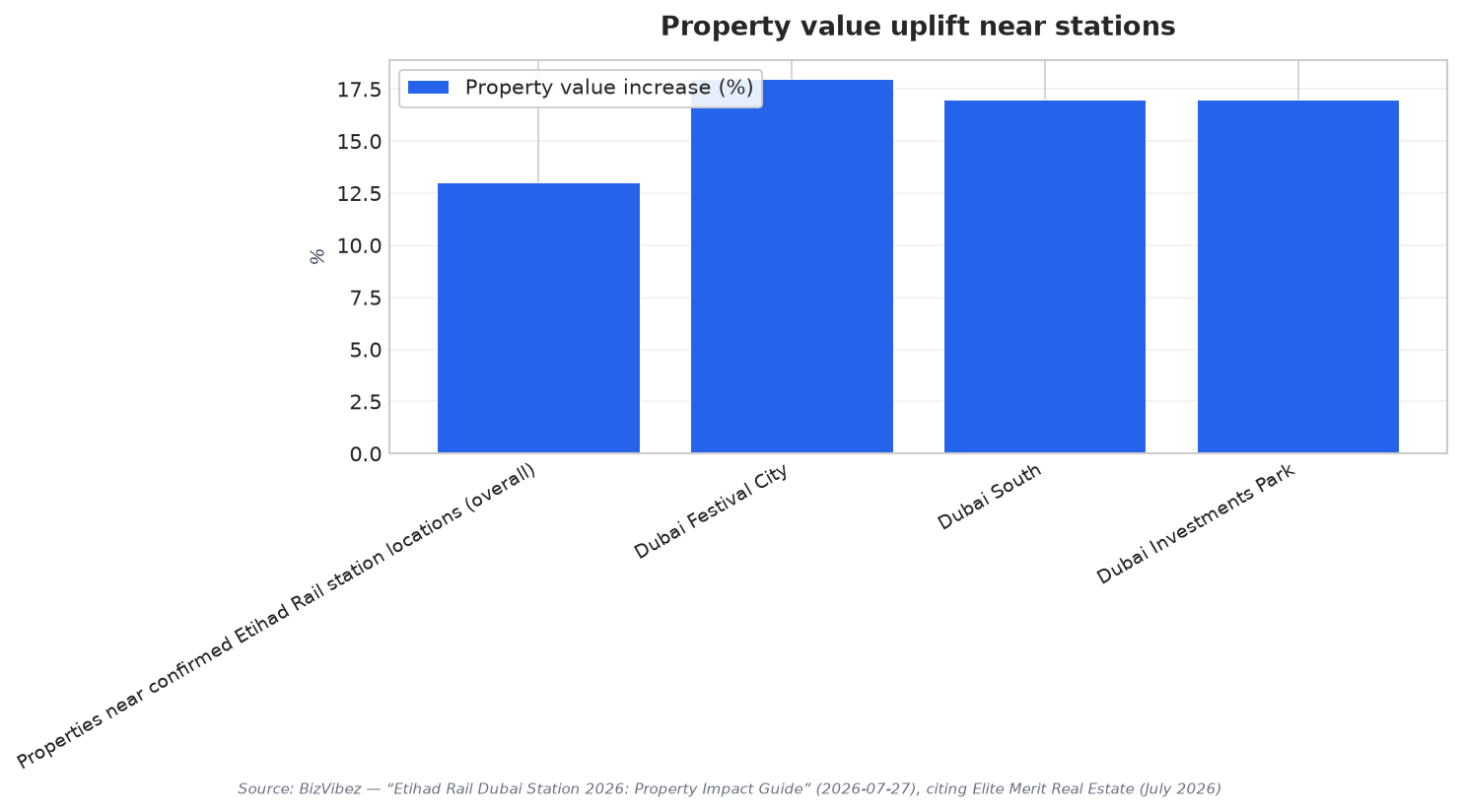
The bigger shift may be in how people value where to live. Travel And Tour World argues that UAE real estate has historically been dictated by prime city-center locations, but that connectivity-based valuation is gaining ground. It reports that in the first half of 2026, properties located within 500 to 800 meters of planned Etihad Rail stations were experiencing accelerated capital appreciation. A Dubai-focused station guide adds that the clearest, most sustained uplift tends to appear when passenger services arrive, because commuter patterns can actually change. It also claims that properties near confirmed station locations across the UAE rose by about 13% over the past nine months, with Dubai Festival City up 18% and Dubai South and Dubai Investments Park close behind at 17%, citing Elite Merit Real Estate data reported in July 2026.
Dubai’s upcoming station at Jumeirah Golf Estates is repeatedly framed as a hinge point for daily commuting. The station guide describes Jumeirah Golf Estates as a fully built-out community spanning 1,119 hectares, operational since 2013, with a Red Line metro station opened in September 2021. It argues that adding national rail access creates new, practical trip patterns, including the ability to reach Abu Dhabi in about 57 minutes and Fujairah in under two hours without a car. That time compression is exactly what can expand “where you can live” while keeping “where you work” fixed, especially as the network expands in staged phases toward March 2027.
Beyond property, the narrative is a wider economic rewiring. The Middle East Observer says the passenger network is expected to strengthen economic integration and support long-term benefits across tourism, labour markets, and urban development, while also building on freight operations that already connect major ports, industrial zones, and manufacturing centres. Sherwoods Property describes the rail build-out as targeting a 900-kilometre network connecting 11 cities and locations across the UAE, with a goal of 36.5 million passengers annually by 2030. As Etihad Rail Passenger Services rolls forward, the Etihad Rail passenger service becomes less about a single route and more about making inter-emirate travel predictable enough to reshape both mobility habits and how markets price station access.
When did the UAE’s national passenger rail service launch?
How long is the Abu Dhabi–Fujairah trip by train, and what is the distance?
What do we know about fares and early ticket demand?
How is the Etihad Rail passenger service linked to property value changes near stations?
What commute times are cited for the planned Dubai station at Jumeirah Golf Estates?