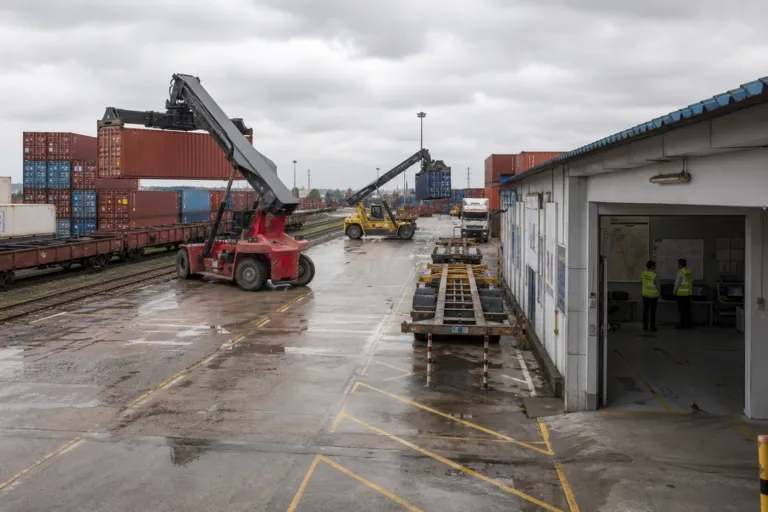
Manufacturing relocation and expanding trade are raising the stakes for moving goods efficiently in Vietnam. Multiple market estimates underline how large the sector has become. Expert Market Research values the Vietnam logistics market at USD 85.81 billion in 2025 and projects it will reach USD 159.57 billion by 2035, at a 6.40% CAGR. MarkWide Research estimates the Vietnam freight and logistics market at USD 72.4 billion in 2026, forecasting USD 153.39 billion by 2035 with an 8.70% CAGR. Even with different methodologies, both views point to a fast-growing system that must keep up with factory needs across road, sea, rail, and air.
Growth, however, does not automatically mean efficiency. KVN Logistics cites a Vietnam Ministry of Industry and Trade statement at the Vietnam Logistics Forum 2025 that the domestic logistics market is approximately USD 45–50 billion, and that it has posted around 14–16% annual growth in recent years. In the same source, logistics costs in Vietnam are described as roughly 16–17% of GDP, while a Springer Nature study frames the burden as 16–20% of GDP. This gap between rapid sector expansion and still-high cost intensity is the practical meaning behind Vietnam logistics costs as a competitiveness issue for manufacturers, exporters, and service providers.
Why 3PL Integration Matters as Supply Chains Get More Complex
As factories scale output, the case for outsourced, end-to-end execution becomes clearer. Mordor Intelligence values Vietnam’s third-party logistics market at USD 4.74 billion in 2026, estimating USD 5.11 billion in 2027 and USD 7.37 billion by 2032, with a 7.59% CAGR during 2027–2032. In that 3PL market, domestic transportation management accounted for 62.45% of share in 2026. Manufacturing represented 36.87% of 3PL end-use in 2026, reinforcing that industrial throughput is central to logistics demand. Southern Vietnam accounted for 46.13% of 3PL size in 2026, while Northern Vietnam is projected to register an 8.34% CAGR during 2027–2032.
Manufacturing-linked investment provides context for why coordination and reliability matter. Mordor reports realized FDI reached USD 27.62 billion in 2025, with manufacturing and processing accounting for 82.8% of disbursed FDI. Ken Research separately reports Vietnam registered USD 38.23 billion of foreign investment in 2024, with USD 25.58 billion going to processing and manufacturing, or 66.9% of total FDI. Ken Research also puts total goods trade at USD 786.29 billion in 2024. These flows intensify demand for inbound material transport, factory-side handling, warehousing, customs coordination, and export distribution, where poor handoffs and weak visibility can inflate end-to-end costs.
Policy targets show how Vietnam plans to narrow the gap. Under Decision No. 2229/QD-TTg, KVN Logistics notes the Government aims to reduce the logistics cost-to-GDP ratio to 12–15% by 2035, while targeting industry growth of 12–15% per year during 2025–2035. The same strategy sets a digital transformation goal: 80% of Vietnamese logistics service providers using digital solutions by 2035. MarkWide highlights national framework measures such as digital customs platforms and green fleet conversion timelines. Together, these targets imply that competitiveness will increasingly come from better multimodal connectivity, documentation control, and integrated solutions, not only lower freight rates.
How large are logistics costs in Vietnam compared with GDP?
What are the main government targets for logistics reform through 2035?
How fast is Vietnam’s third-party logistics market expected to grow?
Why does manufacturing relocation increase demand for integrated logistics services?