The EU’s Carbon Border Adjustment Mechanism (CBAM) is no longer a future policy risk. It ran as a reporting-only system from 1 October 2023 to 31 December 2025, but it is applicable under its definitive regime as of 1 January 2026. Under this phase, importers face authorisation and reporting duties, plus the obligation to purchase and surrender CBAM certificates corresponding to the embedded emissions of covered goods. CBAM applies to imports of cement, iron and steel, aluminium, fertilisers, electricity, and hydrogen. For Gulf exporters selling into Europe, the commercial pressure shows up first through buyers: when importers carry the liability, they can push for verified data, renegotiate prices, or switch suppliers.
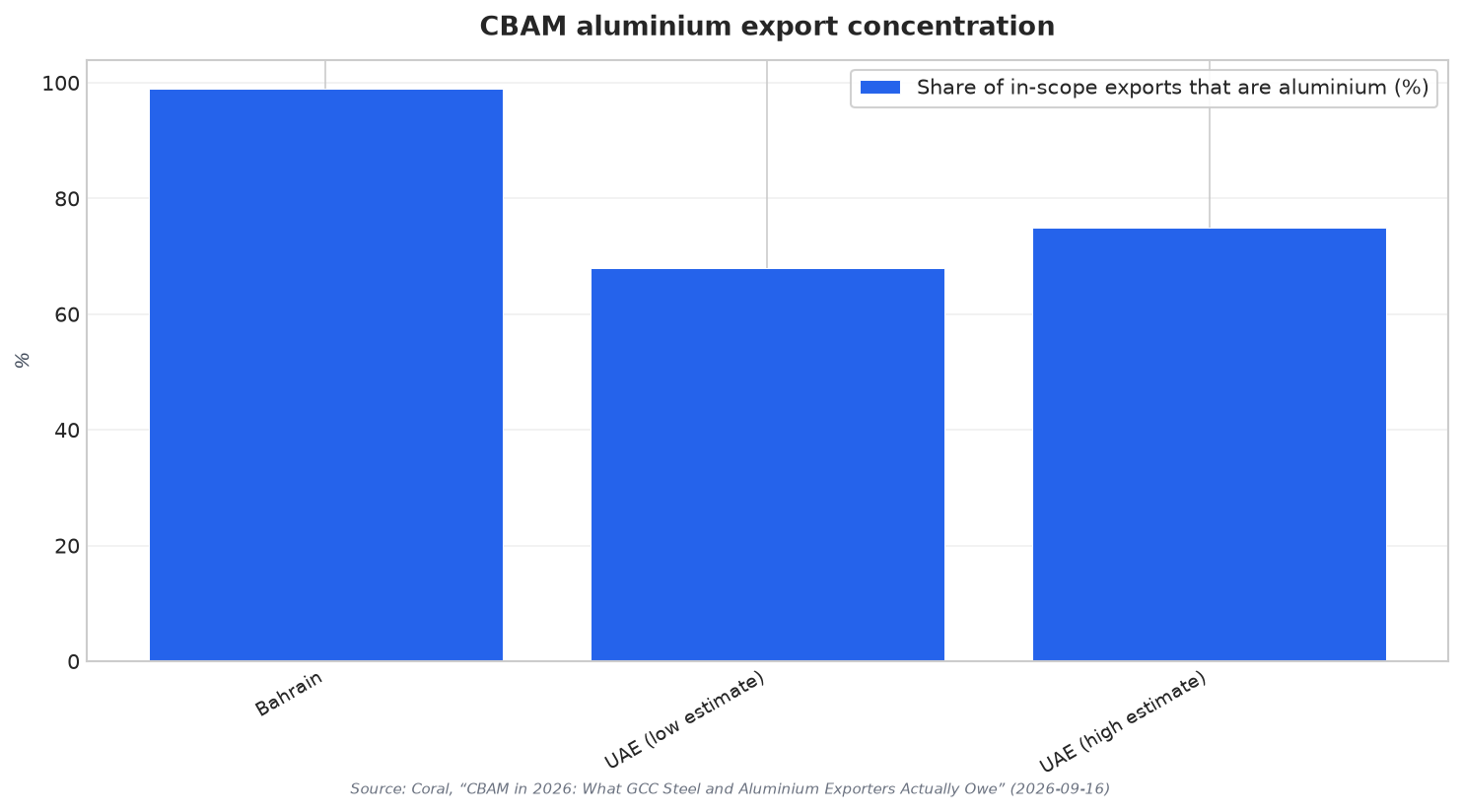
For the GCC, early evidence and exporter-focused guidance point to one clear theme: aluminium is the main impact channel, with exposure varying across member states. Bahrain and the UAE are identified as the most affected in absolute terms and relative to GDP, while Saudi Arabia and Oman face more limited exposure, and Kuwait and Qatar are largely unaffected. Export composition underscores why. Aluminium accounts for roughly 99% of Bahrain’s in-scope exports and between 68% and 75% of the UAE’s, Oman’s, and Saudi Arabia’s. That concentration means that “CBAM impact GCC exporters” is, in practice, largely a question of how fast aluminium producers and their EU customers can lock down credible emissions reporting and contract terms.
What Changes in 2026: Liability Starts, but Payments Lag
Two timing details matter for 2026 planning. First, financial liability begins with the definitive regime from 1 January 2026, meaning covered shipments now create certificate obligations instead of being purely reported. Second, cash settlement does not happen immediately. For 2026 imports, the first payment is not due until 30 September 2027, and CBAM certificate sales open in February 2027. There is also a binding 50-tonne annual threshold that exempts the smallest importers. For many Gulf suppliers, this makes 2026 a data-readiness year: what must be delivered now is verified emissions data that an EU buyer can use in its CBAM declaration.
The cost ramp is designed to start gently and steepen later, so 2026 behaviour can decide 2028 outcomes. A free-allocation adjustment means only about 2.5% of the gross carbon cost is payable for 2026 imports, but that share climbs steeply through 2030 and toward full application by 2034. Missing verified data is flagged as the expensive mistake because default values are described as punitive by design, and the mark-up applied on top rises to 30% from 2028. Recent simplifications also change what is counted: for aluminium, steel, and iron, embedded emissions from precursors are counted by default and emissions from finishing processes are no longer counted, aligning the boundary with ETS rules.
Competitiveness will hinge on what CBAM counts today and what it may count next. Under current CBAM rules that consider only direct emissions for aluminium, analysis finds the carbon intensities for primary aluminium made by GCC producers are similar to the EU and lower than key competitors China and India, creating scope to offset demand decreases by increasing market share. But outcomes are not locked in. Future exposure is tied to whether indirect emissions coverage changes, how EU compensation reforms evolve, the use of anti-resource shuffling measures, and the pace of GCC decarbonisation initiatives. Separately, steel exporters are told to watch EU policy interactions closely, because CBAM’s definitive phase is described as operationally intertwined with EU trade policy for steel.
When did CBAM move from reporting-only to the definitive regime?
Which sectors are covered by CBAM in the definitive regime?
When do CBAM payments start for goods imported during 2026?
How concentrated is the CBAM exposure for GCC exporters?
What does the CBAM impact mean for GCC exporters in 2026?