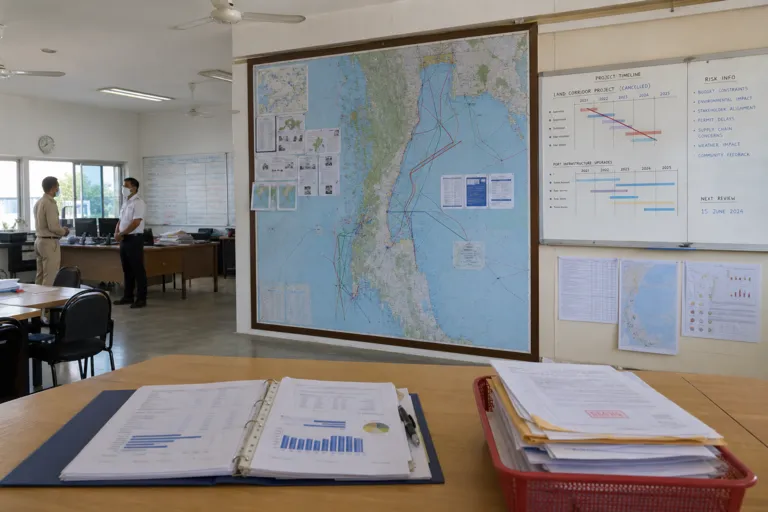
Thailand’s effort to create an overland cargo route across the Kra Isthmus lost its official footing in 2026. A study committee set up by a Prime Ministerial Office order on 5 May 2026 reported on 24 July that the Chumphon-to-Ranong Land Bridge was uneconomic, environmentally risky, and commercially weak. In early August 2026, the cabinet accepted that finding by withdrawing the environmental assessments the project required, removing the permitting basis for the scheme as designed. As a result, route planners looking for a near-term bypass of the Strait of Malacca are left with a blunt conclusion: there is no Malacca bypass this decade.
The shelved design was concrete. It envisioned two deep-sea ports—Laem Riew on the Gulf of Thailand side at Chumphon and Laem Ao Ang on the Andaman side at Ranong—linked by an 89.35 kilometre corridor. The corridor was to carry a six-lane motorway plus both standard gauge and metre gauge rail, described elsewhere as a dual-track railway paired with a six-lane motorway. Total cost was put at 997.7 billion baht, and another report described it as a 1 trillion baht (US$30.45 billion) logistics corridor meant to offer an alternative to the congested Strait of Malacca. Earlier analysis by Thailand’s Office of Transport and Traffic Policy and Planning had calculated an economic internal rate of return of 17.38 percent, a figure that helped keep the project alive for two decades.
Why the Economics Turned Against the Corridor
The updated feasibility work did not hinge on new engineering problems. It concluded that returns had deteriorated. The financial rate of return fell from 8 percent to 4.8 percent, and net present value flipped from a positive 637.7 billion baht to a negative 10.3 billion. Analysts also argued the concept struggled against the “seamless shipping route” through Malacca because a land bridge forces cargo into repeated handling. Containers must be discharged on one coast, moved by rail or truck across the isthmus, and then loaded onto another vessel. That means two extra port calls and additional lift cycles versus a Malacca transit that needs none of them, and the review noted that no major container line committed support—leaving the terminals without anchor volume.
Time-saving claims also faced pushback when operational realities were added. A consulting analysis framed the maximum time saved at sea by avoiding Malacca as 2 days, while time lost to double handling at two ports was approximately 2 days. That arithmetic helps explain why the project was described as highly sensitive to changes in global economic conditions, trade volumes, and shipping demand. Even the pitch evolved toward partial market capture rather than replacement. Thai officials were quoted saying it was not designed to replace the Malacca Strait entirely, but to capture part of the region’s trans-shipment and feeder cargo market. One estimate suggested feeder-to-feeder movements between the Gulf of Thailand and the Andaman Sea could be around 10% cheaper and six days faster than comparable routes through Singapore due mainly to lower congestion, but analysts still warned the plan was economically ambitious.
Environmental and political constraints amplified the decision to shelve the megaproject. One critique highlighted that a 90-kilometer corridor would require seaward land reclamation of roughly 13,000 rai across two provinces: 7,000 rai in Ranong and 6,000 rai in Chumphon. This was contrasted with 5,257 rai reclaimed for Laem Chabang Port, Thailand’s main international deep-sea terminal in the Eastern Economic Corridor. In the project’s place, reporting pointed to a downsized infrastructure upgrade focused on Ranong: modernizing the existing Ranong Port and giving it a direct rail connection to the national network running through Chumphon. Officials also stressed that stopping the plan came with no monetary loss because neither land acquisition nor construction had begun, leaving the main impact reputational.
What triggered Thailand’s Land Bridge cancellation in 2026?
What was the shelved Land Bridge design supposed to include?
Which financial metrics turned negative for the project?
Does shelving the project change Malacca Strait shipping routes this decade?
What is Thailand building instead of the full corridor?