In 2026, Gulf providers are expanding in a financing environment defined as much by competition for capital as by demand for care. Zavis reports that annual investment across GCC healthcare, energy, and digital sectors will reach USD 100 billion by December 2026, and that Middle East strategic capital expenditure is expected to exceed USD 100 billion annually in 2026. The same source notes this equals about AED 367 billion at the UAE dirham’s dollar peg, framing the scale of the pool that hospitals, diagnostic chains, and health-tech vendors will be trying to access. The practical implication is capital discipline: providers need to demonstrate returns in areas like digital health, AI diagnostics, and specialty-care capacity, while competing with energy, cloud, AI, and manufacturing projects for the same investor attention.
Demand signals across the region help explain why the financing question is urgent. Kinmed cites Fortune Business Insights (2025) stating the MENA healthcare services market was valued at USD 241.13 billion in 2024 and is projected to reach USD 256.52 billion in 2025, growing at a 7.0% CAGR through 2032. On the supply side, the same article describes an “unprecedented healthcare construction cycle,” with governments across GCC states and wider MENA investing billions in new hospitals, digital health infrastructure, and medical device procurement. Category data reinforces the procurement pull: Kinmed cites UnivDatos (2024) that the MENA digital health market was valued at USD 10.98 billion in 2022 and is growing at a 19.6% CAGR. It also cites MarkNtel Advisors (2026) that the GCC medical consumables market was valued at USD 459.75 million in 2025 and is projected to grow from USD 495.22 million in 2026 to USD 635.29 million by 2032.
How Insurance Markets and Digital Claims Shape Provider Cash Flow
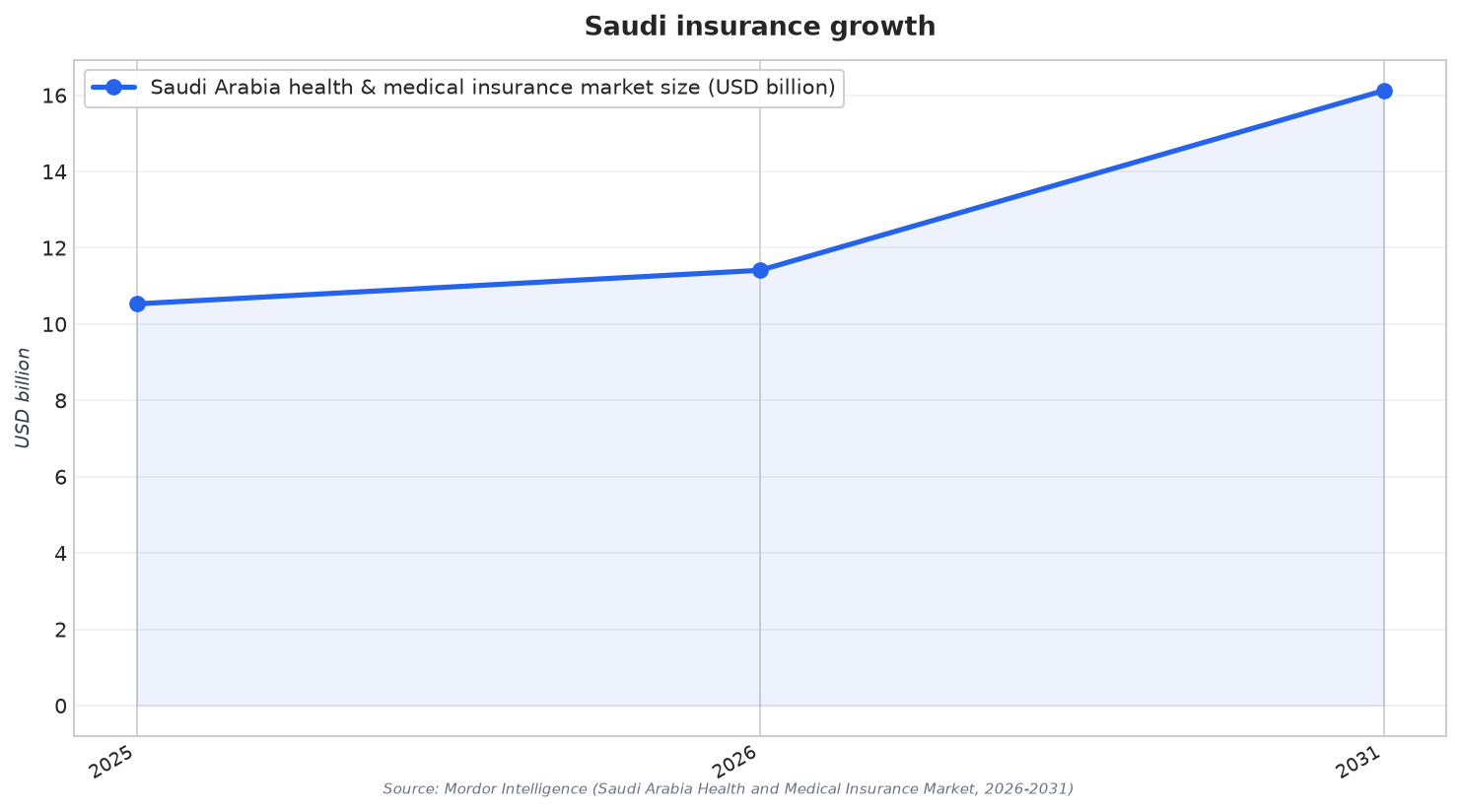
One of the clearest financing levers for expansion is the health insurance engine that pays for a large share of utilization. In Saudi Arabia, Mordor Intelligence estimates the health and medical insurance market at USD 11.41 billion in 2026, projected to reach USD 16.12 billion by 2031 at a 7.16% CAGR. The same report highlights the National Platform for Health Information Exchange Services (NPHIES) as a centralized digital gateway connecting providers, insurers, and TPAs to standardize and automate claims, eligibility, and authorizations across the Kingdom, and says real-time e-claims are improving settlement speeds, lowering denial rates, and reducing working-capital pressures for providers. Regionally, GlobeNewswire forecasts the MENA health and medical insurance market to reach USD 27.79 billion by 2031, at a CAGR of 6.61% from 2026 to 2031, supported by mandatory schemes, expanding public coverage, and healthcare privatization. For providers, faster settlement and a larger premium pool can materially influence the ability to fund capex through more predictable cash conversion.
At the same time, the risk environment can tighten financing conditions. GlobeNewswire notes that across GCC countries, stronger solvency requirements are increasing capital expectations for insurers while improving confidence in claims settlement and financial stability. That matters because it can reshape contracting, payment terms, and the willingness of insurers to cover high-cost therapies. The same source says diabetes affects more than 20% of adults in Gulf countries, increasing demand for continuous monitoring, specialist consultations, and advanced treatment. It also states that specialty medicines for oncology and immunology can exceed USD 100,000 per patient annually, putting pressure on insurer reserves and reinsurance arrangements. In the UAE, MarkWide Research describes the Dubai Health Authority and the Department of Health Abu Dhabi enforcing mandatory coverage laws, with tighter enforcement elevating compliance costs for smaller underwriters and accelerating consolidation among regional carriers. Taken together, Gulf healthcare capex planning for 2026 becomes a balancing act: financing growth while anticipating tighter payer economics, higher medical-cost pressure, and the need to prove ROI on digital integration that regulators and investors increasingly expect.
What is driving the Gulf healthcare capex focus for 2026?
How big is the MENA healthcare services market in the most recent figures cited?
How can digital claims platforms affect provider financing in Saudi Arabia?
What does the regional insurance outlook imply for provider expansion?
Which cost pressures could complicate expansion financing in Gulf countries?