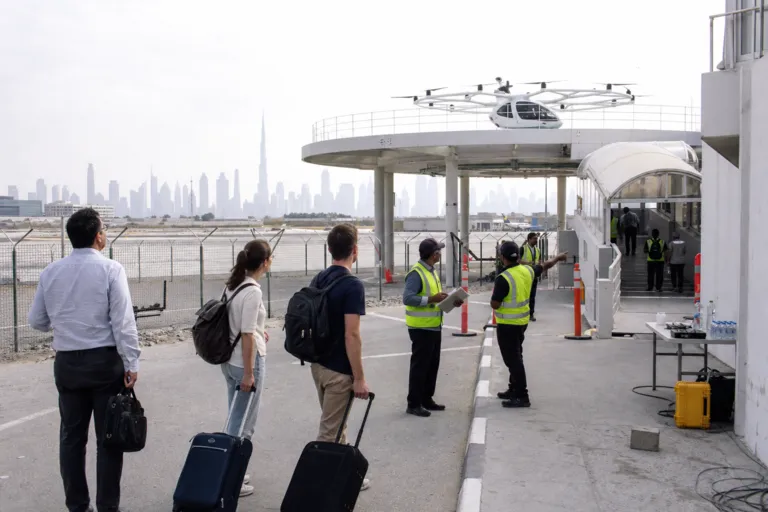
Dubai’s push for faster, smarter urban movement is becoming visible on the ground, even as it points upward. The first air taxi station near Dubai International Airport (DXB) has been completed, positioning the emirate to turn vertical take-off and landing travel into a practical option for residents and visitors. The Roads and Transport Authority (RTA) has framed the station as part of a wider smart mobility ecosystem, where passengers can plan end-to-end itineraries that combine an air taxi transfer from DXB with other transport modes to reach hotels, business districts, and leisure areas. The stated goal is not just novelty. It is to integrate a new layer of mobility into everyday city planning.
The headline promise is time. A trip from DXB to Palm Jumeirah that can take around 45 minutes by car depending on traffic is expected to be reduced to roughly 10 minutes by air taxi. Other coverage of the same corridor puts the flight at about 10 to 12 minutes, and Dubai’s phase-one messaging also describes flights taking just 12 minutes. This time-shift is the core value proposition behind premium point-to-point aerial transport. The service is also positioned as electric eVTOL mobility, with messaging that it supports a shift toward zero-emission technologies within the broader mobility mix.
From One Station to a Four-Stop Network
Dubai’s initial rollout is designed as a small but high-impact network, not a single isolated launch. The plan includes four key vertiports: Dubai International Airport, Downtown Dubai, Palm Jumeirah, and Dubai Marina, creating an initial four-stop network by 2026 that links the airport with major visitor and activity zones. Joby Aviation also signed an agreement with Skyports to design, build, and operate four vertiport sites in Dubai. In parallel, Joby has a deal with the RTA that gives it an exclusive right to operate air taxis in Dubai for six years from the launch of commercial operations, reinforcing the city’s intent to move quickly from infrastructure to service.
What makes this especially relevant for Gulf urban mobility is how Dubai is treating aerial transport as one component within a broader set of city systems. The RTA has highlighted digital and operational integration so people can stitch air taxi trips into wider journeys. Other mobility benchmarks show the city’s focus on reducing waiting and friction across modes. Through Hala Taxi, developed with Careem, waiting times have dropped from 25 minutes to three minutes, according to reporting tied to the same leadership narrative about partnerships and fast implementation. In that context, the Dubai air taxi Joby launch sits alongside a larger pattern: build capacity, link it digitally, and prioritize time savings that can drive organic adoption once passengers experience it.
Operational confidence is also being framed through testing, certification, and passenger experience. The DXB air taxi station followed what was described as an intensive period of testing and route-proving in the emirate. Joby aims to use a dual certification approach with both UAE and US regulators, using FAA-validated data to help accelerate safe commercial operations in Dubai. Separately, a reported trial described an air taxi flight lifting off from the Dubai Jetman Helipad in Margham and landing 17 minutes later at Al Maktoum International Airport (DWC). Together, these details underline what comes next: turning a high-profile infrastructure milestone into reliable, repeatable operations that can scale across the four vertiports.
How fast could an air taxi trip be from DXB to Palm Jumeirah?
Which four vertiports are planned for Dubai’s initial air taxi rollout?
What does the Dubai air taxi Joby launch mean for how trips are planned in the city?
How long is Joby’s exclusive operating arrangement in Dubai?
What kind of regulatory approach is Joby aiming to use for Dubai operations?