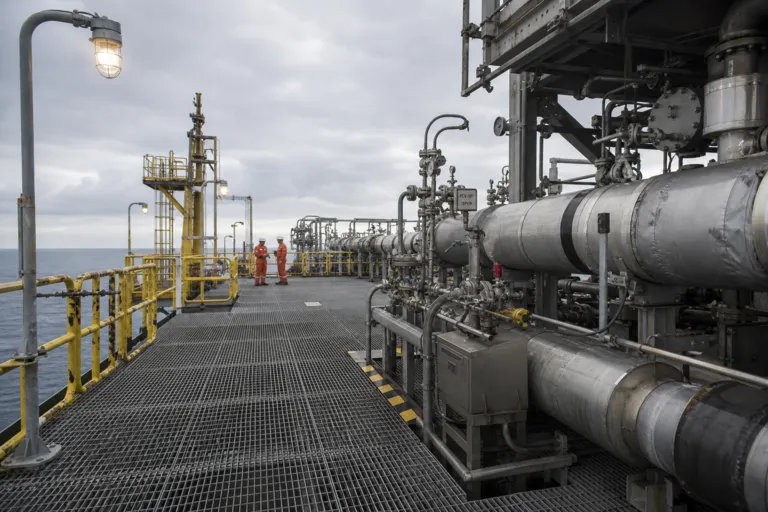
Across Southeast Asia, carbon capture and storage is shifting from concept to physical infrastructure. An analysis in Pipeline Technology Journal describes subsea pipelines forming “the backbone” of a contest between Malaysia and Indonesia to become the region’s premier CO2 storage hub, with some offshore lines stretching more than 100 kilometers. The same analysis notes that industrial emitters from Japan, South Korea, and Singapore are being drawn to Malaysia and Indonesia because they lack suitable geology of their own. This cross-border pull matters because it frames the opportunity: storage is not only about domestic decarbonization, but also about becoming a regional sink for captured CO2.
Malaysia’s most visible momentum is tied to Petronas-led offshore developments. In the Kasawari project, high-CO2 gas is processed and the captured CO2 is planned for transport through a dedicated 138-kilometer, 16-inch subsea pipeline to the depleted M1 reservoir for permanent injection. The project targets 3.3 million tonnes per year, and after gas production began in 2024, Petronas has pushed to accelerate first injection toward 2027, earlier than previous 2029–2030 estimates. In parallel, a Southern CCS hub is being developed at the Duyong field by Petronas, TotalEnergies, and Mitsui, designed to receive liquefied CO2 shipped from Japanese industrial clusters—up to 5 million tonnes annually—before injection.
Policy Signals, Market Plumbing, and Why Cross-Border Volumes Matter
Regulation and market infrastructure can determine whether these projects scale. The Pipeline Technology Journal analysis says front-end engineering is under way for the Southern CCS hub after Malaysia’s first offshore CCS assessment permit under the new CCUS Act 2025, with a final investment decision targeted for late 2027 and operations eyed for the end of the decade. Separately, SEADS reports that Malaysia’s Further Tax Deduction for carbon projects offers up to RM300,000 ($73,195.63) for MRV and related carbon project development expenses for applications submitted through 31 December 2026. SEADS also notes Bursa Carbon Exchange’s July 2024 auction marked the first sale of domestically generated Malaysian carbon credits on the exchange, adding another piece of “plumbing” that can support credible climate claims.
Regional competition is real, and Indonesia is building its own multi-user concepts. The same Pipeline Technology Journal analysis says Pertamina Hulu Energi and ExxonMobil are advancing the Sunda Asri CCS hub offshore West Java, including liquid CO2 shipping, an onshore import terminal, a 180-kilometer pipeline, and offshore wells into a saline aquifer described as having estimated multi-gigatonne capacity. First injection is targeted at 2.5 million tonnes per year by 2030, with a planned mix of domestic and international volumes. A CGSI sector note adds that Malaysia is planning the development of three storage hubs by 2030F to store 15 Mtpa, with another three hubs planned by 2050F with a cumulative 40–80 Mtpa of capacity, and it emphasizes that Malaysia’s storage hubs are all offshore.
Whether Malaysia becomes the preferred hub will also depend on execution and demand signals. Asian Business Review, citing RHB, says Malaysia is still at a nascent stage of carbon price discovery, but policy is moving toward implementation: an upcoming Climate Change Bill is expected to introduce an MRV system and pave the way for a carbon tax initially targeting iron, steel, and energy. RHB estimates Bursa Carbon Exchange has traded 186,500 carbon-credit units across 13 contracts at an average MYR48 per tonne of carbon dioxide equivalent. In that context, Malaysia carbon capture storage is not just a technical question of geology and pipelines; it is also a question of MRV credibility, investment timing, and whether regional emitters keep seeking offshore storage options Malaysia is now building.
What is the Kasawari CCS project designed to do, and at what scale?
When could Malaysia’s Southern CCS hub reach major investment and operations milestones?
How much CO2 could the Southern CCS hub receive from Japan, based on current plans?
What storage hub capacities are planned for Malaysia in the CGSI outlook?
What does the Malaysia carbon capture storage push still need besides offshore projects?