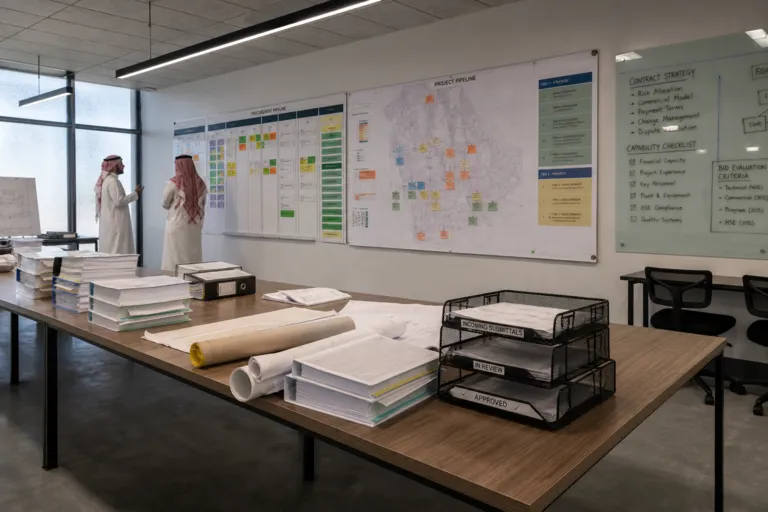
Saudi Arabia is recalibrating how it funds and sequences construction. Multiple sources describe budget tightening and a shift away from “trophy” work, with projects increasingly required to show alignment with national priorities and deliver visible outcomes. AGBI reports that the value of construction contracts issued in Saudi Arabia plummeted last year to less than half of that in 2024, linking the change to Public Investment Fund (PIF) cutbacks and a reprioritisation of projects. This is the practical face of Saudi project spending prioritization: the pipeline remains huge, but contract issuance becomes more selective, and procurement scrutiny increases.
That selectivity sits alongside continued scale. AGBI cites JLL’s estimate of $1.5 trillion in unawarded projects as of the start of 2024, even as “recalibration” gains support. At the regional program level, Gulf Construction reports that along Saudi Arabia’s western coast, 17 giga- and mega projects have already seen $57 billion in contracts awarded, with a further $187.2 billion in the pipeline. Riyadh remains central to the agenda. Gulf Construction, citing Knight Frank commentary, says projects worth over $237 billion have been announced across real estate, infrastructure, and transportation since 2016, with $44 billion already awarded in construction contracts. The story is not contraction alone; it is a tighter filter on what gets to award.
Budget Reprioritisation Is Showing Up in Awards and Allocations
Recent award data points to both activity and changing emphasis. GlobalData notes that the Saudi Contractors Authority recorded 97 project awards between January and July 2026, with a combined value of SAR111.3 billion ($29.7 billion). That compares with 84 projects worth SAR70.1 billion ($18.7 billion) over the same period in 2025. GlobalData also points to major allocations in Saudi Arabia’s 2026 Budget: SAR259 billion ($69.1 billion) for health and social development sectors, SAR202 billion ($53.9 billion) for education, and SAR35 billion ($9.3 billion) for infrastructure and transportation. These allocations illustrate how reprioritisation can steer the contract pipeline toward social and enabling infrastructure, even while broader megaprogrammes are being sequenced.
For contractors, the reprioritisation changes what “competitive” means. Banamind reports that PIF cut spending about 20% in 2025, while also citing awards reaching $196 billion in 2025, up 20% year on year. In the same source, cost control pressure is underscored by operational waste: roughly 80% of Saudi construction projects exceed budget, and rework alone can consume up to 25% of total project cost. This helps explain why owners, lenders, and delivery entities focus more on documentation quality, overhead discipline, and proof of progress. In a tighter environment, the ability to defend milestones and payment claims becomes part of the bid.
Project design and delivery structures are also evolving with the new discipline. Gulf Construction highlights DBFOM models over 20–30 years for major schemes, reflecting long-term performance and lifecycle value as decision factors. Meanwhile, GlobalData frames ongoing growth expectations, estimating 1.8% real-terms growth for the Saudi construction industry in 2026 and an annual average growth of 4.1% between 2027 and 2030, driven by Vision 2030 investments in areas including transport infrastructure, energy, and tourism. It also notes PIF-backed coastal development plans at Al-Khafji spanning about 20km2 and including 16,000 housing units by 2030. In this context, prioritisation does not simply delay work; it reshapes which packages move first, what contract forms are used, and which contractor capabilities win.
What is driving Saudi Arabia’s budget reprioritisation in construction?
How is Saudi project spending prioritization affecting contract awards?
What recent award figures show continued activity in 2026?
Which 2026 budget allocations does GlobalData highlight as relevant to construction?
Why are contractors focusing more on efficiency and documentation?