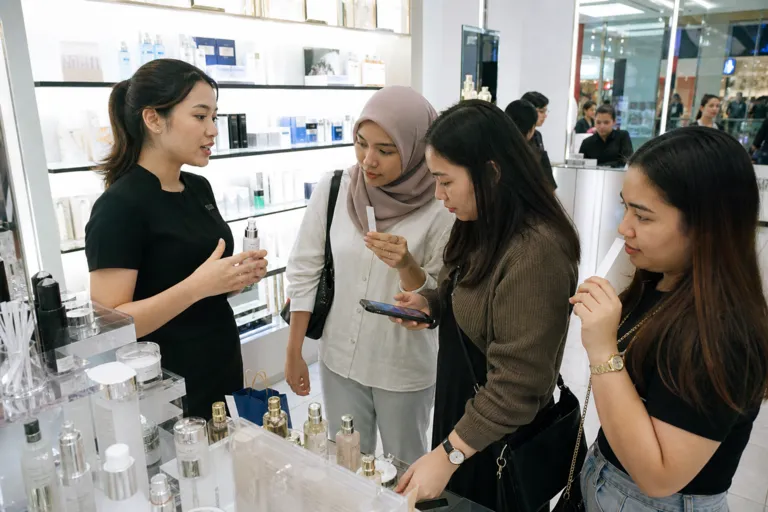
Premiumisation is not only about higher prices. It is about proving value and giving people a reason to trade up. McKinsey’s framing, reported by CosmeticsDesign.com, is that the “era of more-is-more consumption” has shifted toward “value, differentiation, and individuality.” That context matters for Southeast Asia premium beauty strategies aimed at Indonesia, Vietnam, and the Philippines. A premium play has to feel justified. Fashionista, citing McKinsey’s State of Beauty 2025 report, warns that raising prices can backfire and says premium brands must increase value or the perception of it. That puts pressure on brands to communicate performance, credibility, and distinctiveness in every touchpoint.
Fragrance is one of the clearest channels for accessible prestige, and it is also where brands can make premium feel “cost-effective.” CosmeticsDesign-Asia states that “Perfume is cost-effective luxury” and reports that luxury-minded Gen Z are embracing fine fragrances as a “value-for-money” investment, helping drive a surge in South East Asia perfume sales. The same source notes that, despite inflationary pressures, fragrance has remained “relatively unaffected” compared to other luxury beauty categories like skin care. For brands building momentum in Indonesia, Vietnam, and the Philippines, this supports a premiumisation roadmap where fragrance can lead acquisition, with storytelling, craft, and emotional benefits that justify trading up.
How Premium Beauty Is Being Sold: Proof, Education, and Transparency
Premium beauty is also being sold through evidence and education, not just aspiration. Fashionista’s summary of McKinsey’s guidance says skin care brands should emphasize efficacy with “increased transparency around claims,” plus “clinical trials around superior performance or new ingredients.” In cosmetics, the same guidance points to “social virality and innovation,” including “skin-care-infused makeup.” Asian Business Review echoes the same direction in retail execution, describing a shift toward “ingredient-first merchandising, education-led formats and QR-enabled transparency tools,” and noting that Asian consumers are increasingly research-driven, scrutinising ingredient lists and avoiding greenwashed claims. These are practical levers premium brands can use when entering or scaling in Indonesia, Vietnam, and the Philippines.
Winning premium attention is not only about what is sold, but also the innovation story behind it. Vogue Business reports that Mintel’s 2026 Thai Consumer report describes “the fusion of Korean technology with Thai ingredients” as a route to “world-class hybrid products for the region,” and positions Thailand as “an innovation and export hub for beauty in Southeast Asia.” The same article highlights texture and sensorial performance for challenging climates, citing technologies that deliver “hydration without heaviness,” “SPFs that stay put,” and makeup that holds up in “high heat and humidity.” While this example is Thailand-specific, the product problem it solves is regional. It signals how premium can be defined as performance under local conditions, not just luxury cues.
Outside Southeast Asia, premiumisation signals are also coming from the Middle East, especially in fragrance. WWD cites Amouage’s nine-month 2025 sales of $300 million, up 73 percent year-on-year, and points to other fast-rising regional names. It also cites Market Data Forecast estimating the Middle East beauty market at $18.57 billion in 2024 and projecting $25.45 billion in 2033, a 3.6 percent CAGR. For Southeast Asia premium beauty operators, the lesson is not to copy the region, but to notice what scales: niche fragrance narratives, strong brand identity, and products that travel culturally. These cues align with the Gen Z fragrance “value-for-money” framing reported in Southeast Asia.
The practical takeaway for Indonesia, Vietnam, and the Philippines is that premiumisation is a system. Brands can lead with fragrance where shoppers already accept prestige cues, then expand with proof-led skin care messaging and innovation-driven makeup that is easy to share. Retail and content should reinforce the same themes: ingredient transparency, education, and credibility signals that match research-driven consumer behavior. In a world where value scrutiny is rising, differentiation has to be obvious. Premium can still win, but it must be earned through performance, storytelling, and a clear reason to upgrade.
What does "Southeast Asia premium beauty" premiumisation rely on most right now?
Why is fragrance a strong premiumisation entry point in Southeast Asia?
What tactics help premium skin care justify its positioning?
How are retail models changing to support premium beauty?
What can ASEAN brands learn from premium fragrance momentum outside the region?