
Saudi Arabia is pushing harder for logistics speed by connecting maritime arrivals to air freight departures through a new multimodal pathway. According to Gulf Business, a new sea-to-air logistics corridor has been launched, linking seaports on the western coast with the Kingdom’s airport network to move cargo onward to international destinations. Operations have commenced at Jeddah Islamic Port. The stated idea is simple: shipments that enter by sea can be shifted to aircraft faster, creating an alternative route for global cargo when time, routing, or capacity constraints make a single-mode plan less attractive.
The initiative is a joint undertaking involving Saudia Cargo, the Saudi Ports Authority (Mawani), and the Zakat, Tax and Customs Authority (ZATCA). The framework permits the movement of goods between ports and airports using one customs declaration, supported by advanced clearance and inspection processes. Officials say this helps containers transition from ship to plane more quickly. Saudia Cargo has also positioned the corridor as a way to better connect sea and air systems, so transport modes can be adjusted based on circumstances while supporting the consistent flow of essential and commercial products and sustaining supply chain operations.
Why Speed Is Turning Into Strategy, Not Just Service
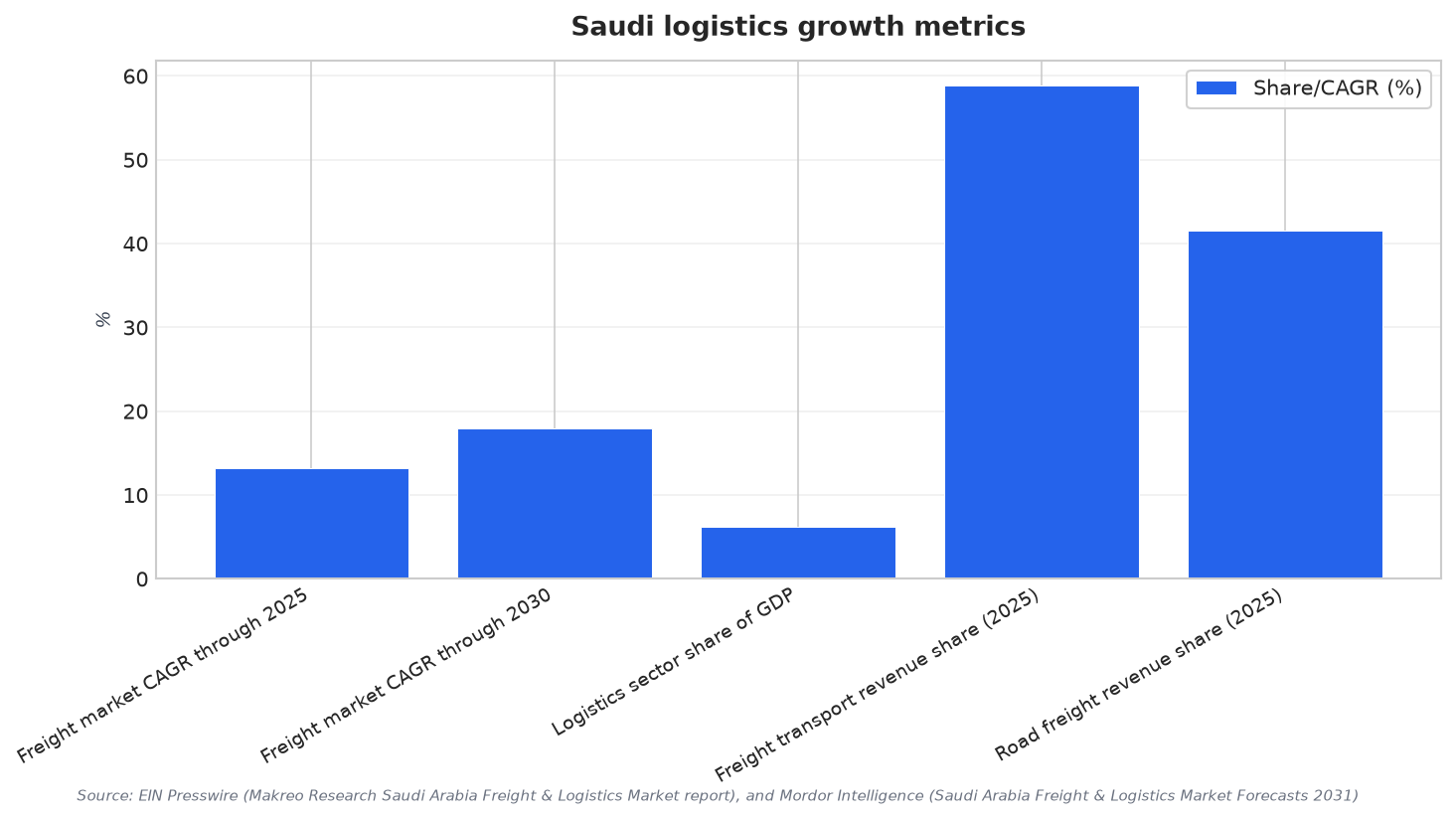
The corridor launch lands in a broader acceleration across Saudi logistics investment and infrastructure. Makreo Research coverage published via EIN Presswire and Knox News states that private-sector transport and logistics investments have surpassed SAR 280 billion (USD 74.6 billion), and that the sector’s contribution to national GDP has reached approximately 6.2%. The same reporting says Saudi Arabia’s freight market grew at 13.24% CAGR through 2025 and is accelerating to 18% through 2030, tying that momentum to investment and multimodal corridor expansion, including the sea-to-air capability at Jeddah Islamic Port.
Speed also depends on what happens beyond a single port. In April 2026, Saudi Arabia Railways (SAR) launched five new freight logistics corridors spanning more than 2,500 kilometers, connecting gateways including Jeddah Islamic Port, King Abdulaziz Port in Dammam, and King Abdullah Port with inland dry ports, industrial cities, logistics hubs, and neighboring GCC markets, according to the Knox News/EIN Presswire report. That same report describes a Saudi-UAE trade bridge connecting Sharjah and Dammam via Khorfakkan Port, supported by integrated customs procedures and pre-clearance mechanisms. Together, these efforts frame time savings as a network outcome, not a single-lane advantage.
Market structure data reinforces why sea-air handoffs and expedited clearance are drawing attention. Mordor Intelligence reports that, by logistics function, freight transport captured 58.92% of the Saudi Arabia freight and logistics market share in 2025, and that road freight held a 41.55% revenue share in 2025. It also reports warehousing and storage surpassed USD 8.23 billion in 2025, while air freight is projected to expand at a 6.78% CAGR between 2026–2031, and CEP services are advancing at a 6.45% CAGR between 2026–2031. In that context, the Saudi sea-to-air cargo corridor is less a standalone announcement than an operating model designed to keep pace with faster air, expanding parcels, and the warehousing backbone that makes rapid transfers possible.
What is Saudi Arabia’s sea-to-air cargo corridor designed to do?
Which organizations are involved in the corridor’s launch and operation?
How does customs processing change under the new corridor?
How fast is Saudi Arabia’s freight market expected to grow, according to the cited report?
How does the Saudi sea-to-air cargo corridor fit with other transport corridors mentioned in the sources?