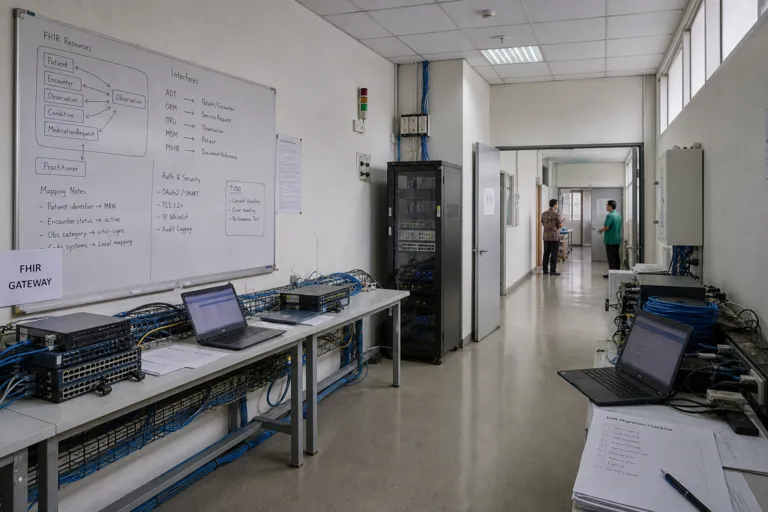
SATUSEHAT is Indonesia’s national health data platform managed by the Ministry of Health. It was launched in July 2022 to integrate health data across facilities, and Regulation of the Minister of Health No. 24 of 2022 required every health facility to keep electronic medical records and connect them to the national platform. The same regulation set an end-2023 requirement for facilities to keep electronic medical records and make them interoperable with the Ministry’s integration platform. By late October 2025, the Ministry reported more than 34,000 facilities as integrated. This scope matters because it sets a single compliance target for hospitals, clinics, community health centers, and independent practices.
For hospitals, the fastest impact shows up as procurement pressure and modernization work. One report says 80% of surveyed hospitals are initiating EHR modernization projects to comply with mandatory data exchange obligations via the SATUSEHAT hub. Another research finding cited in the same source says 43% of Indonesian hospitals intend to replace their core SIMRS/EHR within 24 months, citing SATUSEHAT compliance as the primary procurement driver. The workflow goal is not just digitization, but standardized exchange through HL7 FHIR resources that can be shared across different systems. In practice, many providers and vendors treat SATUSEHAT as the required “bridge” for information exchange during emergency and referral situations.
Connection Is Not Enough: Why Data Quality at Exchange Becomes the Next Bottleneck
Scaling a national gateway raises a second-order challenge: data that arrives but cannot be trusted or reused. A policy commentary argues that connection to the gateway is not the same as interoperability “in the sense that matters,” because HL7 FHIR standardizes structure and transport but does not guarantee that records are coded, complete, plausible, timely, or linkable. It proposes a quality-at-exchange approach that the gateway can compute the moment each resource arrives, including national profiles with terminology bindings, validation that returns machine-readable error reports, and per-facility and per-vendor scorecards. For HealthTech building around Indonesia’s health data platform, this reframes success from “integrated” to “fit for use,” which is what clinicians, payers, and public health programs ultimately need.
The platform is already being used to record large-scale preventive activity, which raises the stakes for reliable data. Cek Kesehatan Gratis (CKG), the free national health check program, reached 70 million people during 2025 and passed 82 million during 2026 by late August, against a target of 130 million for the year. Screening is recorded through SATUSEHAT so results flow into an individual’s longitudinal health record and are accessible through the SATUSEHAT mobile application. Among 9.2 million participants re-screened in 2026 who were recorded as healthy the previous year, approximately one million new cases of hypertension were identified; among 8.3 million re-examined for diabetes, 188,000 were newly diagnosed. Another report states the platform now connects more than 10,000 community health centers across all 514 districts and cities, and that as of 2026, 99% of community health centers use digital recording through a SATUSEHAT health worker application.
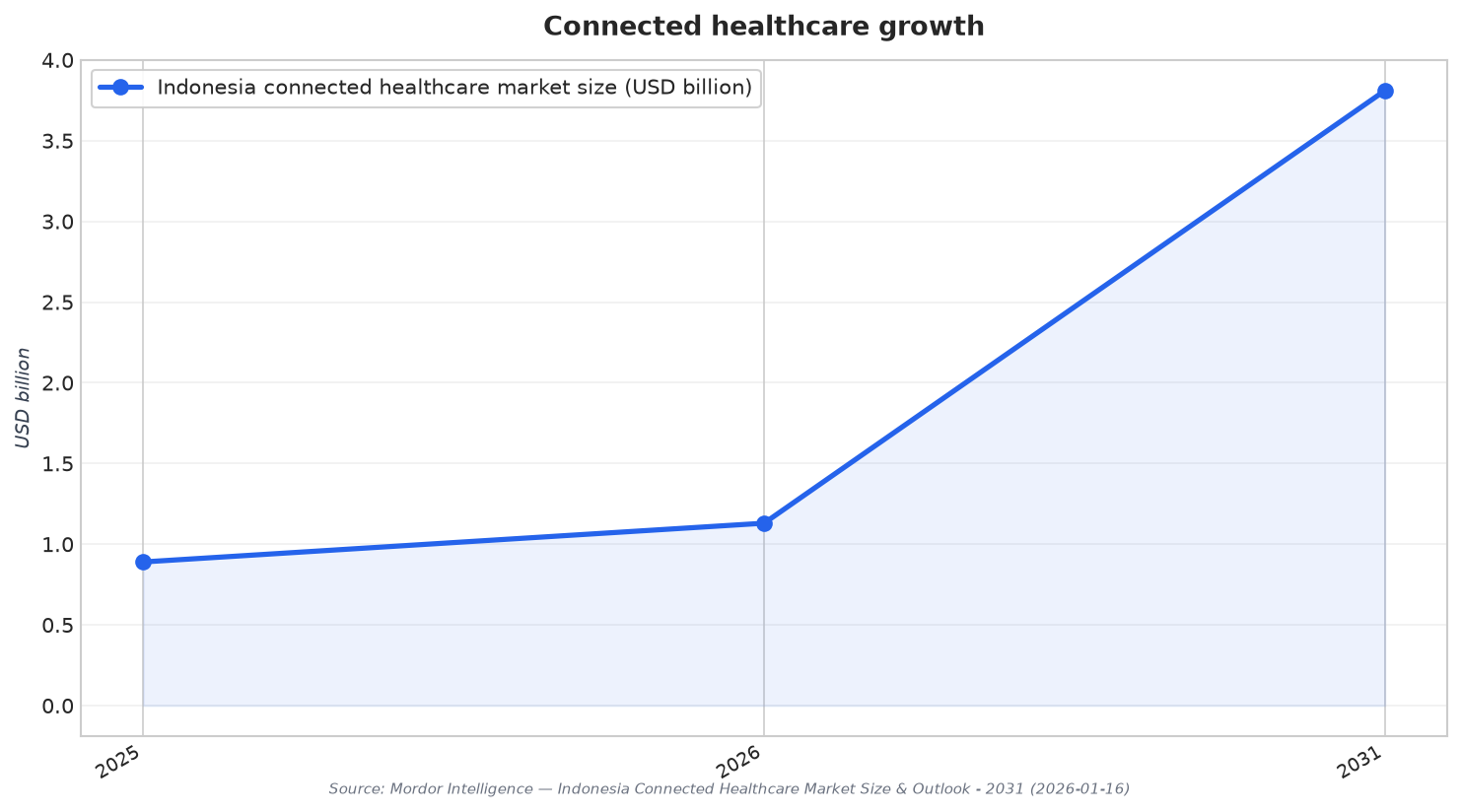
For HealthTech vendors, the market signals point to sustained integration demand, especially for cloud-first delivery and hospital settings. Mordor Intelligence estimates the Indonesian connected healthcare market at USD 0.89 billion in 2025 and USD 1.13 billion in 2026, with projections of USD 3.81 billion by 2031 at a 27.4% CAGR (2026–2031). In the same report, hospitals held a 45.20% share of the market in 2025, and cloud-based platforms captured a 64.90% share. This aligns with service models that reduce in-house build requirements; for example, one developer guide describes managed SATUSEHAT integration that handles FHIR mapping, queue management, and ongoing API change monitoring, and says it serves 50+ hospitals across Indonesia. The opportunity is big, but the winning products will be those that make compliance durable and make exchanged data usable.
What is SATUSEHAT and when did it launch?
How many facilities were integrated with SATUSEHAT by late 2025?
What does the regulation require hospitals and other facilities to do?
Why does an Indonesia health data platform need data quality checks, not just connectivity?
What evidence suggests hospitals are modernizing EHR systems because of SATUSEHAT?